
Forecasts, and the investment tips that come with them, are pretty much always in season — but especially around the turn of the year. Yet they are never useful for your investment strategy; quite the opposite. Here's why that is, and what it means for your investing.
"The best of the best: the winning stocks of 2026", "10 forecasts for the 2026 investment year", "How you should invest your money this year": that's just a small selection of the headlines you could read in December and January. As always, this period was high season for forecasts and the investment tips that go with them. As if the return opportunities were reshuffled entirely when the calendar changes — along the lines of: new game, new luck.
But looking into the future isn't in demand only at the turn of the year. The question of what the markets might do next is constantly in the air. And whether you therefore need to act.
Nobody knows the future
Wanting to take a look into the future is entirely understandable. How exactly will the markets develop over the coming months? Which stocks will really take off? Which ones are best left alone? Knowing this in advance would be worth a lot of money. But being right with a forecast is pure chance.
Because a great many things can play a role in prices — for example, decisions by companies, central banks and governments. Or by consumers. "Even experts or an artificial intelligence don't know these decisions before they've been made," points out Philipp Dobbert, Head of Wealth Management at quirion and at Quirin Privatbank. "With some developments we don't know how they will unfold; with others we know absolutely nothing in advance."
What's more, no one can reliably say how buyers and sellers will react to the unforeseeable news. "Sometimes it's made out as if similar relationships apply here as in physics," Dobbert notes. "That a ripe apple falls to the ground and doesn't simply float through the air is due to gravity. But there is no law of nature from which you can reliably derive whether, say, share prices will rise or fall after an interest rate cut." The logical consequence: "In the short and medium term, you can't even reliably work out which direction prices will go."
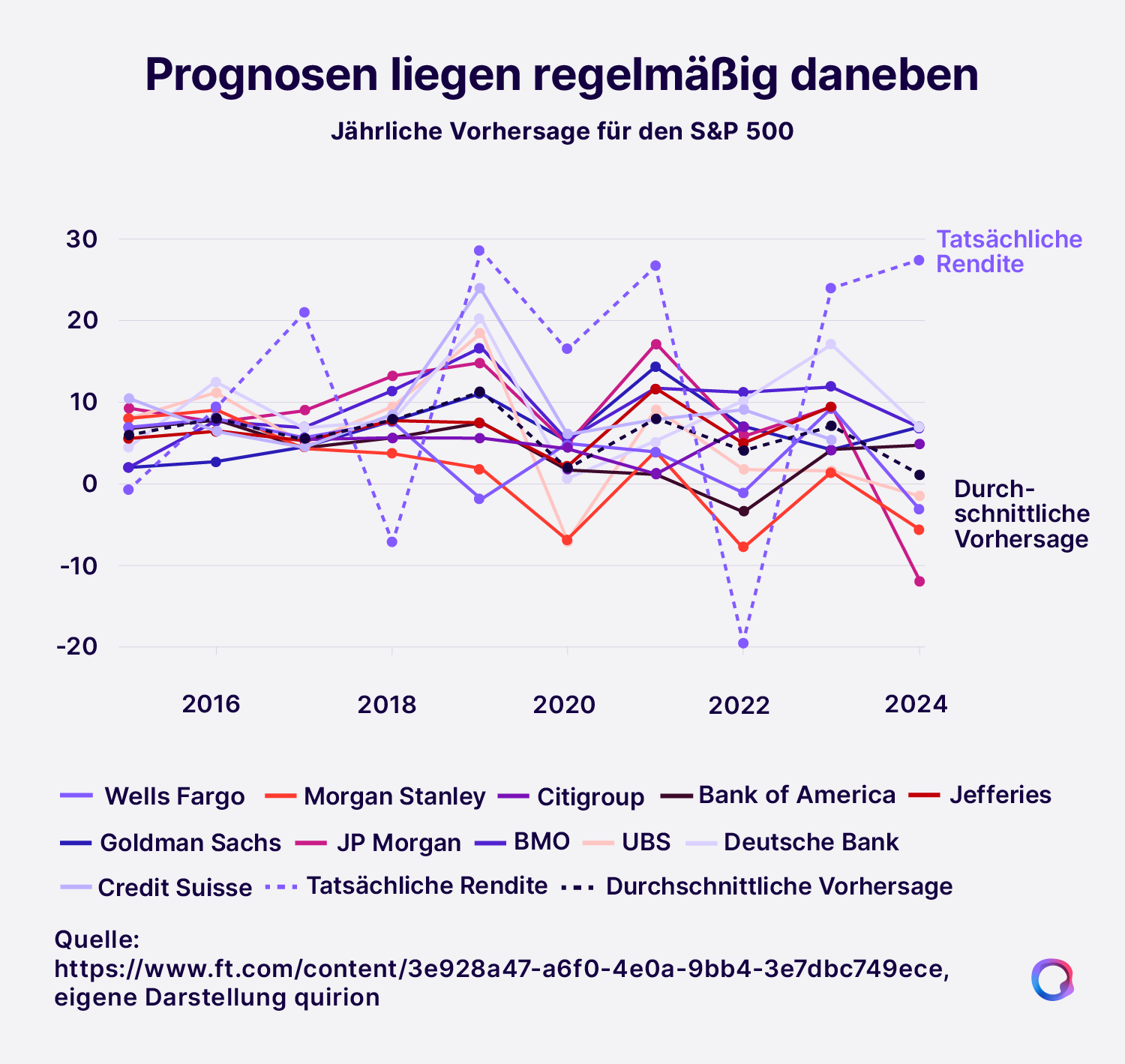
Deceptive hopes
Forecasts should never be the foundation of an investment strategy. "Forecasts don't help investors, they harm them," Dobbert stresses. "Because they suggest that you can calculate short- and medium-term developments and therefore base investment decisions on them." Anyone who trusts in that, however, is taking on unnecessarily large risks.
You can certainly make money with forecasts — in the media and finance industries. A glance into the crystal ball delivers headlines and material for a constant stream of new investment tips. Banks, fund companies and trading platforms use it to offer supposedly good arguments for a particular selection of securities. Or for deliberately timing entries into and exits from certain stocks, sectors or regions. Even when it isn't spelled out clearly, it's really always about the promise of outperforming the broader market.
Over the long term in particular, however, this promise can hardly be kept. Studies have shown this again and again. One example is an analysis by S&P Global from September 2025. According to it, over a ten-year period 98 percent of euro-denominated global equity funds were unable to beat a comparable index.
Better to invest without forecasts
Even if financial market research isn't a natural science: "From the insights gained over decades, you can derive fairly clearly what makes sense in investing — and what doesn't," Dobbert emphasises. "One key insight is that you should diversify your portfolio as broadly as possible and then stay invested for the long term."
That's why, for its global ETF portfolio, quirion doesn't rely on speculation about the possible performance of individual stocks, sectors or regions. Instead, it always relies on the broadest possible diversification, based on scientific findings and thorough analysis. The goal is to optimise the balance of return opportunities and risks.
With that, the investment strategy is geared towards the long-term upward trend of the world's equity markets. "This trend is no coincidence," Dobbert stresses. "Shares are stakes in companies and thus in the economy." It does happen from time to time that individual stocks fail or that individual sectors and regions run into lengthy crises. "But the global economy as a whole is fundamentally geared towards growth — a basic fact that you put to work for your own wealth building with a global portfolio."
You can find out more about building wealth with our global portfolio here.