







What is the cost-average effect? [simply explained]
The cost-average effect („pound-cost averaging“) can take effect when investors invest fixed sums of money regularly, e.g. via an ETF savings plan. By regularly buying additional securities units (for example equity ETFs), savers can, over longer periods (ideally at least 10 years), potentially achieve a favourable average price and, on top of that, build wealth or provide for their retirement.
Good to know: The German term for the cost-average effect is Durchschnittskosteneffekt. Since the English term is the more common one in the German-speaking world, in what follows we refer exclusively to the cost-average effect, or CAE for short.
With steadily rising prices, the cost-average effect offers no advantage over a lump-sum investment, because with every instalment you are buying units at a higher price.
Cost-average effect: meaning
The cost-average effect (CAE) can therefore – particularly with a longer-term, regular savings plan – help you turn the volatility of the markets (larger fluctuations) to your advantage and help achieve better returns through, on average, favourable purchase prices.
To understand the meaning of the cost-average effect, three aspects are decisive:
1. The effect takes hold above all with volatile securities, such as equities.
2. With less volatile forms of investment, the CAE tends to play a subordinate role.
3. The effect can only have a positive impact with savings plans, not with a lump-sum investment.
Good to know: Investors who, for example, invest in an equity-ETF savings plan may under certain circumstances benefit from the cost-average effect. As is well known, equity funds are an investment with relatively strong fluctuations.
The fact that the price of equity ETFs also falls more sharply from time to time during the savings period, meaning you acquire the securities more cheaply, is then likely to have a positive impact, especially over long savings periods, because equity markets generally tend to move upwards in the long run.
The two ways of investing: lump-sum investment or savings plan?
If the cost-average effect exists only with savings plans, does that conversely mean that staggered investing is always better than a lump-sum investment?
The answer to that is a clear no.
When higher sums of money are freely available, a lump-sum investment is often more profitable than paying the amount in over longer periods (via a savings plan). This mainly has to do with what are known as opportunity costs, which arise if you do not invest and the target investment delivers a positive return.
Good to know: Opportunity costs generally stand for the „forgone benefit“ of an alternative not chosen. The concrete opportunity costs of a lump-sum investment that is not made are missed returns and, in that context, possibly also a loss of purchasing power through inflation or interest rates that are too low (e.g. if the uninvested money is sitting in an instant-access savings account).
There is also a psychological component: those who invest in bursts (larger one-off amounts) expose themselves to the risk of not investing further once prices have risen. You then possibly wait again for falling prices. But once prices have actually fallen, you not infrequently become afraid of prices falling further – and again do not invest.
In reality, it is usually the case that investors who have larger sums available also mostly invest them all at once, and that investors who mostly invest them all at once, and that investors who have no or only little wealth set aside part of their income each month and invest it in an ETF savings plan. Both approaches are advisable.
Ultimately, with regard to timing, there are the following two ways to invest money:
1. Lump-sum investment: investing a larger available sum
2. Savings plan: regularly investing constant amounts
Good to know: When deciding between a savings plan and a lump-sum investment, the cost-average effect plays – if anything – a subordinate role. Rather, it comes down to the financial circumstances of the investors. As a rule of thumb: if sufficient capital is available, the (long-term) lump-sum investment offers advantages. If no larger amount of capital is available and at least some money can be set aside each month, the savings plan is an ideal way to build wealth over the long term. And the earlier you start, the better.
When the cost-average effect can be an advantage – examples at savings-plan level
The cost-average effect can be particularly advantageous when investors plan long-term securities investments (10 years and more) and want to smooth out the (sometimes heavy) fluctuations of the market as far as possible.
The following examples are intended to illustrate this:
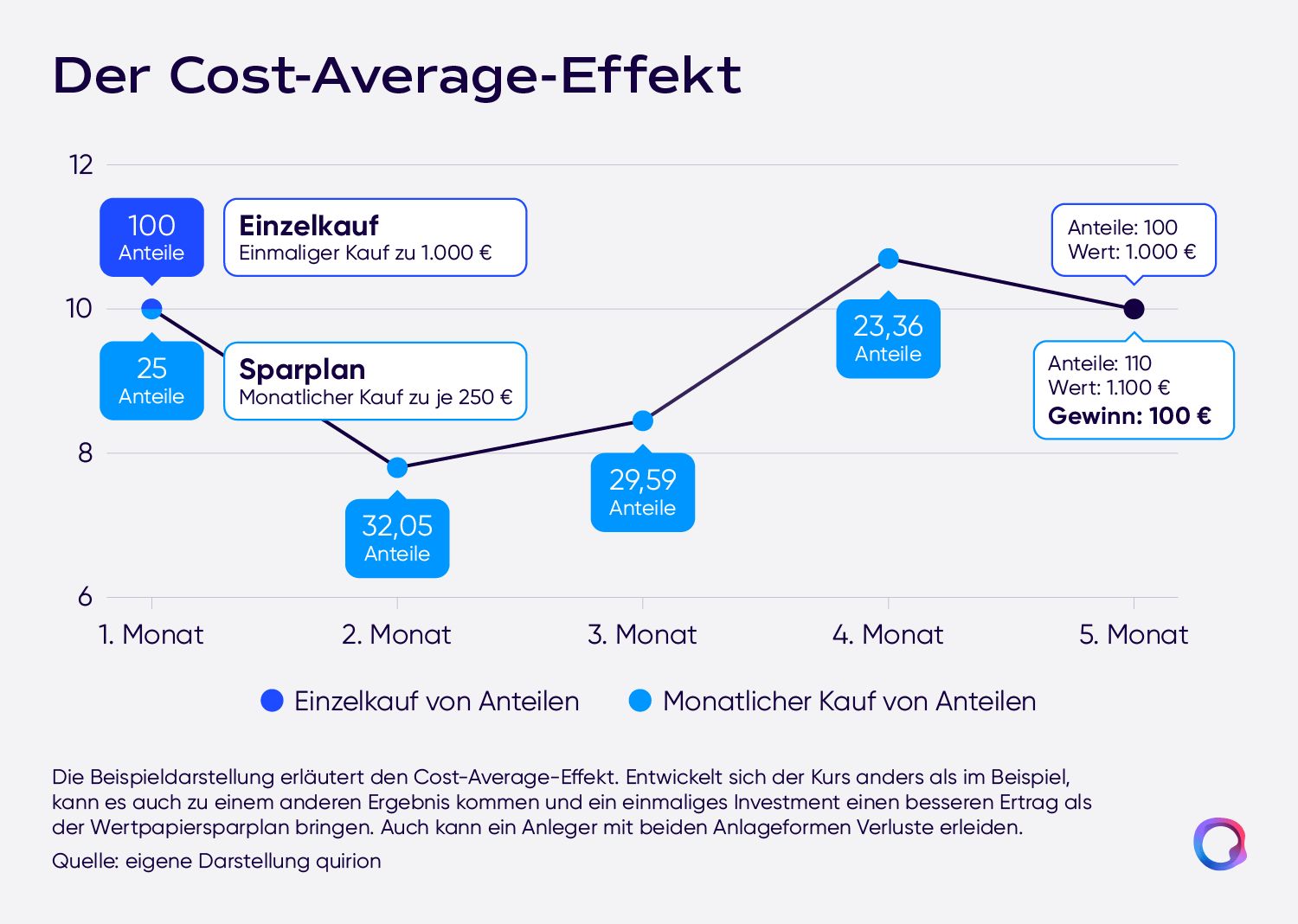
1. Theoretical example (using an equity ETF): the ETF prices first fall, then rise
In this example, the average acquisition costs of equity ETFs are reduced over a certain period by the cost-average effect. This works as follows:
- Suppose you invest 250 euros each month in an equity ETF.
- If the ETF price is initially 10 euros, you can consequently buy 25 units.
- If the price falls the following month to 7.80 euros, you receive 32.05 units.
- If the price rises again in the third month to 8.45 euros, you can buy 29.59 units.
- If the price rises further in the fourth month to 10.70 euros, you receive 23.36 units.
Bottom line: in total you receive 110 units for a total of 1,000 euros that you have invested (4 x 250 euros).
By contrast, the lump-sum investment yields only 100 units for the same 1,000 euros.
The average acquisition costs are, in the present example, reduced over a period of 4 months, namely from an original 10 to 9.09 euros. The cost-average effect can thus hold out the chance of higher gains compared to an immediate lump-sum investment. In addition to this, there is also a psychological component, which can be nicely illustrated with the next example.
2. Real-world example: the MSCI World Index in the time of coronavirus
The coronavirus crisis had struck the markets in mid-February 2020 with full force and caused share prices to drop sharply in the short term.
The well-known MSCI World Index (blue chips of the industrialised countries) lost around 34% of its value within just six weeks (on a euro basis including dividends).
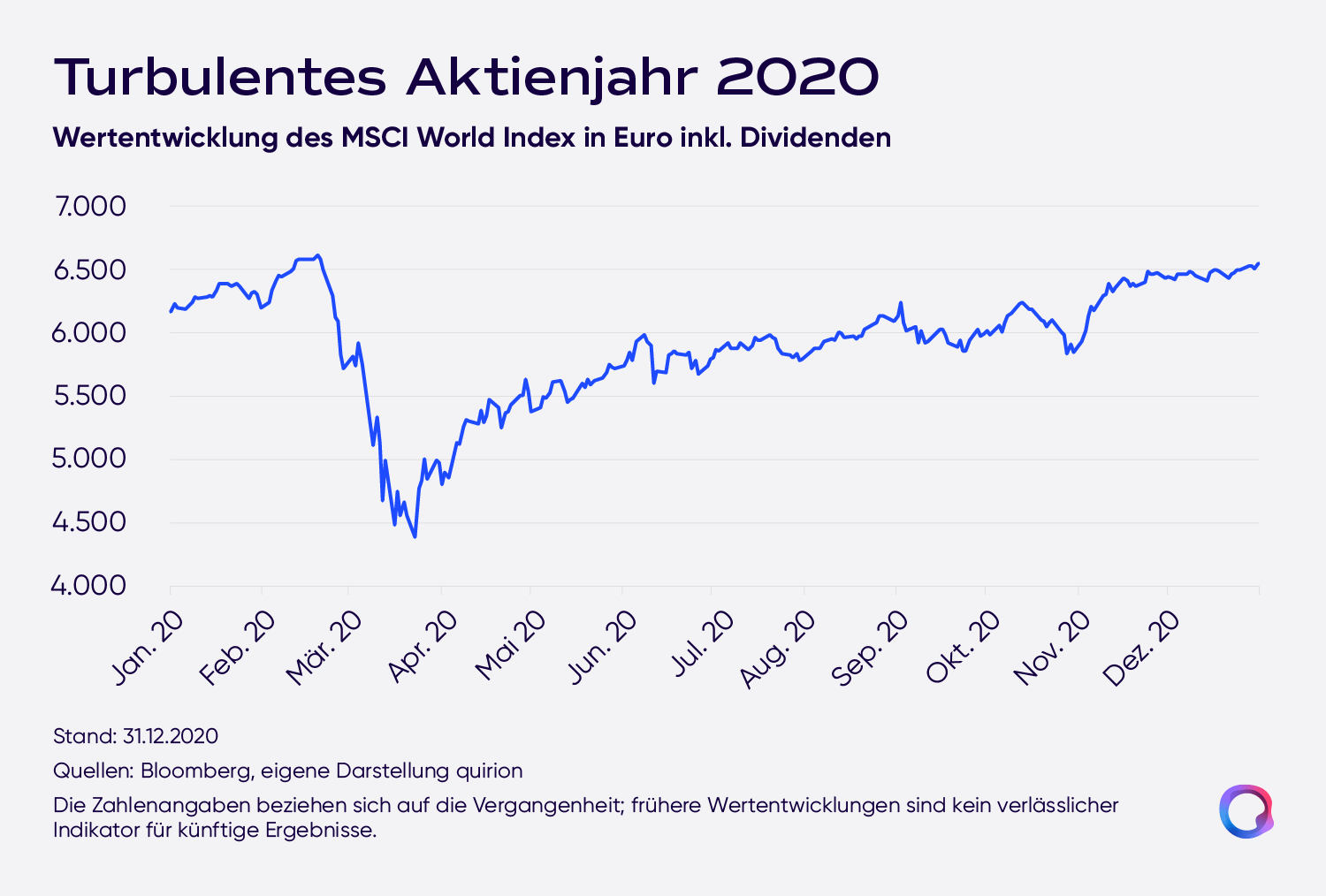
From this dramatic event, the following conclusions can be drawn:
- Anyone who invested a one-off amount shortly before the crash needed strong nerves – in the sense of „close your eyes and get through it“ (buy-and-hold strategy).
- Anyone who had a savings plan on the MSCI World ETF was able to buy at more favourable prices (than before the crash) for almost 12 months.
- Anyone who, because of the sharp slump, hastily sold everything (and did not re-enter later) – whether via a savings plan or a lump-sum investment – has missed out on a lot of return ever since.
- From a psychological point of view, it is often easier for investors – regardless of the size of their wealth – to invest smaller sums regularly than to invest one large sum at once, even though the immediate lump-sum investment usually brings more return over the longer term.
The year 2020 is a good practical example of a positive cost-average effect. The following charts illustrate the course of an equity-ETF savings plan with twelve monthly contributions of 250 euros and an alternative lump-sum investment of 3,000 euros, using a real MSCI World ETF.
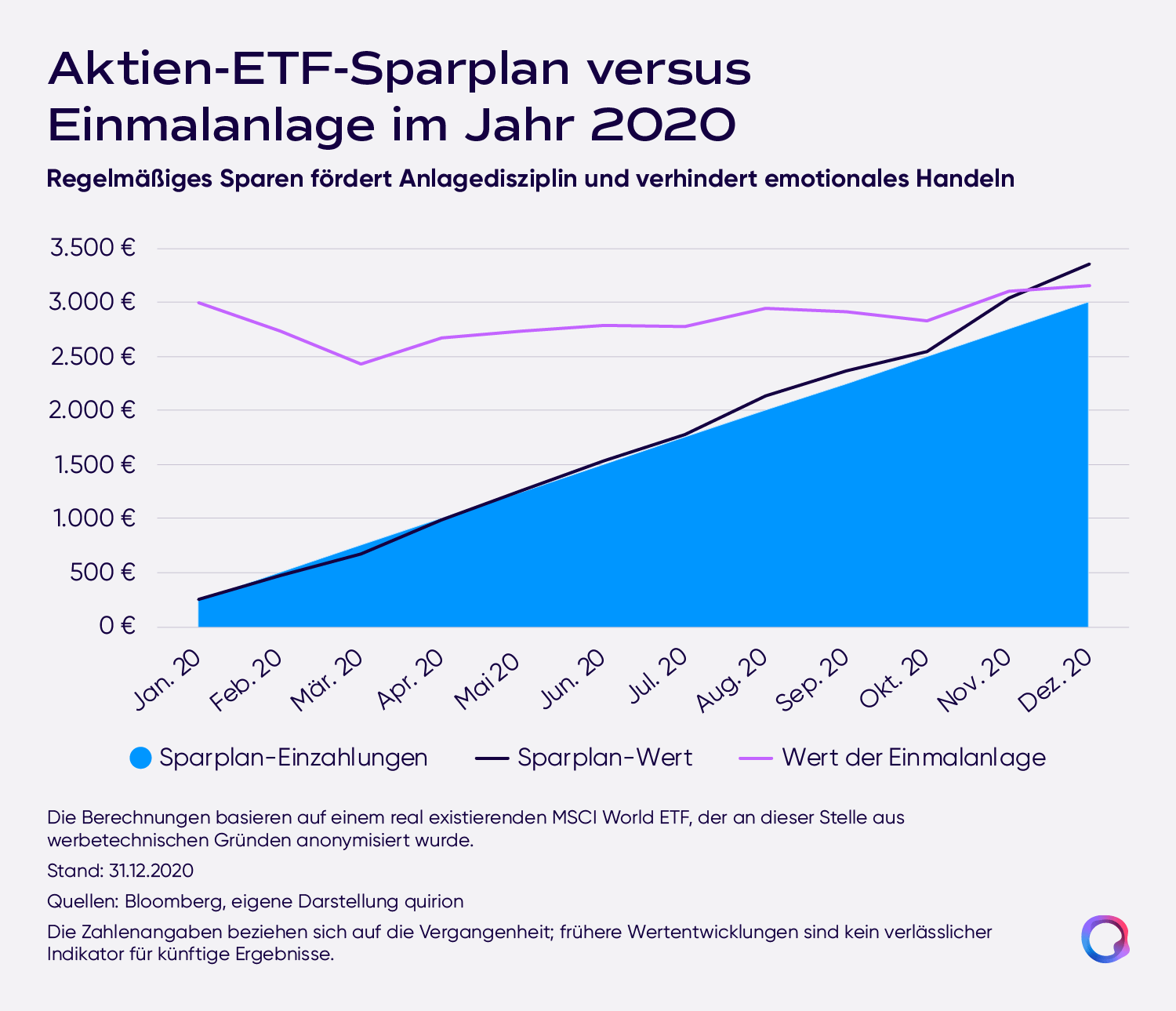
In the present example, with the savings plan the units acquired result from dividing the monthly contribution of 250 € by the ETF price prevailing at the time. After 12 months, the value of the ETF units came to 3,351.42 euros – in simplified arithmetical terms, a gain of around 11.7% relative to the capital invested.
The illustrative lump-sum investment of 3,000 euros on 31/01/2020 had a value of 3,159.62 euros at the end of 2020 – in simplified arithmetical terms, a gain of 5.3% relative to the capital invested, and thus around 6 percentage points less than with the savings-plan variant.
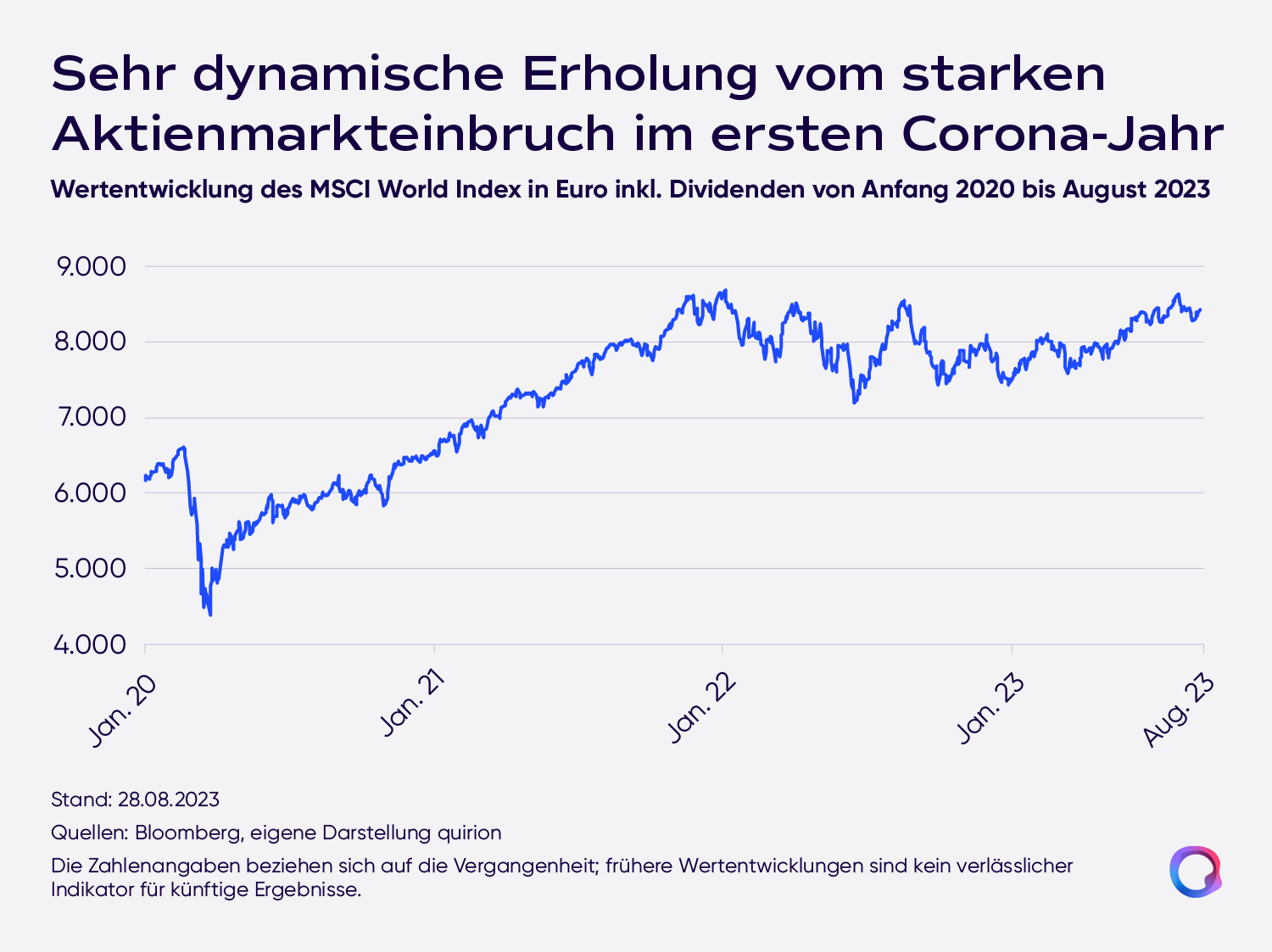
Good to know: In the good three and a half years since the outbreak of the coronavirus crisis, the MSCI World Index has shown a pleasing performance. Even if you had invested in an MSCI World Index ETF immediately before the crash, you would have been able to more than make up for the initial losses through the subsequent strong rise, provided you had stayed disciplined and invested. From its high point before the start of the coronavirus crisis, the index gained more than 25% (up to the end of August 2023). But this look back also shows how sharply even broadly diversified investments can temporarily fall in price, which is why a pure equity investment is by no means suitable for all investors, especially as in other cases the recovery has also dragged on for even longer.
What disadvantages can the cost-average effect have?
Investors should be aware that, although the cost-average effect can have noticeably beneficial effects when investing gradually in volatile markets, there can also be some disadvantages that one should be aware of.
No reliable advantages over a lump-sum investment
In principle, it is right to set up a savings plan if no larger investment sums are available. In that case you may, under certain circumstances, benefit from the cost-average effect. Conversely, however, it is not advisable to split up every larger sum that could be invested immediately and to invest it bit by bit because you expect an advantage from doing so.
Our advice: investors who have larger sums of money that are not needed in the short term should always invest the entire amount immediately – and specifically for the following reasons:
- Those who invest larger one-off amounts in bursts expose themselves to the risk of not consistently continuing to invest once prices have risen (more sharply). In that case you may prefer to wait for falling prices. If those prices then actually fall more sharply, you may under certain circumstances become afraid of prices falling even further – and again do not invest. This „psychological trap” is something to guard against and should on no account be underestimated.
- Since no one knows the ideal moment to enter, the best time to invest is always now.
- If enough starting capital is available, the immediate lump-sum investment is often more profitable than paying the sum in piecemeal over longer periods (via a savings plan). This mainly has to do with what are known as opportunity costs, which arise if the money is not invested – such as returns missed on particularly good market days.
Good to know: For investors who do not have larger amounts available for a lump-sum investment, the monthly savings plan remains an attractive way to build wealth in a disciplined manner over long periods.
How the effect works with steadily rising prices
As already mentioned: the cost-average effect can unfold its impact particularly with volatile (more strongly fluctuating) securities, that is, when prices also correct more sharply from time to time.
With steadily rising prices, by contrast, the CAE even holds returns back:
Sample fund savings plan over 6 months with 100 euros per month
Two remarks on this:
- In January, with a lump-sum investment of 600 euros, the investor would have received 12 units.
- Through the savings plan with monthly purchases, the investor received, for 600 euros, only 9.22 units in the end.
However: with an average purchase price of 65.08 euros, neither the lowest price as at the start (50 euros) nor the highest price (80 euros) was achieved.
How the effect works with steadily falling prices
With steadily falling prices, however, the CAE shows a beneficial impact: compared to the lump-sum investment, the loss with the savings plan is smaller in the end:
Sample fund savings plan over 6 months with 100 euros per month
Three remarks on this:
- In January, with a lump-sum investment of 600 euros, the investor would have received 12 units.
- Through the savings plan executed each month, the investor received, for 600 euros, 19.05 units in the end.
- Since the price of the security slumped by more than half over the period under consideration, in this scenario there is no positive return for either variant, but rather losses throughout. However, these losses are considerably smaller with the savings plan than with a lump-sum investment (average purchase price under the savings plan: 31.50 euros – with the lump-sum investment: 50 euros).
Over longer periods, the effect loses its impact
When investors consider a very long savings period – that is, of at least 10 years – for their equity investment, the interim price fluctuations of the equity ETFs they acquire through a savings plan tend to be negligible, as the following chart shows:
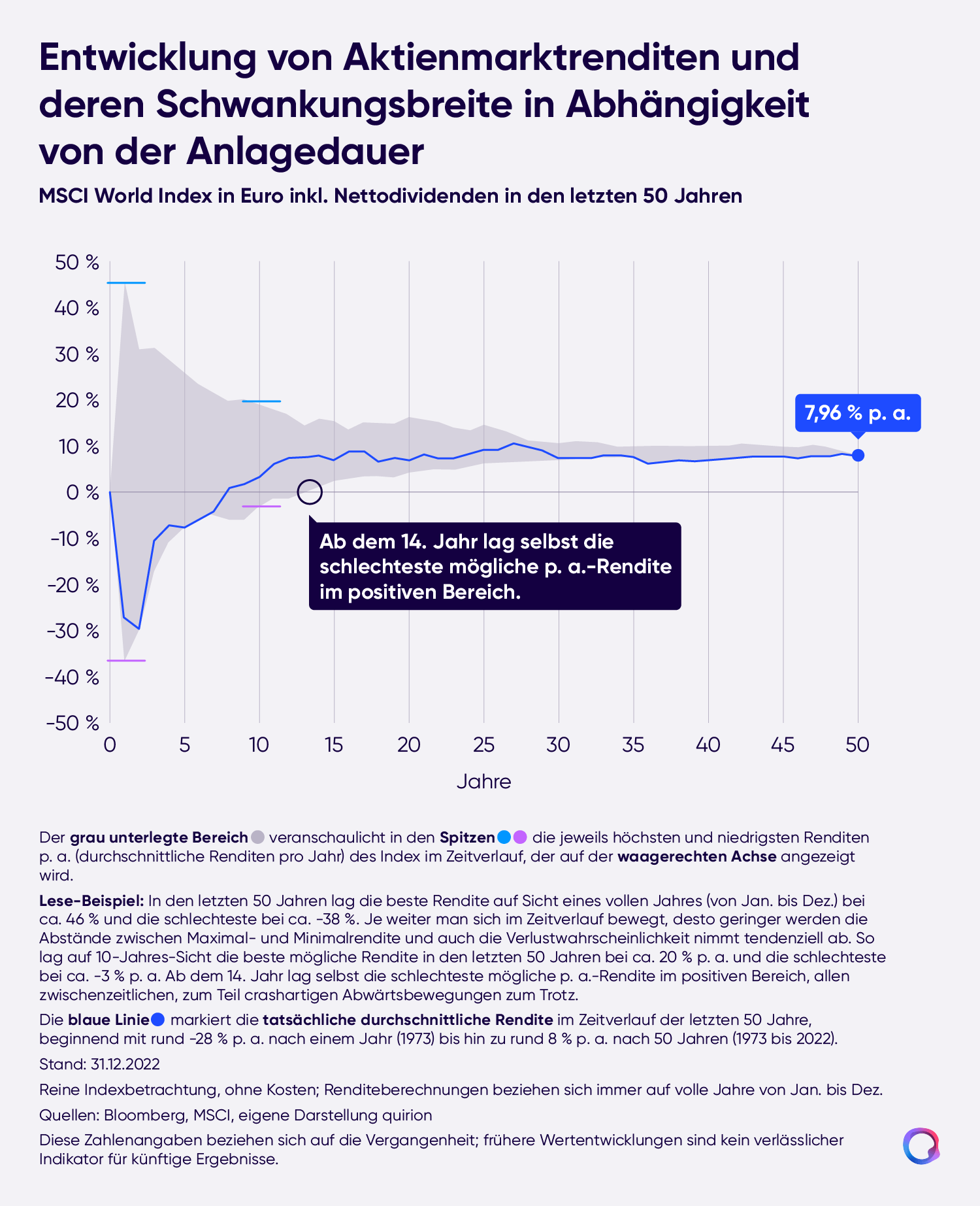
From this, the following observations can be derived:
- Over long investment horizons, the cost-average effect loses its impact compared to the lump-sum investment.
- With a lump-sum investment, calculated over long periods you can often generate more return than with a savings plan.
- Investors who, for psychological reasons, would rather use a savings plan or do not have sufficiently high capital, can likewise generate good returns over long periods – and in doing so may, under certain circumstances, benefit from the CAE.
Why do many people regard the cost-average effect as a myth? What does the science say?
There are some investment experts who dismiss the cost-average effect as a myth.
In (empirically substantiated) science, the cost-average effect is indeed disputed, especially when it comes to possible return advantages specifically in long-term investing.
What is undisputed, however, is that the CAE, in the context of a regularly executed savings plan, ensures that you automatically buy more units more cheaply during weak market phases – and, under the legitimate assumption of long-term rising markets, the savings plan has a positive impact for that reason alone, because it motivates investors to stay invested.
If the CAE then also achieves additional positive return effects on top of that – which it certainly can (cf. the examples above) – then every investor will rightly be happy to take that as a bonus.
How can investors make optimal use of the cost-average effect?
Investors who pay into a savings plan regularly can make optimal use of the cost-average effect by taking to heart a few tried-and-tested investment practices:
1. Discipline and broad diversification
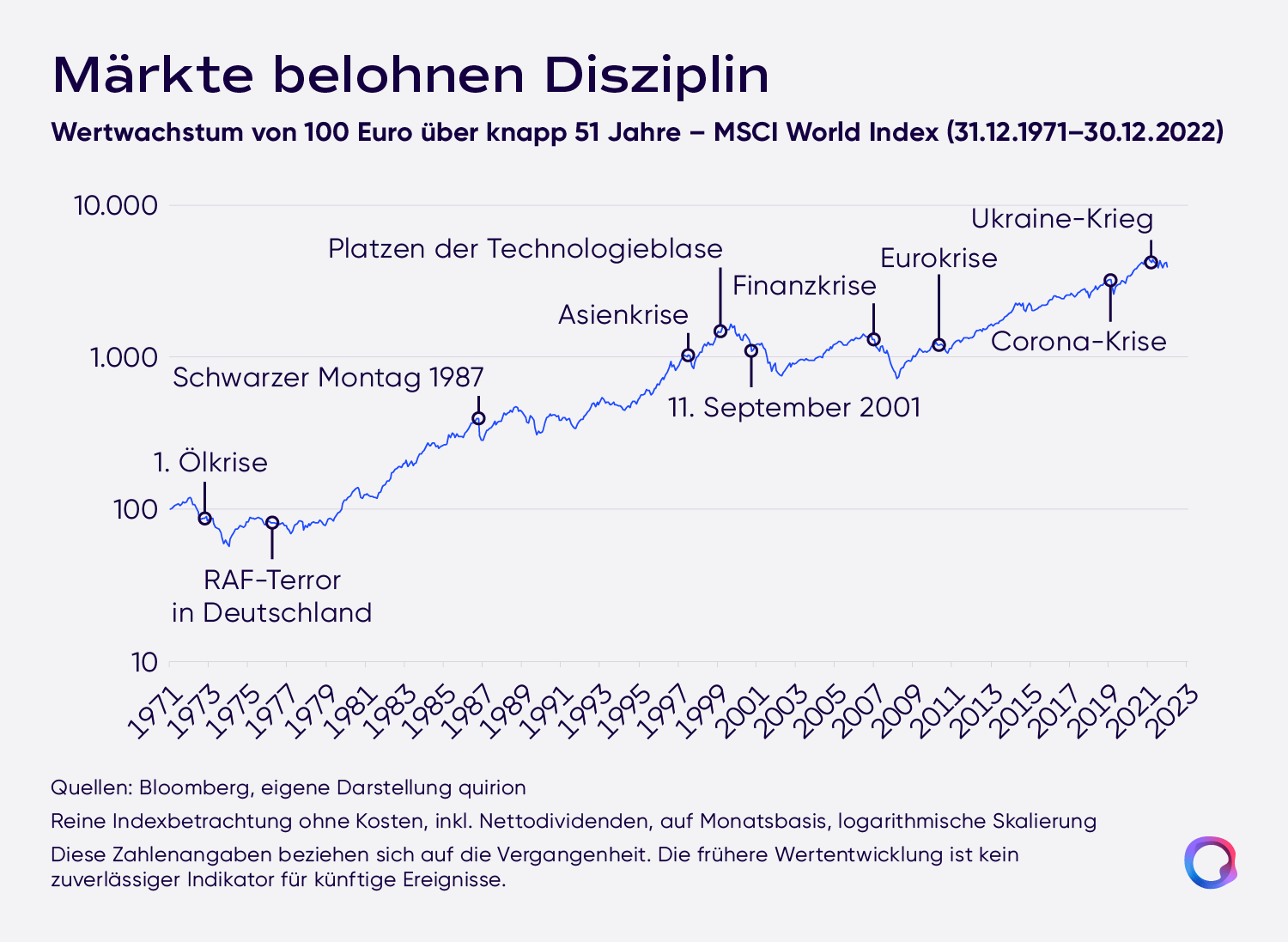
The equity markets in particular reward discipline as well as diversification that is as broad as possible over the long run.
In this case, discipline means: to hold consistently onto the ETFs or funds you once chose (taking your individual risk profile into account), and for as long as possible, without frantic buying and selling. The discipline of investors is put to the test especially in times of crisis, yet it is precisely then that the principle applies: keep calm, keep your securities and consistently keep investing!
As for broad diversification: investors who select their ETFs in such a way that they thereby invest as broadly as possible across the entire global equity market obtain the best ratio of expected return to expected risk.
2. Savings plan over long periods
For investors who do not have a large enough amount of wealth for a lump-sum investment and who instead want to set aside part of their income each month, a savings plan is ideal for turning the cost-average effect and, above all, the long-term positive equity returns to their advantage.
With an investment in equity ETFs – by nature rather volatile securities – over a period of 10 years and more, it is likely that prices will also give way more sharply from time to time, so that investors then benefit from favourable purchase prices that push down the average price of all the units purchased.
Good to know: To make optimal use of the cost-average effect, three prerequisites in particular are needed:
1. A regular savings plan
2. Broad diversification of the investments
3. Discipline over long periods, even if market prices should come under heavier pressure from time to time in the meantime
How does quirion's robo-advisor use the cost-average effect?
Through a portfolio that is optimally diversified from a financial-science perspective as well as a forecast-free investment strategy, quirion's robo-advisor offers its customers a simple and cost-effective way to invest with good long-term prospects of pleasing returns.
Investors who use a savings plan at quirion can thereby not only benefit from the cost-average effect, but also enjoy further advantages.
1. Diversification and product selection
We at quirion want to cover the global equity market as representatively as possible, because only in this way is an optimal risk-return ratio achieved with regard to the expected values.
Here, three factors in particular should be taken into account:
- Country diversification: make investments spread as broadly as possible across industrialised and emerging countries
- Sector diversification: make investments in as many industries as possible
(technology, finance, healthcare, consumer goods, industry, etc.) - Diversification by company size: make investments in companies of different sizes (small and mid caps, large caps/blue chips)
To build an optimised portfolio, you should select ETFs that invest as broadly as possible across the whole world, in as many industries as possible and in companies of different sizes.
That is why we at quirion tap the positive effects of broad diversification efficiently for our investors – by investing worldwide in around 8,000 companies. And indeed from all regions and industries, and including different company sizes. This can be achieved through a clever combination of different ETFs.
When selecting the appropriate equity ETFs for our customers' portfolio, we additionally take into account what are known as „equity factors“ and reflect these in a ratio that is as optimal as possible (in the bond segment, incidentally, we likewise take special factors into account).
Our extensive analyses have shown that, for the broadest possible equity-market coverage – alongside a blue-chip block – the following four factors in particular have turned out to be relevant:
- Value (=shares with a high intrinsic value)
- Low Volatility (shares with low fluctuations in the past)
- Small Caps (shares of smaller companies)
- Momentum (shares with recently strong price momentum)
Based on historical performance data reaching back more than 20 years, we can use the correlation effects between the factors and thereby tap the diversification advantage very well for our investors.
Good to know: The relationships between these individual factors are indeed complex, but not impenetrable. Based on historical performance data reaching back more than 20 years, our analysts develop an optimised and cost-efficient ETF portfolio for our customers. Because of its suboptimal coverage of the global equity market, a single equity index – such as an MSCI World ETF – proves to be too weak a representative of the worldwide overall market.
>>> You can find out more in the guide on diversification
2. Investors benefit from the low asset-management fee
Because we act as a digital asset manager, we can trade on the market differently from private investors and thus offer our customers attractive terms.
The fee in the Digital package is 0.48 per cent per year of the additional investment volume incl. VAT.
This fee covers the costs of …
- managing the portfolio
- the permanent monitoring of the investments
- and the rebalancing
Good to know: The asset-management fee of 0.48% includes all of quirion's services and is relatively low compared to other providers. Positive effect: because of the comparatively low management costs, more return is left over for investors in the end.
3. There are no hidden costs at quirion
In principle, the asset-management fee of 0.48% p.a. on the invested capital is the relevant figure for drawing meaningful comparisons between different providers.
For this, you need to know:
- The service fee is a flat rate that investors pay on the invested capital.
- In addition, there are product costs for holding ETFs – in quirion's case an average of 0.18% p.a. These costs are not billed separately, but are already priced into the corresponding ETFs by the ETF issuer. Incidentally, investors always have to bear these ongoing costs, even in a self-managed securities account.
- By way of comparison: investors pay a far higher fee, for example, with actively managed funds – in the equity segment, for instance, on average a good 1.5% p.a. or more (plus transaction costs within the funds)
Good to know: Some robo-advisors charge additional fees for certain services such as providing tax documents or personal advice on financial matters. In addition, some robos have a so-called performance fee, that is, a performance-based additional fee levied on gains. At quirion, for example, there is no performance fee, but the option, if needed, to book personal advice for an additional charge.
Conclusion: how investors can turn the cost-average effect to their advantage
The cost-average effect refers to splitting an investment into several equal amounts that are, as a rule, invested regularly over a longer period. So the CAE only takes hold with savings plans or when investors invest in a staggered manner!
In closing, investors should know the following about the cost-average effect:
- Savings-plan investors can benefit from the CAE – particularly with equities that are subject to stronger fluctuations.
- Investors who have larger sums of money that are not needed available for a lump-sum investment should invest their money fully and immediately, since market timing has been shown not to work.
- From a psychological point of view, it is however easier for many people to invest amounts in a staggered manner.
- From the return perspective, however, it is usually better to invest larger amounts directly in a single sum.
- Nevertheless: a savings plan that regularly invests in broadly diversified equity ETFs is, and remains, an unreservedly recommendable way to build wealth over the long term and in a disciplined manner, for example to provide for retirement!