In 2024, the ECB began its descent on key interest rates. But while key rates are still fairly high, many interest offers once again have a zero in front of the decimal point. For long-term investment goals, there's no way around the stock market.
"The comeback of low interest rates": that's how the consumer portal Verivox recently titled a current analysis of interest offers. There you can read that, at around a quarter of the roughly 800 banks and savings banks included, there was no more than 0.25 percent interest on instant-access savings. On average, nationwide instant-access offers reached their lowest level since October 2023, at 1.62 percent. Five-year fixed-term deposits carried an average interest rate of just 2.22 percent a year. The days when banks constantly outdid one another with ever higher interest rates are over again.
In 2024, the European Central Bank (ECB) already cut its key interest rates four times. The interest rate for deposits with the ECB has stood at 3.0 percent since December, and thus one percentage point below the peak reached in September 2023. This is also reflected in the money market, where yields usually lie close to the key-rate level.
An ETF portfolio like Cash-Invest, which focuses on the money market, can still be a clever alternative to instant-access savings. But only for money that is meant to be parked for the short term. Otherwise the return simply remains too meagre to make long-term wealth growth possible.
Make better use of return opportunities
Germans in particular, however, are practically addicted to interest. Even in the years of zero interest rates, interest products such as passbook savings and instant-access accounts were among the popular forms of investment. Evidence that the appeal of such products doesn't necessarily lie in the return — but above all in the certainty of having no fluctuations in value when investing.
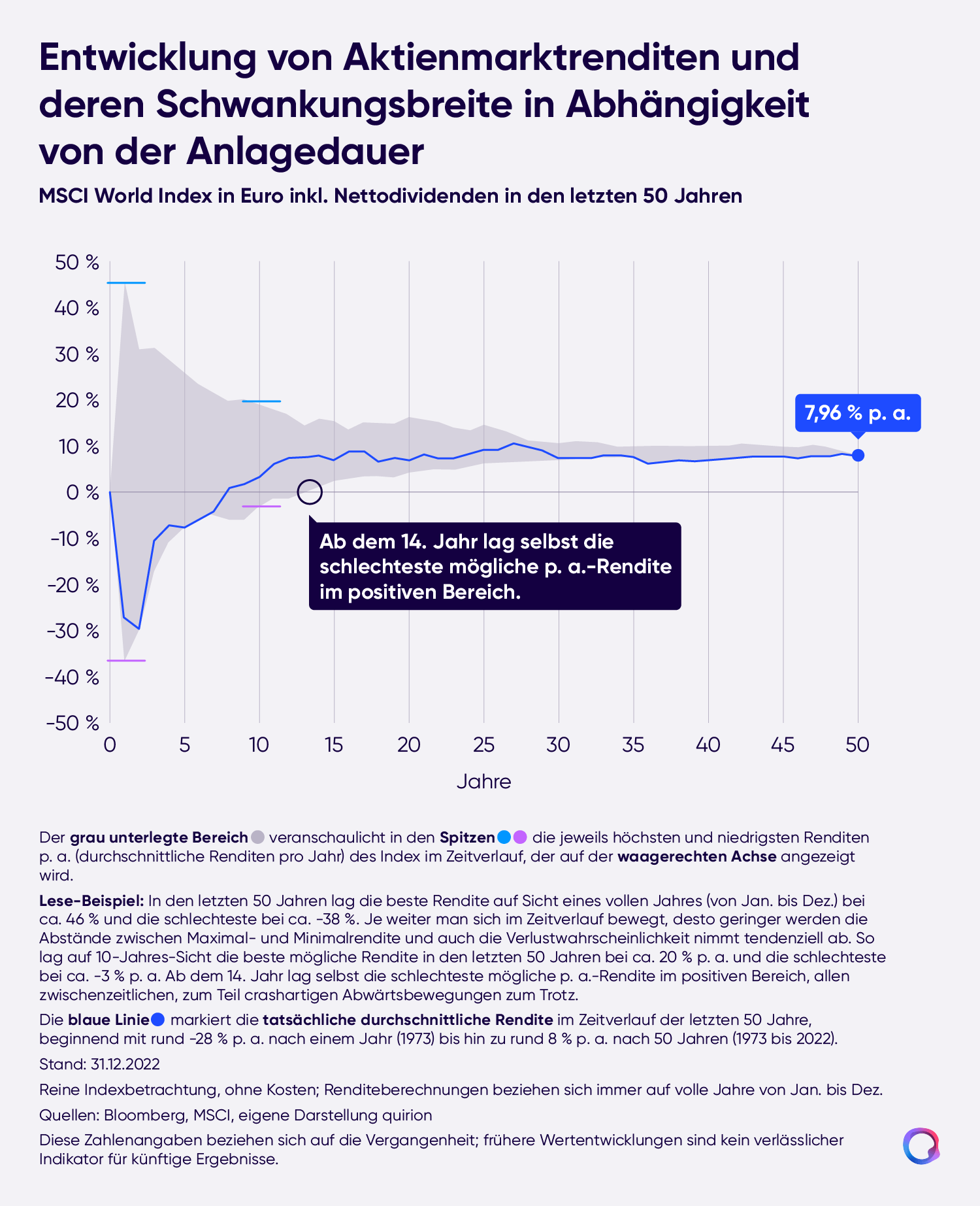
On the stock market, the return opportunities are far greater. Over the long term and on average, 7 to 8 percent a year has always been realistic so far. But the fluctuations in value put many people off. Yet these are put into perspective precisely over the long run.
Simply sit out price fluctuations
Sometimes the performance of many stock markets is well above average, as in the past two years. Sometimes it's below. That's precisely why a long investment horizon is so important. And a broad set-up of the portfolio: because which company, which sector or which region will be among the long-term winners cannot be reliably predicted. Not even by experts. The attempt to bet on the "right ones" tends to go wrong even for the pros.
What can be said, though, is this: the world economy is geared towards growth. And because shares mean holding a stake in companies, investors participate in the economy through the stock markets. So with a broadly diversified world portfolio, you tap into global economic development, in a sense.
quirion's global ETF portfolio pursues exactly this goal. It currently contains around 8,000 shares from over 70 countries and every conceivable industry. To optimise the balance between return opportunities and risks, the investment strategists draw on the current state of capital-market research when assembling the portfolio.
Avoid unnecessary risks
Even if you diversify as broadly as possible on the stock market, it isn't advisable in every case to invest 100 percent in shares. Which equity allocation makes sense depends above all on two things: how long do I want to invest for? And how large may the price fluctuations be? Depending on how the investor's risk profile turns out, quirion adds bonds to the mix. These serve above all to cushion the price fluctuations of the equity portion as much as possible.
In this way, you can in principle benefit from the return opportunities of the world's stock markets with any risk profile, without taking on unnecessary risks. And you don't have to take care of anything else yourself in the process. All these advantages of digital asset management can also be used within an ETF savings plan, starting from investment amounts of just 25 euros a month.