
By trading individual stocks or specialized financial products over the short term, some people hope to squeeze extra returns out of the markets. That’s very risky, and rarely successful. Here’s why betting on the broad market over the long term is far more promising.
Up 400% in just one week: the headlines about “meme stocks” – shares that achieved cult status through internet forums and multiplied in value in no time solely for that reason – are still fresh in our memory. In the summer of 2021, shares in cinema operator AMC were bid up to around 60 US dollars. By the autumn of 2022 they were back to about 6 US dollars, roughly the level before the hype. The boom lured many in. Quite a few of those who joined in paid dearly for it.
The dream of striking it big through trading is nothing new. Steeply up, then back down – and then the whole thing all over again: for some, these short-term swings are reason enough to stay away from the stock market. Others are drawn to them for exactly the same reason. Thanks to digital platforms, the next trade is only a click away. Overall, market activity has become more short-winded. According to statistics from the World Federation of Exchanges, the average holding period for shares worldwide was 9.7 years in 1980; by 2020 it had shrunk to just about 7 months.
Too much speculation
Trade fast and get rich faster: anyone counting on that is usually disappointed. Academic research has shown this for many years. The financial economist Brad Barber, for example, has examined trading success in day trading – trading within a single day – across several studies. Among other things, he found that in a typical year only about 20% of day traders make any net profit at all. So roughly 80% end up in the red. And more than 75% of day traders give up within two years.
Too much appetite for risk, trading too often – that’s often the reason for a portfolio’s poor performance. According to behavioral finance, this tendency stems partly from the “overconfidence bias.” Those who are convinced they have the better insight or the right instinct often overlook the risks and take on too much.
On top of that, reports about the dream returns others supposedly are already earning have a seductive effect. But be careful: stories of getting rich quick exist in the lottery too. It’s just more obvious there that whether you pick the right numbers comes down to chance.
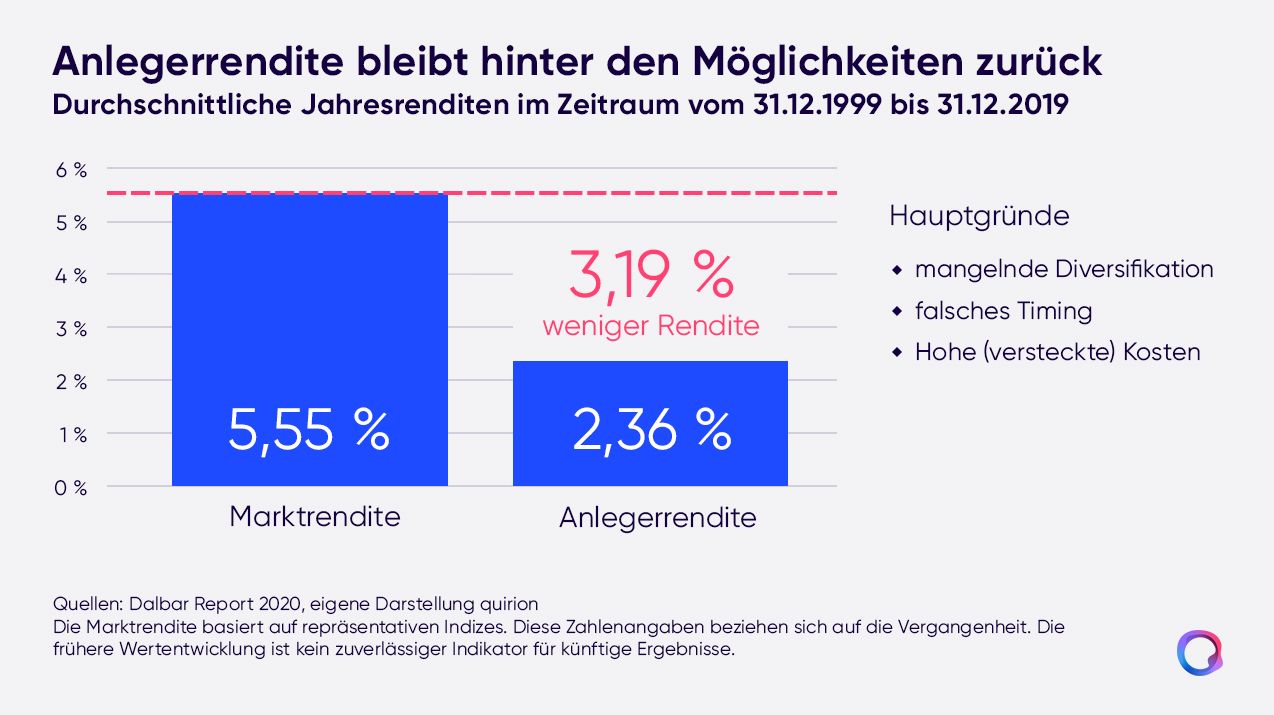
When speculating on individual stocks or specialized financial products, too, you may get lucky and win the odd time. But you can’t repeat that systematically over the long term. Beyond short-term trading, a lack of diversification and the attempt to catch the supposedly right moment to invest are the factors that keep dragging investor returns down.
Invest smarter
A market economy is geared toward growth – and stocks give you a share in the companies that generate this growth. That’s the economic reason for capital gains and for the expectation that stock markets will rise over the long term. But which specific company will stand out from the competition tomorrow, or in the coming year, is something you can only speculate about in advance. If you trust capital-market research, you’re better off not engaging in that speculation at all, and instead relying on the link between the global economy and the stock market.
Capital-market research also reveals that with the broadest possible portfolio, the balance between return and risk can be brought into a particularly favorable relationship. quirion’s investment concept is based on findings like these. Its investment strategists cast a wide net over the world’s markets. The global portfolios are invested in more than 8,000 stocks. That boosts the chances of success. And it’s also far more relaxing for investors.