Robo-advisors want to use artificial intelligence to outperform the market, but you can't actually talk to them about investing? Every so often, misconceptions crop up about what a robo-advisor like quirion actually does. Let's clear up a few of these myths.
Myth 1: With robos, artificial intelligence decides the strategy
Robo-advisors are often associated with artificial intelligence. This sometimes leads to the misconception that, with robos, all the decisions are made by machines. The fact is: while we at quirion make extensive use of digital technologies, we don't leave our portfolios to the algorithms. Our investment proposal is always based on our globally diversified ETF model portfolios. These are built on insights from capital-market research, but they are put together not by a machine, but by our investment strategists. So the strategy is firmly in human hands.
Myth 2: Robo-advisors have to beat the market
Closely linked to the misconception that artificial intelligence sets the course is another myth: that sophisticated algorithms can regularly beat the market return, because all future developments can supposedly finally be predicted with certainty by (alleged) artificial intelligence. But even with the help of algorithms, it remains true that gazing into the crystal ball isn't worth it. Neither people nor machines know the future. No one knows exactly when a particular stock will be especially in demand, or when and for how long another will slump. Of course, you might occasionally happen to pick an especially lucrative stock. But random "hits" can't be repeated systematically. The same goes for trying to catch the optimal entry and exit points. Some funds do manage to beat their benchmark index over several years. But the longer the period under review, the more those successes tend to fade again. And above all: which fund pulls off this feat cannot be said in advance, but only ever in hindsight. Whether it's "experienced fund management" or a "sophisticated algorithm": no one beats the market return over the long run. Science shows the opposite: in terms of the risk-return ratio, a globally diversified, broadly spread portfolio is superior to any alternative investment strategy. We build on this insight of forecast-free investing.
Myth 3: Active robo-advisors do a lot of work, passive robo-advisors sit back and relax
Comparisons often distinguish between "active" and "passive" robos. But the terms are misleading. Even "passive" robo-advisors like quirion very actively select the products they use from hundreds of ETFs through multi-stage filtering processes. We monitor our model portfolios and clients' portfolios continuously and regularly align them with the risk profiles. When weighting portfolios, "active" robos additionally tend to rely on certain risk metrics. Yet common risk measures can sometimes lead you astray, because they can't predict the future either. This is another reason our investment strategy is forecast-free. We don't rely on guesses about what might happen. We'd simply rather trust science than the crystal ball.
Myth 4: Building a global portfolio — one ETF is enough
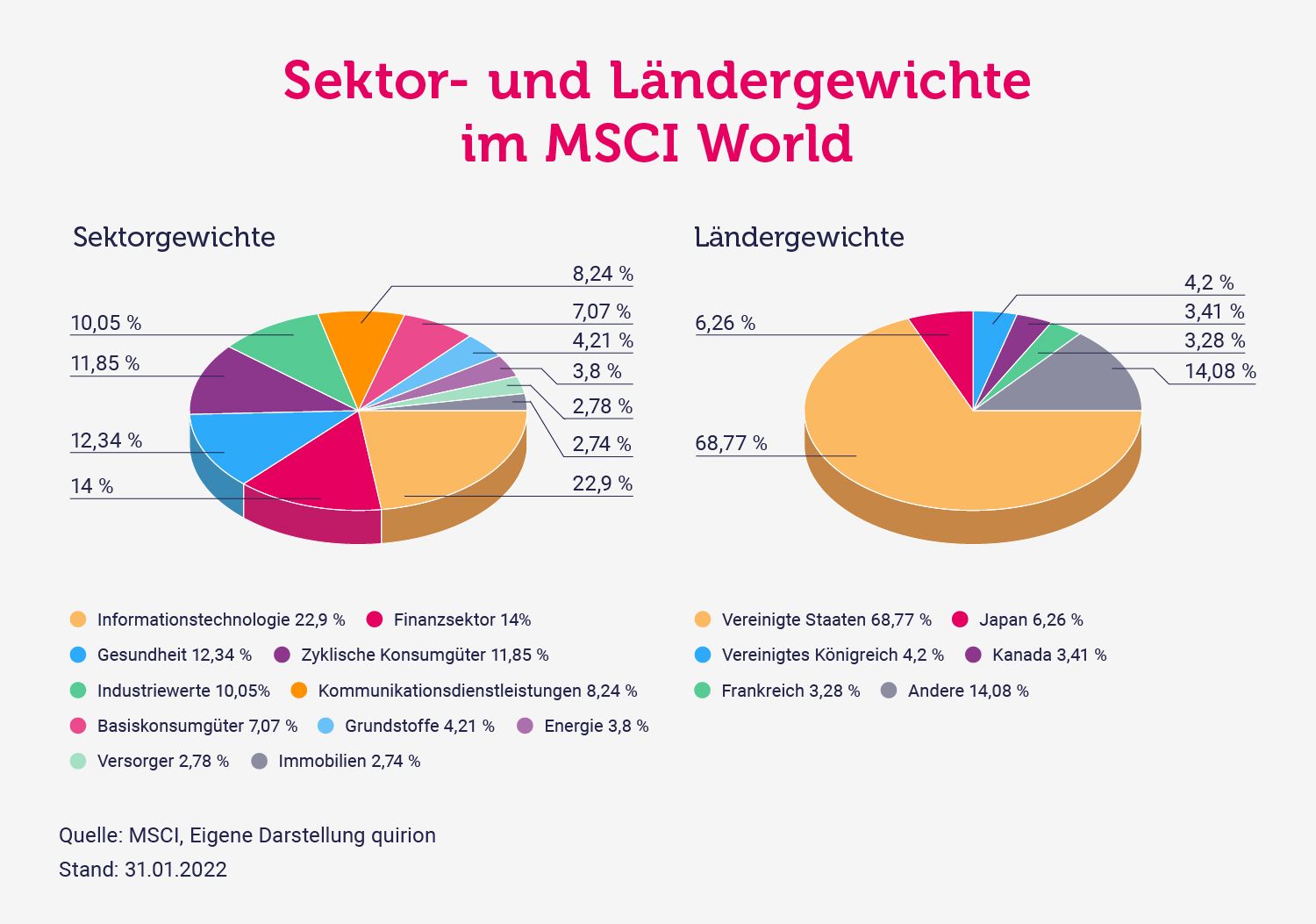
How broadly you position your own portfolio, or where you set your priorities, is something everyone has to decide for themselves. In any case, ETFs are an excellent tool for cheap diversification. But buying an ETF on an index like the MSCI World does not bring a true "global portfolio" into your portfolio. Statistical analyses show that individual indices always develop uncontrolled, shifting concentrations. In the MSCI World, for example, the focus is clearly on information technology and the USA. Emerging-market countries are missing, as are small caps (secondary stocks).
We at quirion, by contrast, want to get as close as possible to the return of the "global equity market." To do so, many factors have to be taken into account and coordinated with one another. We take the fine-tuning very seriously. If someone tops up their portfolio with us by €500, for example, we don't simply order shares in one particular ETF. Our software calculates what proportion of the portfolio should be held in the up to 15 different ETFs of the model portfolios according to the intended strategy. With an amount of €500, this can then sometimes mean fractions — right down to thousandths of a share. Because the portfolio should match the chosen strategy as precisely as possible.
Myth 5: Robo-advisors are too expensive
Costs are one of the most important levers for your investment result. That's why we use low-cost ETFs, like most robo-advisors. For active equity and mixed funds, the ongoing costs still frequently run between 1.5 and two percent. The costs of robos, by contrast, are usually below one percent per year. At quirion, you can get the "all-round worry-free package" of a digital wealth management service starting at just 0.48 percent per year. In addition to the scientifically grounded construction of the portfolios and their ongoing monitoring, this also includes services such as order management with cost-optimized trading, plus account and custody management.
Myth 6: Robos don't offer personal advice
Not everyone wants purely digital advice. Most robo-advisors, however, limit themselves to impersonal client communication. At quirion, it's different. Premium-package clients can turn to the qualified advisors of Quirin Privatbank, at 13 branches across Germany. Quirin Privatbank, of which quirion is a majority-owned subsidiary, is Germany's only fee-based advisory bank. It deliberately does without commissions from product providers. Because only this way do the advisors focus exclusively on the client's interests.