Broader support, a lower cost cap: in the final stretch, quite a bit changed again in the reform of private retirement provision. Here's how savers benefit.
The Bundestag has passed the reform of private retirement provision, which is set to replace the old Riester model from 1 January 2027. The central building block of the reform is the introduction of the new retirement provision accounts (Altersvorsorgedepots). With these, you'll then be able to build up subsidised retirement wealth using ETFs, for example.
Shortly before the vote in the Bundestag, there were a few more important adjustments. For instance, the self-employed were added to the circle of those directly eligible for support. There were also improvements for families as well as for savers who can't pay in large sums.
How much the state contributes
The basic allowance is now set to be 50 cents for every euro you pay in yourself, up to an amount of €360 a year. For a further €1,440, eligible savers receive 25 cents per euro saved. This means that on a maximum personal contribution of €1,800, you get €540 from the state. Originally, €480 had been envisaged. The maximum child allowance of €300 per child per year is now set to be available from as little as a savings rate of €25 a month. Anyone who takes out a retirement provision contract before their 25th birthday will also receive a one-off €200 career-starter bonus.
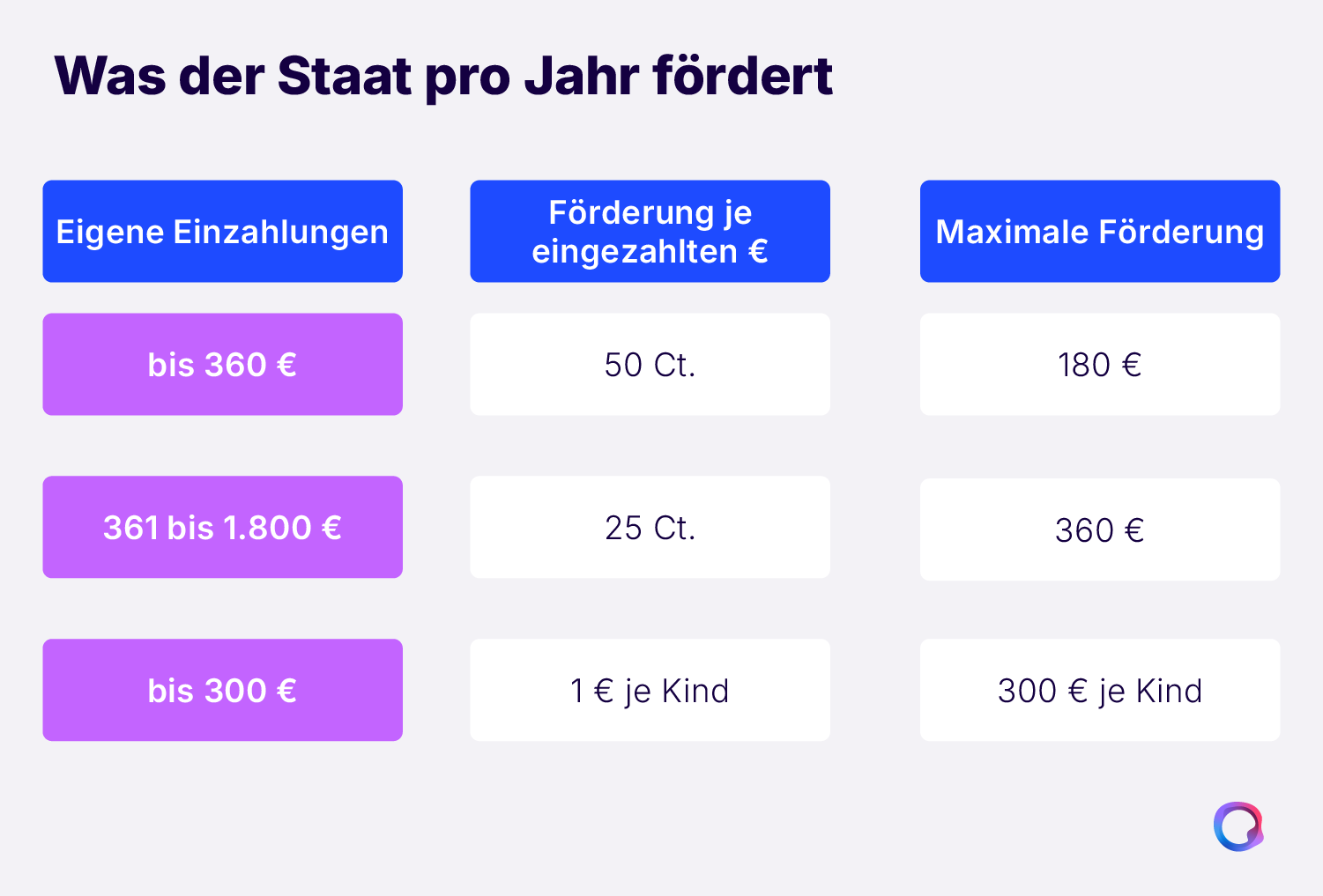
An example shows how this plays out. Suppose a family with two children sets up an ETF savings plan of €150 a month within this framework. In that case, the basic support amounts to €540. As long as both children are entitled to child benefit, an additional €600 in child allowances is added. In total, this means €2,940 a year is saved for retirement.
Why you have to keep an eye on costs yourself
According to the current resolution, the cost cap for all standard accounts is now limited to a maximum of 1.0 percent rather than 1.5 percent. „That's already considerably better,“ notes our CEO Martin Daut. But efficient retirement provision can be had for far less. „We demonstrate that with our current offering for retirement provision. And it will also apply to our special product for retirement provision accounts, which is in preparation.“
In any case, savers should make absolutely sure that their product isn't unnecessarily expensive. Because costs eat into returns, especially over the long term. A worked example for a savings plan of €150: assuming a hypothetical return after costs of 7 percent a year, after 30 years you arrive at a sum of around €176,000. If higher costs push this return down to 6.5 percent, that's around €15,500 less.
What matters when choosing a product
The Bundestag has now also resolved that there should be a state-run standard account as well. Which public body will provide it has not yet been decided. But whether from the state or from private providers: the rules for a purposeful investment strategy are the same for everyone.
„Costs are important, but not everything,“ Daut emphasises. „The portfolio should be systematically diversified in order to rule out unnecessary risks.“ That is important precisely for the investment goal of retirement provision. „Anyone who simply speculates away exposes themselves to far too high a level of risk.“
Systematic diversification isn't merely about the number of securities. Rather, it's about optimising the ratio of return opportunities to risks as far as possible. In its investment strategy, quirion is guided by scientific criteria.
What additional contributions bring
Under the new regulation, a maximum of €6,840 a year can be paid into a retirement provision contract. Up to two retirement provision contracts can be taken out. Now you might ask: why might it make sense to pay money into a retirement provision account, for example, beyond the contribution support limit? The idea: during the saving phase, no capital gains tax currently applies. The payouts are indeed taxed later in retirement. But until the payout stage is reached, compound interest can unfold all the more, the more you concentrate your private retirement-provision efforts.
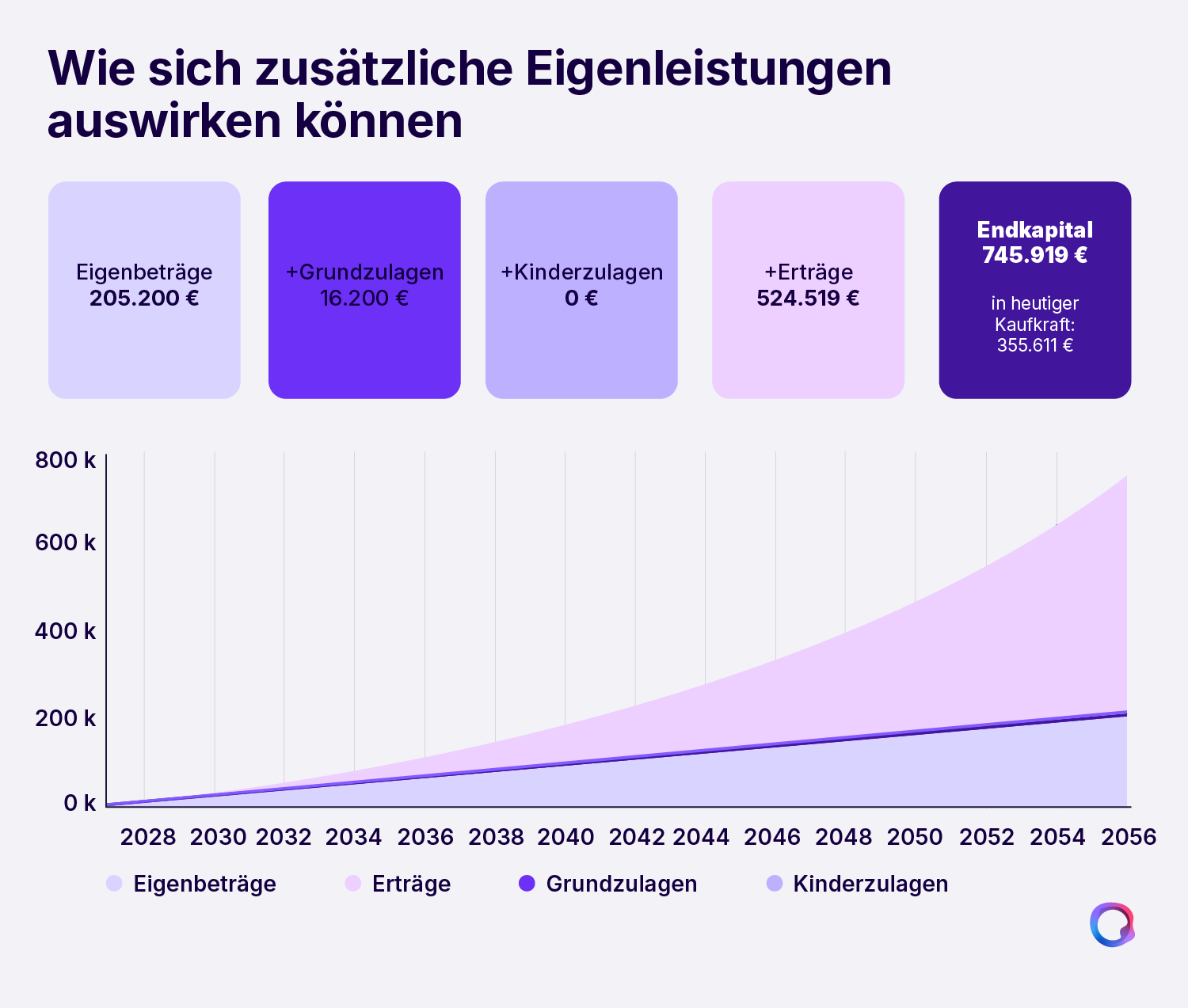
That the compound-interest effect can be a huge lever for your wealth can be demonstrated with a sample calculation. Suppose €570 a month, or €6,840 a year, is paid into a retirement provision account. With the maximum basic allowance, the annual savings volume comes to €7,380. If we now assume, purely as a numerical example, that the hypothetical return after costs is 7.0 percent a year, the wealth grows over a period of 30 years to more than €745,000. And this doesn't even yet account for the advantages of possible child allowances.
What Riester savers can do
Anyone who already has a Riester contract can switch to the new model of retirement provision accounts, but doesn't have to. There are still set to be two support variants with guarantees: products in which 100 percent of the accumulated capital must be available at the start of the payout phase, and products with a capital guarantee of 80 percent.
However: „Guarantees are expensive. And they prevent the return opportunities of the equity markets from being used efficiently,“ Daut warns. High costs, low returns: „It's not without reason that the old Riester model failed. Building wealth for retirement is an investment goal, not an insurance claim.“
What's still to come
The legislative package still has to pass through the Bundesrat as a final step. It is expected to take this up on 8 May. But one thing is already certain: „When the support begins, we will offer an attractive solution — with an eye to both costs and quality,“ Daut promises. „This will make it possible to use the long-term return opportunities of the capital markets efficiently and without unnecessary risks for retirement provision.“
What matters when investing for retirement, you can find out here.