Since the outbreak of the Iran war, inflation has been making headlines again. The topic is also moving the bond markets and the central banks. Many are asking: is the next turnaround in interest rates coming?
Will the Iran war end soon or not? Speculation about a resolution of the Middle East conflict keeps driving the oil price first in one direction, then in the other. By now, this back and forth leaves many stock markets largely unmoved. Other topics dominate there. On the markets for government bonds, by contrast, worries about a rising level of consumer prices weighed on prices in April and May and at times sent yields jumping sharply.
Inflation is back in the headlines. In Germany, energy prices shot up by 10.1 percent year on year in April, after a rise of 7.2 percent in March. Faced with figures like these, some already felt reminded of the situation at the outbreak of the Ukraine war, when surging energy costs triggered a broad wave of inflation – followed by a dynamic turnaround in interest rates.
"As things stand today, I consider a rate hike in June to be necessary," said ECB Executive Board member Isabel Schnabel on May 21. She did explain that what matters for monetary policy is the scale and duration of the price shock. But she also noted: "By historical comparison, this shock is very large."
A different starting position than in 2022
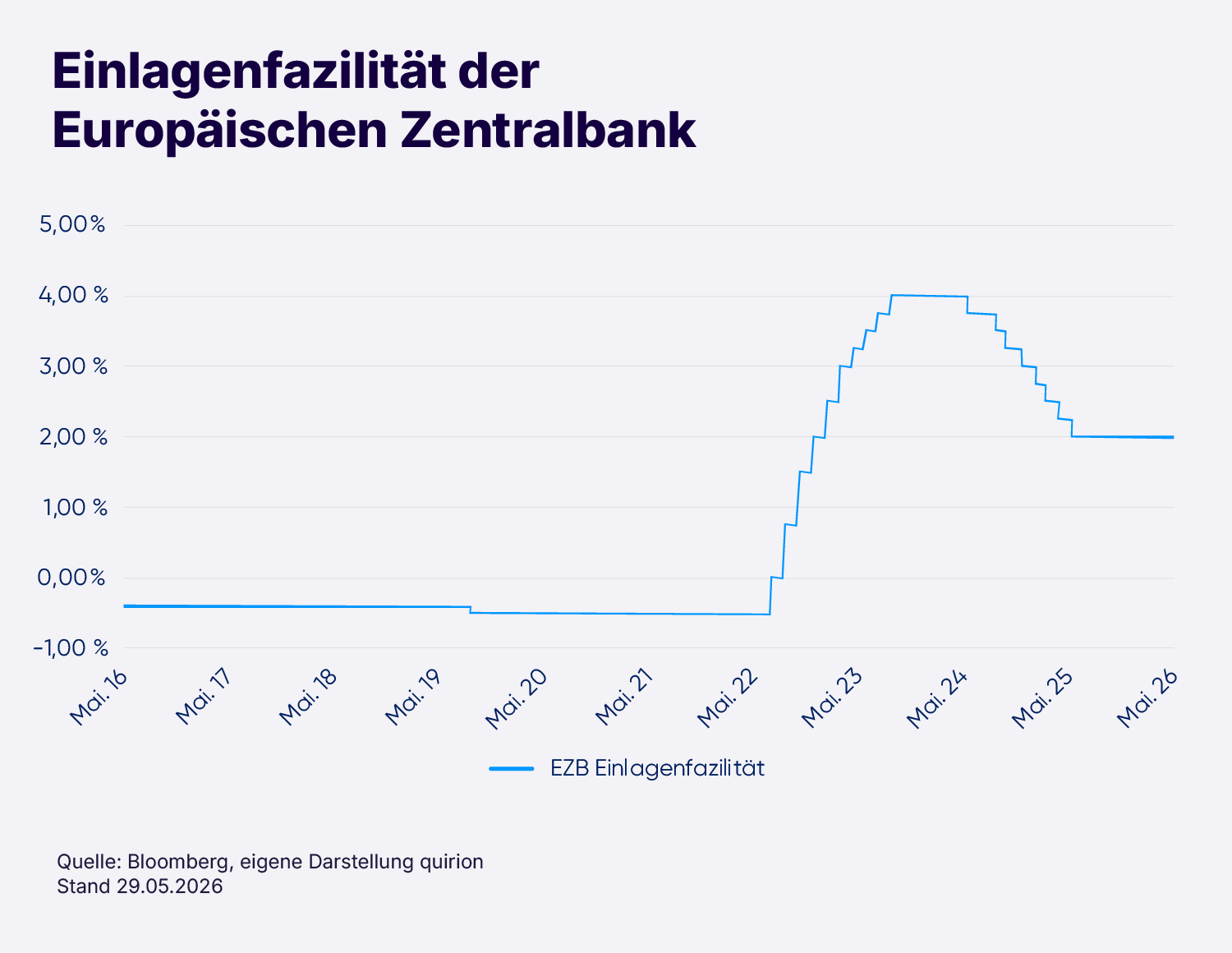
Even if the ECB takes a rate step upwards: in the assessment of our chief economist Philipp Dobbert, there is no need to fear turbulence on the bond market like during the 2022 rate turnaround. "There is one very fundamental difference between the situation then and the situation today – namely the starting level," the economist explains. "Back then, we had ten years of zero and negative interest rates behind us." That dynamic turnaround upended the entire interest rate landscape, he says. "Now we are moving at a normalized interest rate level."
On top of that: "So far, significant price increases have shown up almost exclusively in energy," Dobbert notes. And the level of energy prices could quickly change again if the Middle East conflict is resolved. "Inflation only becomes a bigger risk for the markets if price rises increase considerably over a period of several months and successively spread to more and more segments of the economy."
New Fed chair faces a crucial test
In the USA, too, inflation is a big topic – amid robust economic growth. "If anything, that points more towards rising than falling key interest rates," says Dobbert. A challenge for the new Fed chair Kevin Warsh. His predecessor Jerome Powell was constantly insulted and threatened by Donald Trump because he did not comply with the US president's wishes for rate cuts. In April, Trump hinted that he would be disappointed if the new Fed chair he had nominated did not cut interest rates immediately.
Warsh himself has always emphasized that he intends to preserve the Fed's independence. He was already a member of the Fed's Board of Governors from 2006 to 2011. At the time, he was counted among the advocates of a restrictive interest rate policy. On the other hand, some of his most recent remarks have been interpreted as signs of a possible loosening of monetary policy – such as his statement that the spread of artificial intelligence (AI) could lead to growth spurts without simultaneously driving up inflation.
"As a central banker, Warsh has to engage with the possible effects of AI on the economy," Dobbert underlines. "But I don't know a single central banker who would be ideologically in favor of rising or falling key interest rates." Even if individual people took different monetary policy approaches, when it comes to rate decisions they would all be guided by the data. "I assume that will be the case with Warsh, too." In any case, the Fed chair does not decide on interest rates alone. That is done by the so-called Federal Open Market Committee (FOMC). Powell remains one of its 12 members, until early 2028.
Investing without speculation, in bonds too
quirion essentially uses bonds to cushion the risks of the equity portion in customers' individual portfolios. "Even in the current market environment, the price fluctuations of government bonds from industrialized countries in particular are much smaller than those of stocks," Dobbert emphasizes.
The speculation about interest rates changes nothing about the strategy for quirion's bond portfolios. "As with stocks, with bonds we work towards the broadest possible diversification and steer clear of forecasts," says Dobbert. Last year, the bond portfolio was restructured and split into two modules, a risk-reducing one and a return-oriented one. "In both, we recently refined the setup once again – to further optimize the balance of return opportunities and risks."
You can find out what's inside our portfolios here.