When it comes to investing, many people in Germany still focus on overnight deposits or other interest-bearing products. Five reasons that argue against this and instead speak in favor of investing in equities. At least when the investment strategy fits the investment goal.
For most people in Germany, interest still plays a major role in building wealth. Admittedly, the number of those who invest in equities in one way or another rose in 2025 by two million to 14.1 million, according to the Deutsches Aktieninstitut. But a shareholder rate of around 20 percent means, conversely, that around 80 percent still forgo the return opportunities of the equity market. This considerably hampers the growth of their wealth.
1) Inflation eats into your returns
According to an analysis by the consumer portal Verivox, in mid-March nationally available fixed-term deposits with a two-year term paid an average of 2.09 percent interest. One-year fixed-term deposits stood at 2.02 percent. For overnight deposits, average interest was 1.30 percent. Average overnight-deposit interest was significantly lower at the savings banks, at 0.37 percent, and at the regional cooperative banks, at 0.42 percent.
The inflation rate in Germany was 2.1 percent in January and 1.9 percent in February. If you roughly calculate with inflation of 2 percent, one thing immediately stands out: with interest rates like these, at best a minimal gain in real terms, that is, after loss of purchasing power, remains for growing your wealth. The risk is high that your wealth will shrink in real terms.
2) The return opportunities of equities are superior
In the "Global Investment Returns Yearbook 2026," UBS, in collaboration with the London Business School, looked back over 126 years of capital markets. One finding is that, with their historical average returns, equity markets have far outstripped inflation.
Take the US market, for example: there, equities achieved average growth of 9.8 percent per year over the entire period, compared with 4.6 percent for US Treasuries and 3.4 percent for money-market instruments. Average inflation over that time was 2.9 percent. And as the authors note, the superior performance of equities has not only been observed in the US. Since 1900, equities have outperformed bonds, money-market instruments, and inflation in all 21 countries with an uninterrupted investment history.
3) Price fluctuations are a question of time
In a survey by the Association of German Banks, 67 percent of respondents said that security was especially important to them when investing. Only 42 percent named "return" as a particularly important aspect. Security is a key reason why overnight deposits and the like are held in such high regard by investors. After all, interest-bearing products come with no price fluctuations. Equities, by contrast, often fluctuate strongly, especially in the short term.
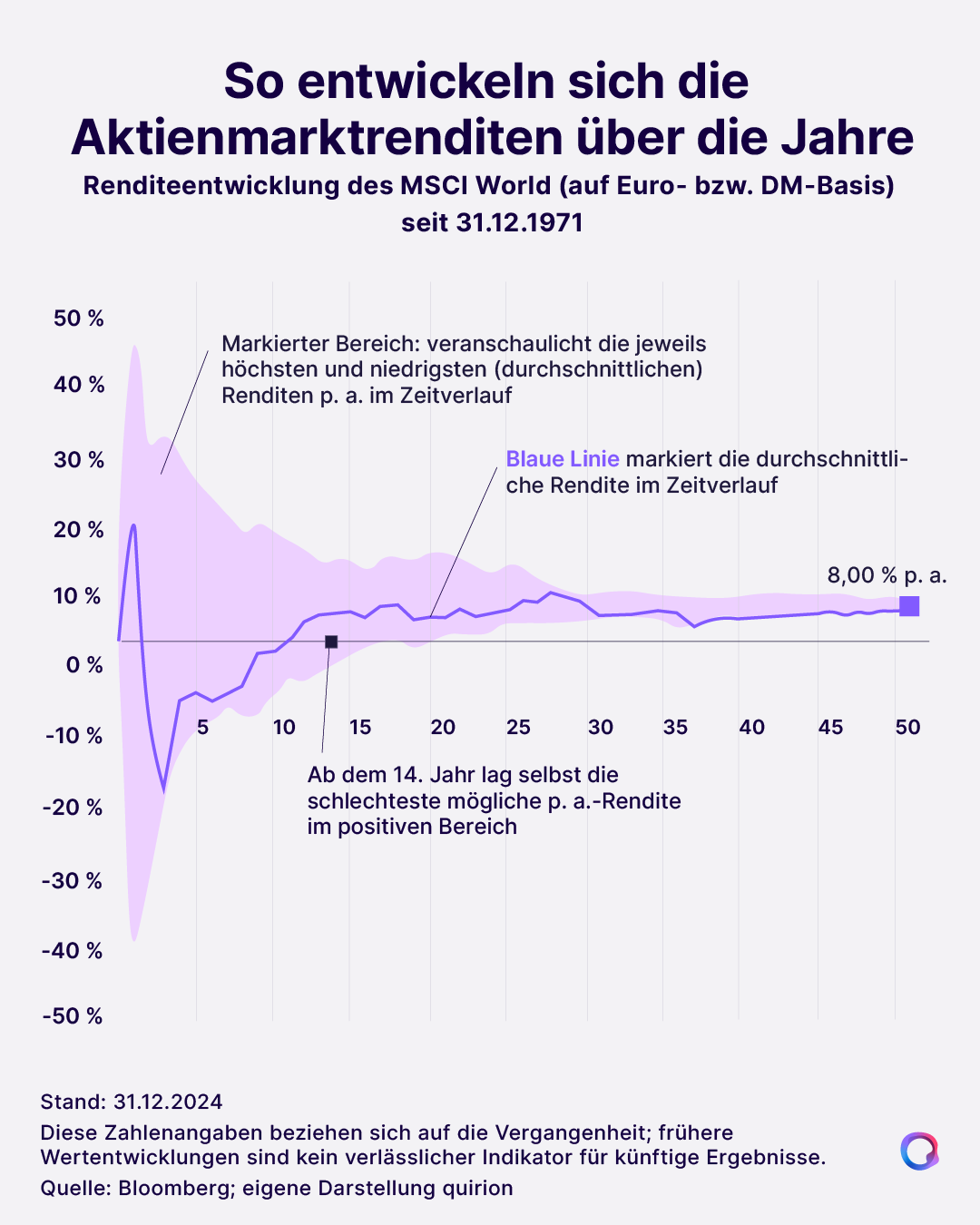
However, the matter of price fluctuations is also a question of perspective. Because over the long term, price fluctuations usually even out, at least if you spread your portfolio broadly and internationally.
4) Goal and strategy come before product selection
When investing, the first thing you should think about is not products, but rather your own investment goals, and derive your strategy from them. Because every goal has its own risk profile. Here, overnight deposits and the like can certainly be the right choice when it comes to parking money short-term, for example your emergency fund.
Anyone who wants to build wealth for long-term goals, however, should not forgo the earning power of equities. Broad diversification is important here. Because if a portfolio is diversified broadly enough, return opportunities can be seized without taking unnecessary risks.
5) Investing can be delegated affordably
Many people shy away from investing in equities because they find it too complicated or don't want to deal with the markets all the time. But building wealth can be delegated quite easily, affordably and efficiently. With quirion, digital wealth management is possible, for example as an ETF savings plan with investment amounts of just 25 euros a month.
Included is an investment strategy tailored to your own goals, your personal investment horizon, and your individual appetite for risk. Part of that is recognizing that a pure equity investment is not suitable for everyone. Depending on your risk profile, quirion adds bonds as a buffer against the price fluctuations of the equity portion.
In their investment strategy, the experts follow scientific insights instead of engaging in reckless speculation. What's more, all ETFs are analyzed in detail before they are added to the portfolio. Investors don't have to worry about anything else themselves.
Find out more about our ETF savings plan here.