Whether prices are currently falling or have already risen sharply: the question of whether now is a favorable time to invest is practically always in the air. Why it is better not to waste any time searching for the answer.
High energy prices, disrupted supply chains, dampened growth expectations: especially in the first weeks after the outbreak of war, the negative consequences of the Iran conflict repeatedly weighed on the stock markets, too. This unsettled many investors. One sign of this was that they held back strongly on new investments. According to figures from Morningstar, more than 8 billion euros did flow into equity ETFs in Europe in March. But in February, at just under 40 billion euros, inflows had been many times higher.
In April, many stock markets then delivered a surprise with a strong rally. In the US, new all-time highs were reached one after another. Some attributed this to strong earnings growth at numerous companies in the first quarter. Others saw the reason more in speculation about an approaching end to the Iran conflict. Whichever was true: anyone standing on the sidelines missed out on return opportunities.
Missed return opportunities
Markets moving differently from what was generally expected beforehand is something that happens quite often. Investors have to be prepared for that. Acting with foresight, however, means precisely not speculating on optimal times to get in and out. Landing a hit that way would be a matter of pure luck. In most cases, the problem is getting (back) in too late.
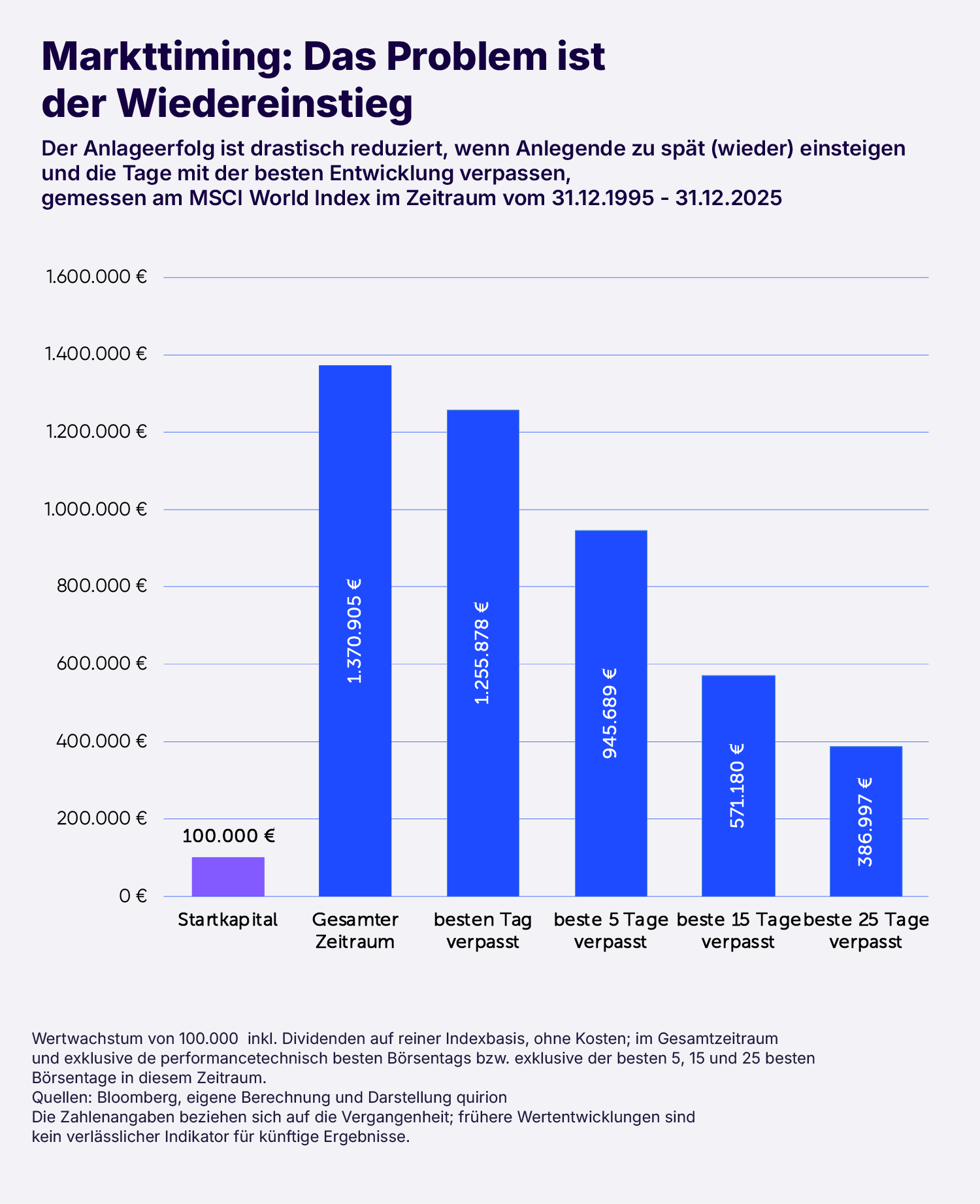
Why it is better to trust the market
You only ever know the optimal time to get in and out with hindsight. That also applies to experts – such as active fund managers who try to beat the broader market through targeted selection and market timing. A study by S&P Global published in March showed this once again. According to it, over a period of ten years, around 97 percent of active funds investing in European equities were unable to beat a corresponding index. Among those investing globally, it was around 98 percent.
What can be established beyond short- and medium-term forecasts, however: on average and over the long term, the trend on the stock markets points upward. Despite all the slumps and corrections. The reason is that stocks give you a stake in companies and thus in the economy. And the economy is fundamentally geared toward growth.
Even in phases of crisis, the economy is often astonishingly resilient and adaptable. A look at the annual growth rates of the global economy over the past ten years shows this – in other words, a period in which there was truly no “shortage” of crises. Only in 2020 was there a significant decline due to the coronavirus pandemic, but it was quickly made up again.
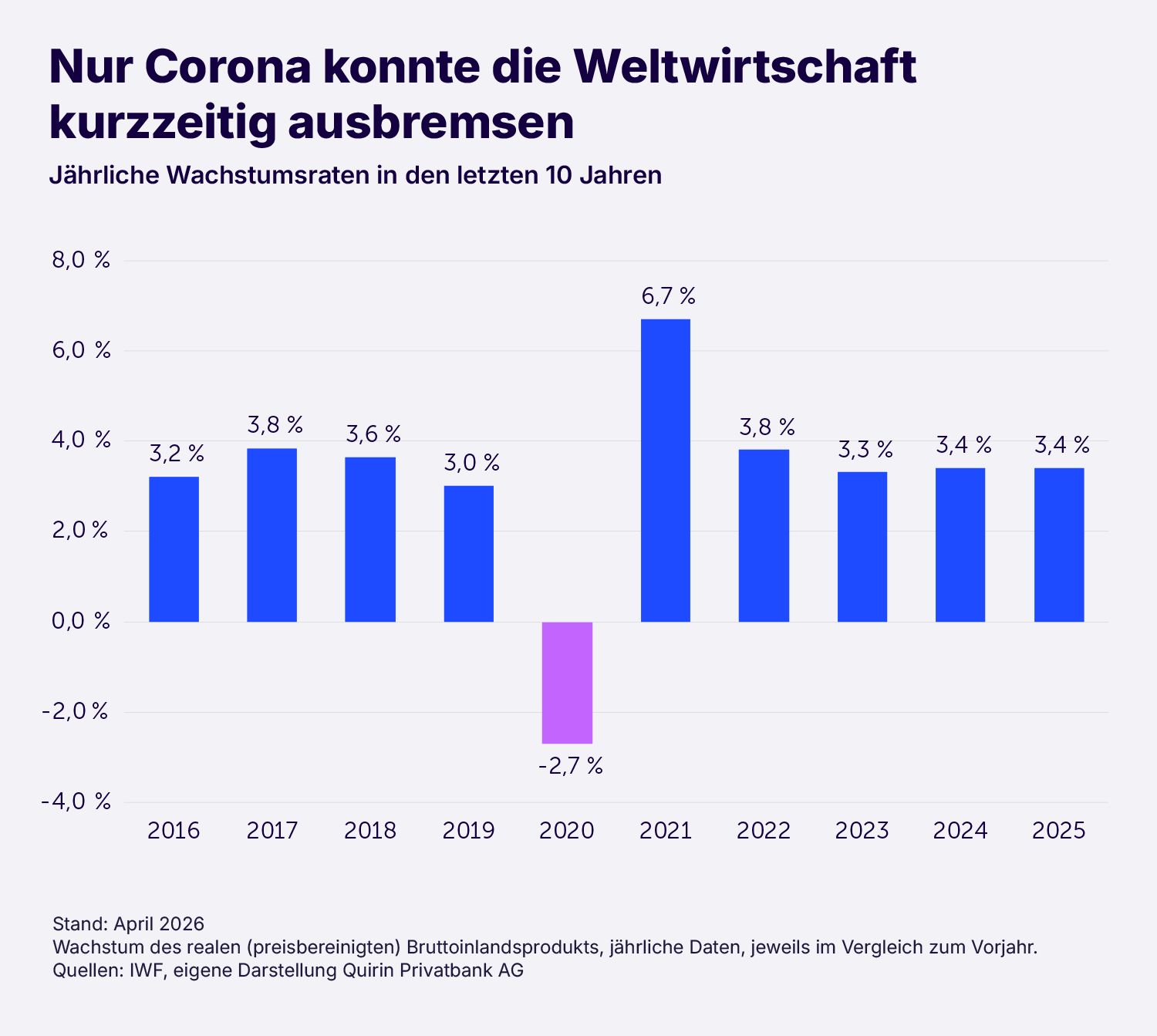
Time counts, not timing
Staying consistently invested regardless of crises and slumps: isn't that too risky all the same? Some people may ask themselves that. The investment company Vanguard recently ran a thought experiment on this. It analyzed the performance of an investor who invested at seven very bad moments over the past 30 years. Namely, always exactly when the stock markets crashed a short time later – for example, before the financial crisis, the coronavirus pandemic, or the start of the war in Ukraine.
What the hypothetical investor with the unlucky touch did do, however: he invested in a globally diversified way. And – despite new purchases – he did not reallocate or sell anything over the entire period. The result: purely arithmetically, even under these unfavorable conditions, a total of 45,000 euros paid in would have grown into assets of 155,580 euros by February 2026. For comparison: with the money in a fixed-term deposit account at an assumed interest rate equal to the ECB key rate, he would have ended up with a final value of just 56,871 euros over the same period.
A strategy for every market phase
Instead of speculating about the optimal moment, you are better off optimizing diversification when investing. That way, you avoid unnecessary risks and don't miss out on return opportunities. Our global ETF portfolio is diversified according to scientific criteria and currently gives you a stake in more than 10,000 stocks from over 70 countries.
Depending on your personal risk profile and individual risk appetite, we also add bonds to the mix. Bonds can help cushion the fluctuations of the equity portion of the portfolio. That is why our answer to the question of the best time to invest is: “always now”.