With the new retirement provision account, providing for retirement is becoming much easier. What is not quite so easy is picturing the possible investment outcome today – partly because the new rules are quite complex. Four example calculations.
Using the capital markets with government support and building up a financial cushion for retirement that way: the new retirement account will make this possible from 2027 – a great opportunity. That becomes clear when you consider how contributions, government support, and the return opportunities of the stock markets interact over the long term.
For the following example cases, we draw on our calculator for the retirement account. The details – the assumptions on returns, taxes, and costs – can be found there.
Example 1: career starter (21), low income
In the first example, we assume a young woman at the start of her career. We assume a monthly savings rate of 30 euros. For contributions of up to 360 euros per year, the basic allowance is 50 cents per euro paid in. And anyone who takes out a retirement provision contract before their 25th birthday receives 200 euros as a one-time allowance.
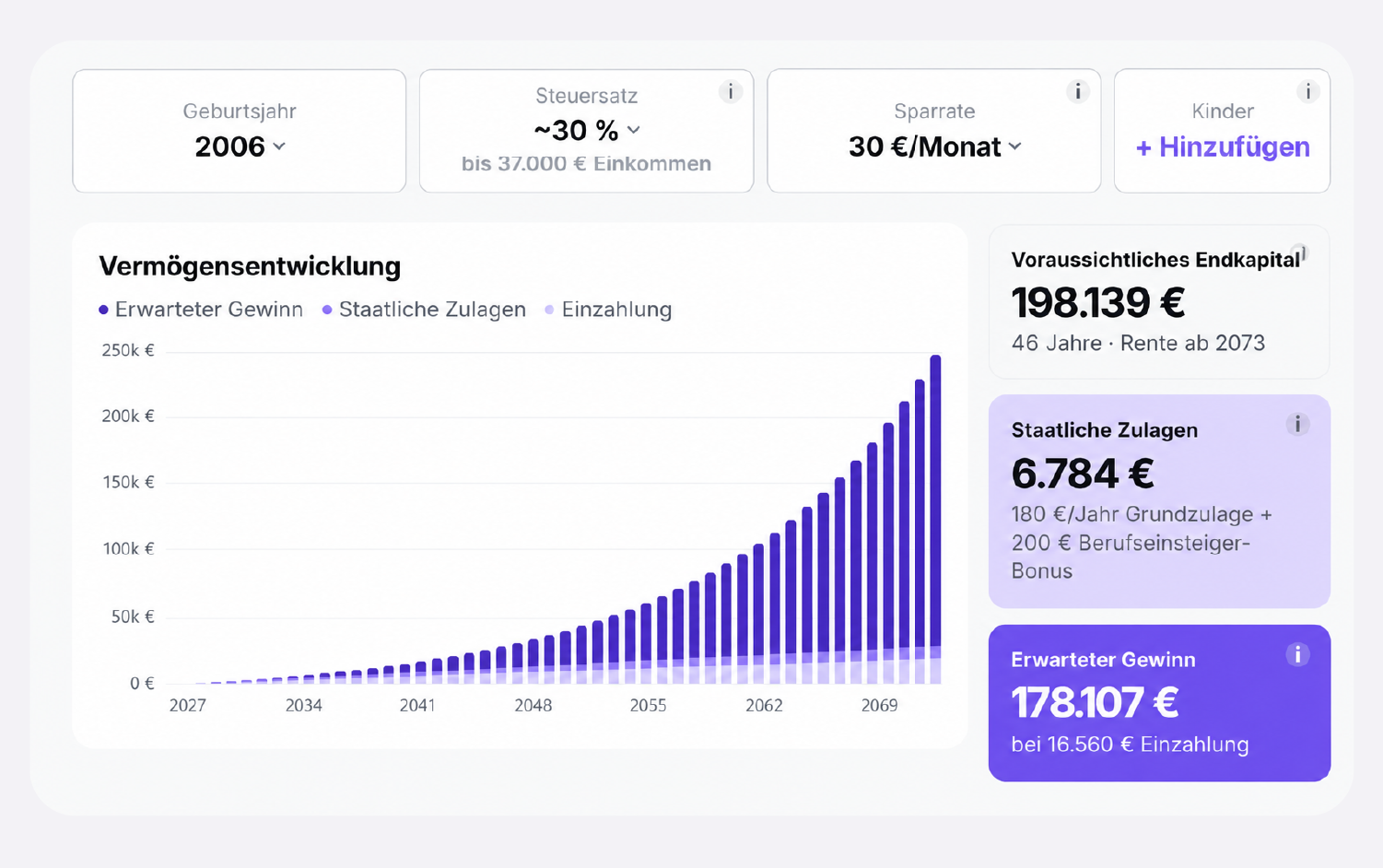
In the calculation, we leave aside the fact that the saver can also increase her savings amount over time. But even so, one thing is already clear: over the long term, the capital markets can be a powerful lever for building your own wealth. That is mainly due to the compound interest effect. The longer the time until retirement, the stronger its impact. If you start saving early, you can build up a respectable amount of wealth even with small amounts.
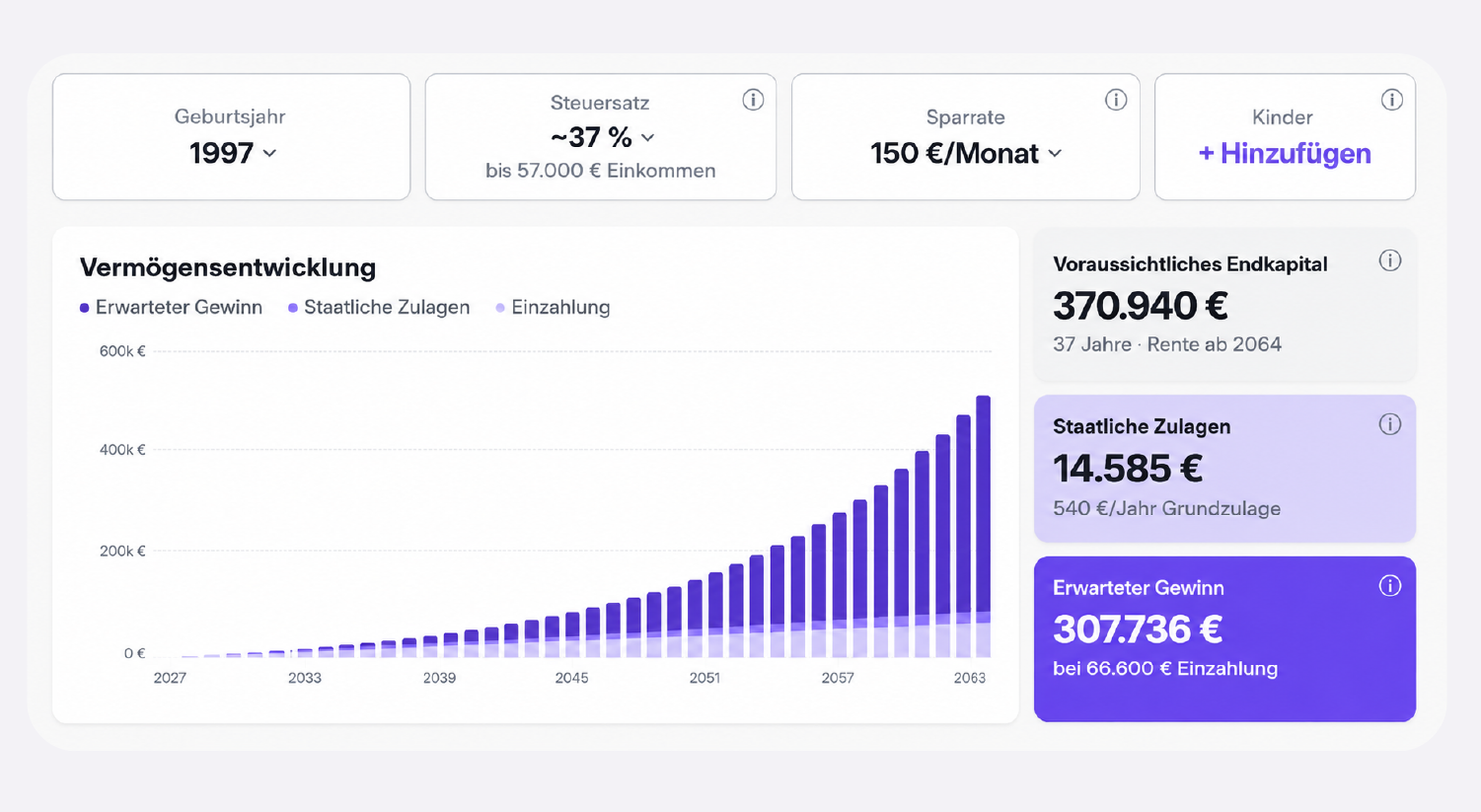
Example 2: employee, medium income (30)
In our next example, we assume a somewhat higher income. And a higher savings rate of 150 euros per month. At a maximum personal contribution of 1,800 euros per year, that is also the subsidy limit. In this case, the state adds 540 euros annually.
Example 3: family, medium income, 2 children
Families benefit particularly from the new support. Our next example shows this. The assumptions differ from the previous one in only one respect. We include two children. One was born in 2023, the other in 2026.
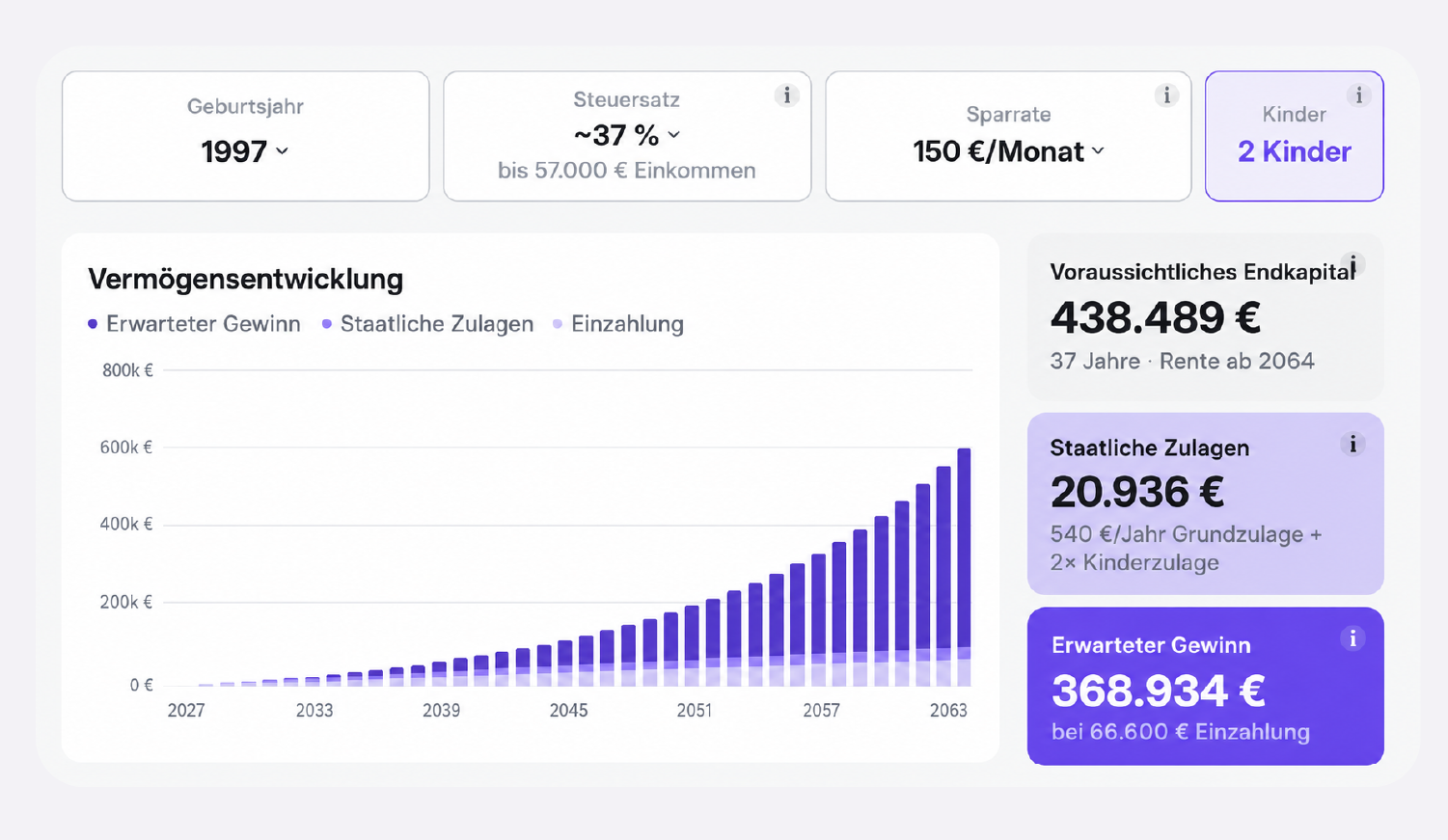
The maximum child allowance of 300 euros per child per year is available from a savings rate of just 25 euros per month. Important: the child allowance is tied to the entitlement to child benefit. That means you are only entitled to the allowance for as long as that entitlement exists.
Example 4: self-employed, high income (42)
Unlike under the old Riester model, the self-employed are also eligible for support under the new rules. So they, too, now have better options for securing their finances for old age. What's more: up to 6,840 euros per year can be paid into a retirement account – far more than is subsidized. Here is a further example calculation.
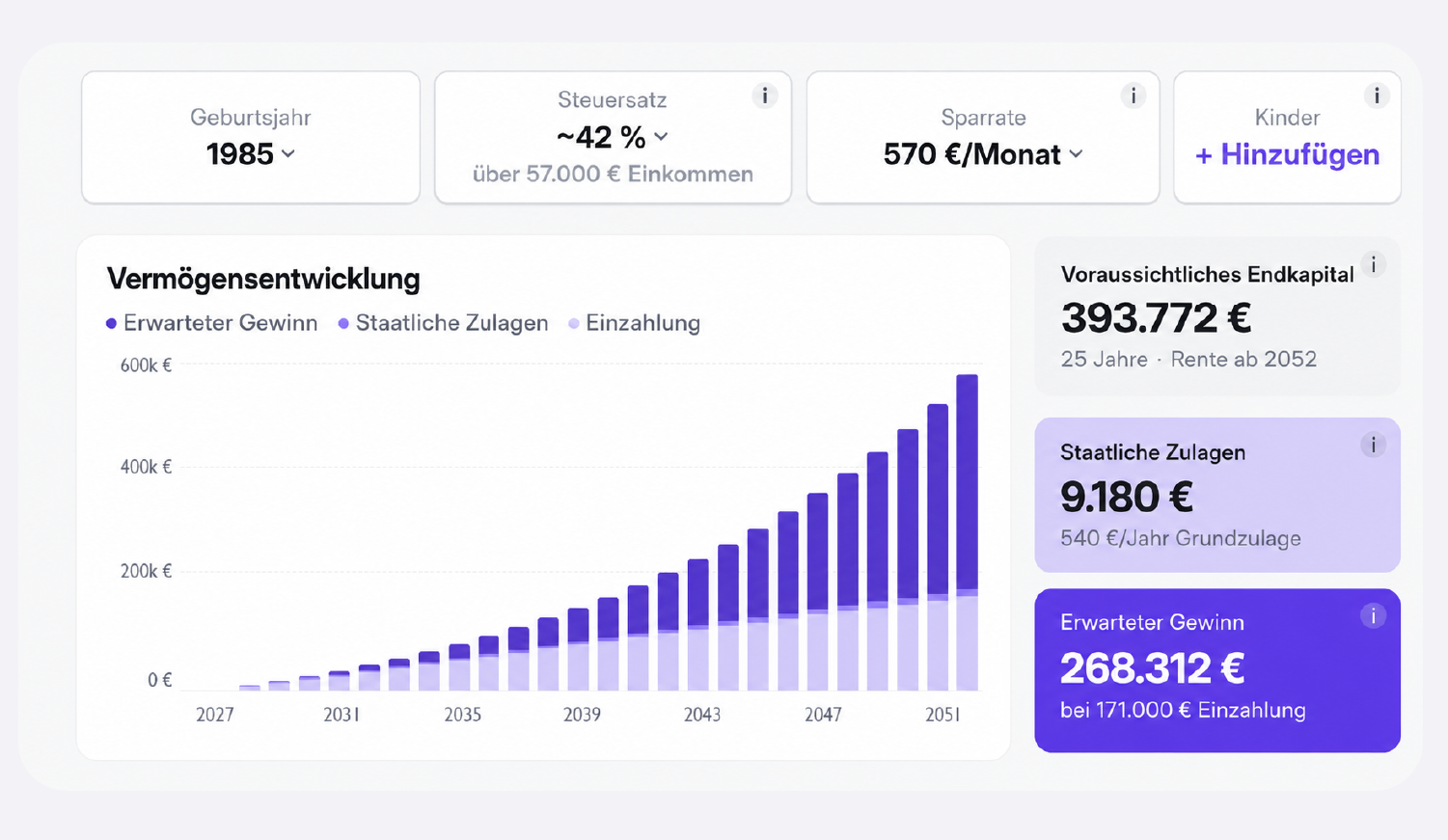
But why should you go beyond the subsidy limits? The idea: in the retirement account, no tax is due during the savings phase. The payouts are taxed later, at retirement age. By then, the individual tax rate is often lower. Until then, compound interest can unfold its full effect – all the more so, the more you bundle your retirement provision efforts in one account. That applies in any case, and not just in this example.
What you should look out for
The calculations are only meant to give a first impression. In a specific individual case, they can turn out quite differently. Among other things, that will depend on the characteristics of the product chosen. Above all, two levers will be important here: costs and diversification.
In our assessment, the cost cap of 1.0 percent for a so-called standard account is far too high. We are still fine-tuning our offering, but one thing is already certain: with us, the costs will be considerably lower. And – as in our core strategy – we will once again place great value on the broadest possible diversification. Because that is how you avoid unnecessary risks. So with our retirement account, you will be able to build up a financial cushion for old age very efficiently. That's a promise.
You can find more information and the calculator for the retirement account here.