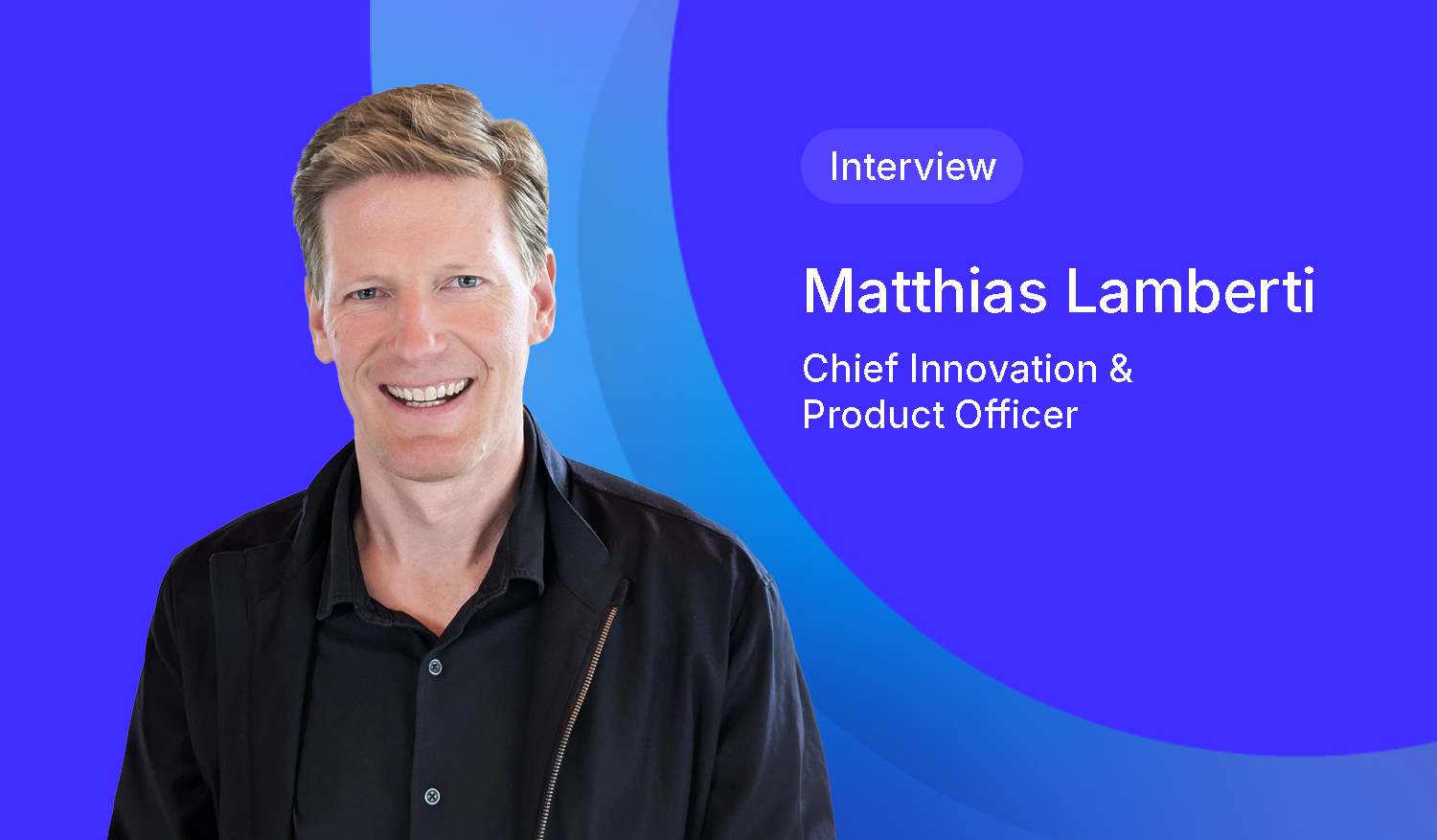
The government's reform of private retirement provision brings significant improvements for building wealth. Matthias Lamberti, our Chief Innovation & Product Officer, puts the changes in context. And gives a little preview of our offering for making use of the new incentive.
Whether it's the standard account or the cost cap: when the reform of private retirement provision comes up, plenty of new buzzwords appear. Which changes should you absolutely be aware of?
Regardless of the buzzwords, one thing above all is important: that you can finally use the capital markets as a springboard for your retirement provision. The heart of the reform – the retirement-savings account – is an invitation to everyone. Especially to people who aren't investing yet. That's the essential point.
The new incentive enables more people to harness the power of the capital markets to build their wealth. The standard account, in particular, will be especially easy to handle. What's more, its costs may not exceed a maximum of 1 percent per year. Although I can already say this much: the offerings we're currently preparing will be far more affordable.
What can you already reveal about your offerings?
We'll offer an efficient standard account. And, beyond that, a further alternative. Its investment strategy will take an approach that's a bit more refined by scientific criteria. Both offerings include our customer service , which helps investors quickly with any questions.
I can't reveal much about the details just yet. We're working on them right now. But what I can already say clearly is: there will guaranteed be no guarantee products with us.
Why no guarantee products?
A guarantee may sound like something positive at first. But the high costs of an insurance policy are a key reason why the old Riester model failed. During the saving phase, the priority has to be not burdening returns with unnecessary costs. Because over the long term especially, those costs really add up.
To illustrate the point very schematically, here's a sample calculation. Suppose I pay 100 euros a month into a savings plan. If I assume a long-term average return after costs of 7 percent per year, after 30 years I arrive at a sum of around 118,000 euros. If higher costs push the return down to just 6.5 percent, that's around 10,000 euros less.
But price fluctuations on the stock markets can sometimes be larger. Wouldn't a guarantee make sense after all for security-minded people?
No, it wouldn't. Retirement provision takes time. And over the long term, price fluctuations have evened out – at least if you invest as broadly diversified as possible and don't take on unnecessary risks. A lack of diversification and excessive costs are the real risks in investing. That's why, in our products, we place the utmost importance on avoiding both.
The very biggest risk to your finances in old age, however, is doing nothing. Another small sample calculation: suppose that, after taxes and health-insurance contributions, a respectable 3,000 euros a month is left of a pension. With inflation of 2.0 percent a year, the purchasing power of that amount will be only around 1,660 euros in 30 years.
What do you recommend to those who have so far been saving under the old Riester model?
I think it's fair that everyone can switch to the new incentive if they want to. And carry on saving in a retirement-savings account. What's best in any individual case can't be said across the board. It depends, for example, on how much time is left until retirement. The longer the period, the more worthwhile a switch to the new retirement-savings accounts will be.
We're working on solutions that make it easy to determine whether switching from a Riester contract to a retirement-savings account is worthwhile. We also want to make transferring the assets very simple.
The bottom line: what do you make of the new incentive rules for private retirement provision?
The state is now genuinely making it easier to provide for old age. Suppose you set aside just one euro a day on 360 days a year. The state adds 50 cents for you every day. If you have children, there's even more. If you do this for many years and let the capital markets put your money to work in the meantime, tens of thousands of euros can add up in the end. I think that's a double gift. And, wherever it's at all possible, you shouldn't turn it down.
Even if the rules do turn out to be quite complex in detail again …
That's true. The new rules won't entirely prevent products with opaque structures and excessive costs. But it's now up to us and to the competition to give people some orientation. And to build trust. Including among those who had a bad experience with the old Riester model.
The reform is a great opportunity. We want to do our part to help more people seize it. I know that many people still feel wary of stocks. But here's the thing: we deal with the companies these stocks come from quite casually every day. We order from Amazon as a matter of course, post our news on Instagram and the like, chat on WhatsApp or meet up on Teams. These companies make hefty profits from it. Through investing in the stock markets, we have the chance to share in those profits. And that's easier than most people think.
You can find out what the new incentive means for you here.