







Lump-sum investment vs. savings plan: what does the decision depend on?
The decision between a one-off purchase of ETFs or a savings plan is closely linked to your financial starting position. As a general rule: as soon as you have a larger sum of money at your free disposal that you will not need for a while, there is nothing to stop you investing it in full right away. Many investors, however, encounter a certain psychological barrier here.
Let us take a closer look at the two options lump-sum investment and savings plan.
Buying ETFs: the lump-sum investment
With an ETF lump-sum investment, you invest any amount as a one-off in one or more ETFs. Usually, this one-off amount is a larger sum that you will not need in the coming years. A lump-sum investment therefore makes sense above all for investors who already have a certain amount of capital at their free disposal and wish to invest it on the capital market.
The right time to get started
The question of the right time to invest particularly concerns investors who invest as a one-off. Many are afraid of price losses shortly after their ETF purchase. Yet you should never lose sight of the following: ultimately, the world economy has always trended upwards over the long term so far, even if this growth has been interrupted by crises along the way. No one knows the optimal entry point in advance. The most important thing is to get started at all!
This helps against the psychological barrier
Investing a large sum all at once can feel unsettling at first. If you notice that this barrier keeps causing you to put off your investment, the following tip will help: Split your investment into 2–3 tranches. You invest these partial sums one month apart. It is important here that you really do invest on your set dates – do not let current prices dissuade you under any circumstances!
Do not hesitate for too long: Do not spread your investment over a period of more than 6 months. Studies show that by stretching out your investment in this way, you forgo too much of the return you would have earned with an immediate investment. This loss is known as opportunity cost.
When investing, the general principle applies: the best time to get started is always now. Studies have confirmed this too. The longer you are invested, the higher your chance of a return. But the further back the entry point is pushed in time, the longer you are not invested. As the stock-market saying goes: “Time in the market beats timing the market.”
What happens if I invest at the “wrong time”?
Throughout history, the capital markets have recovered after every crisis. After 15 years at the latest, you would have been back in positive territory even at the least favourable entry point in history and would have started to generate returns. In the past, the long-term return of a broadly diversified equity ETF portfolio averaged between 7 % and 8 % per year.
For the performance of your portfolio, it is essential that you stay consistently invested. Buy and hold is therefore the motto here. If you pull your money out of the portfolio because prices are developing negatively, you not only sell at a loss but also miss out on the rising markets that, throughout history, have always followed every financial crisis.
Compound interest effect – the “return turbo”
When investing a larger sum of money as a one-off, the so-called compound interest effect can take effect immediately. It arises when the earnings generated are reinvested and in turn generate new gains themselves. With accumulating (reinvesting) ETFs, this happens automatically. In the case of a distributing ETF, the gains achieved would have to be reinvested manually.
Advantages and disadvantages of a lump-sum investment
Going into the capital market with your money straight away brings primarily advantages:
- Return turbo: With a lump-sum investment, the compound interest effect works on a larger sum of money right from the start. Historically, immediate investments therefore deliver the best returns.
- Convenient: Once invested, your money works for you and, apart from an occasional check to see whether your investment still suits your profile, you no longer have to do anything more.
- Wide choice: From a technical point of view, with a one-off investment you can buy any ETF that your broker or bank offers. The selection of ETFs eligible for savings plans is usually smaller.
So if you have a certain sum of money available, you should invest it as soon as possible, provided you are able to invest:
- Prerequisites: For a lump-sum investment, you should not need the money to be invested for other purposes in the coming years.
- Psychological barrier: Investing a large sum can lead you to want to wait for the most favourable possible entry point. Anyone who wants to invest on the capital market with a lump-sum investment must overcome this barrier, for example with the following argument: no one can predict the most favourable entry point. That is why the right time to get started is always now. Getting started later may give rise to opportunity costs (missed returns and losses of purchasing power due to not investing).
- Costs: A lump-sum investment may initially incur higher costs than executing a savings plan. This includes the product costs for ETFs, transaction costs and order fees.

Investing regularly: the ETF savings plan
An ETF savings plan is ideally suited to people who want to build up wealth over the long term and provide for the future. It is a standing order with which you invest in your ETF portfolio regularly. Once set up, the ETF savings plan automatically carries out the purchases at the amount you have chosen. Since it is especially important to stay invested during turbulent market phases, a savings plan offers a practical form of automation for savings discipline.
The compound interest effect also applies to an ETF savings plan. However, more slowly and with a delay, since the capital in the portfolio only builds up over time. How much, when and how regularly you pay into the savings plan can be flexibly adjusted at any time to suit your circumstances. Pausing the savings plan is also possible.
Good to know: An ETF savings plan is very well suited to people who can regularly invest a certain portion of their income. Monthly execution is therefore possible for most people.
Cost-average effect – the balancing factor
Especially with securities that are prone to fluctuation, you benefit from the so-called cost-average effect. Thanks to this, the question of the right time to buy does not even arise for ETF savers. Since you invest regularly with an ETF savings plan, for example always on the first of the month, you buy the units sometimes at higher, sometimes at lower prices.
In doing so, you acquire fewer units the higher the price is (when the respective units are more expensive) and at the same time more units when prices fall (that is, when they are cheaper). Over time, this results in an average purchase price.
Advantages and disadvantages of an ETF savings plan
Anyone who wants to build up wealth and has a regular income is very well served by an ETF savings plan:
- Strong returns: No other asset class offers such high return prospects as equities. The risk of price fluctuations can also be reduced with broadly diversified equity ETFs. A further adjustment to your personal risk profile is possible by adding bonds.
- Cost-effective: You can build up wealth over the long term with even small savings instalments (from €25). Execution of the savings plan is free of charge with many providers, or at least very inexpensive.
- Versatility: An ETF savings plan is suitable both for investors who are still looking to build up wealth and for those who wish to invest their wealth for their own retirement provision or for their children or grandchildren.
- Flexibility: Increasing or decreasing the savings amount, adjusting the savings intervals or even pausing the payments for a certain period: all of this is easily possible with an ETF savings plan.
However, the compound interest effect works more slowly with an ETF savings plan than with a one-off investment of a large sum of money:
- Delayed return: The compound interest effect only becomes really noticeable after a few years. But then it really picks up momentum → exponential growth.
- Choice of options: Not every ETF is eligible for a savings plan – check with your respective broker or bank about this.
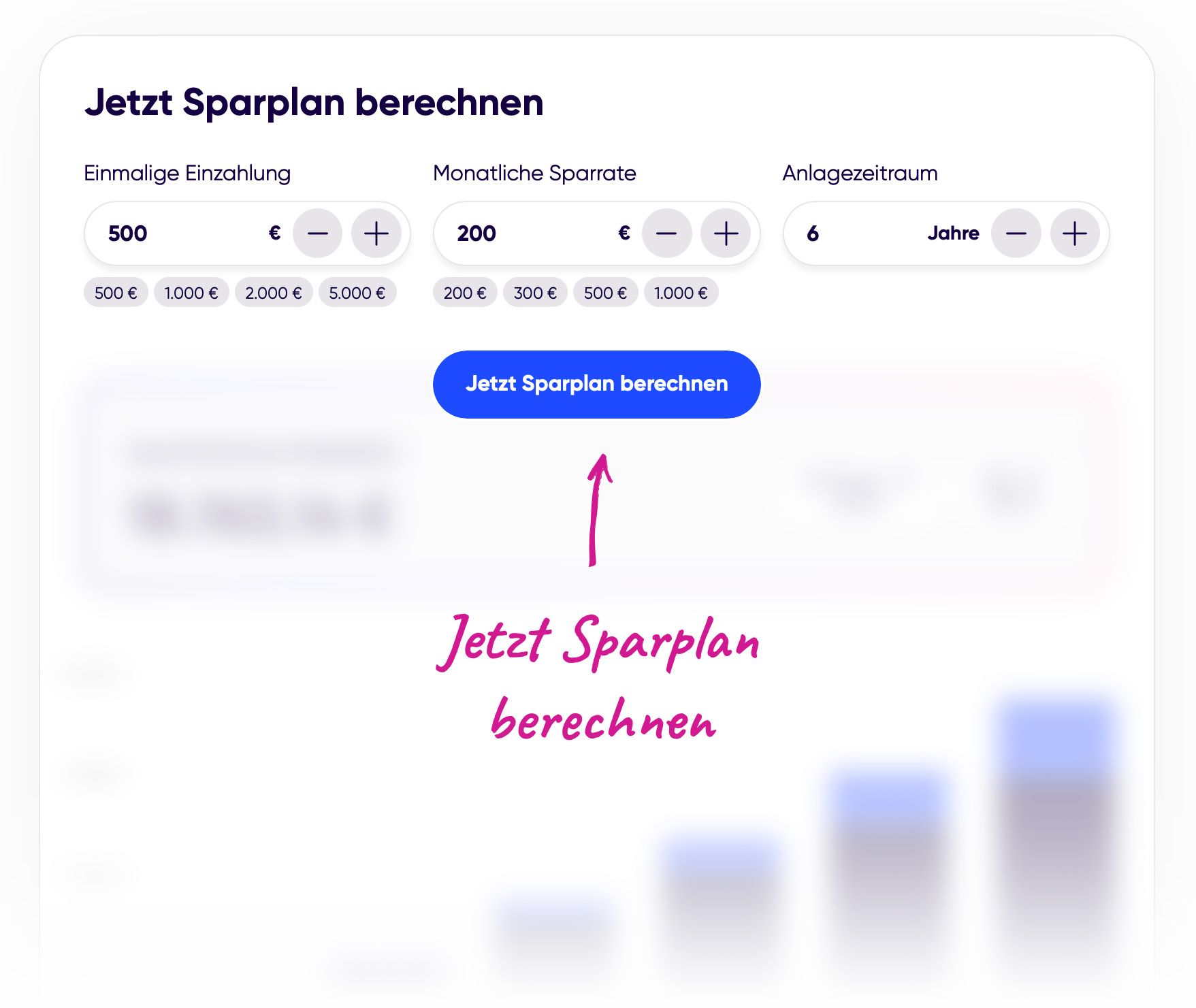
With the handy savings plan calculator from quirion, you can find out in just a few clicks how your investments might develop depending on the investment period and the capital invested.
Lump-sum investment vs. savings plan: which suits you better?
Whether a lump-sum investment or a savings plan is the right choice for you depends on your personal situation, your freely available wealth and your risk tolerance.
The lump-sum investment is an option, if you …
- … already have a certain sum of money available that you do not need for other purposes,
- ... can and want to invest straight away,
- … do not want to set up a standing order for your investment and
- … are not worried about a possibly unfavourable entry point. If you are: split your lump-sum investment into three to six equal monthly payments.
An ETF savings plan is a solution if you …
- … want to build up wealth over the long term with ETFs,
- … can and want to invest smaller amounts regularly,
- … want to save in small steps for your own retirement provision or for your children/grandchildren and
- … want a flexible investment that you can adjust at any time to your current life circumstances.
If you are not yet entirely sure which option suits you better, you can also ask yourself the following questions.
Good to know: With both the lump-sum investment and the savings plan, the buy-and-hold strategy – that is, buying and staying invested for as long as possible – pays off over the long term.
Combining a lump-sum investment and a savings plan
Do you want to combine the advantages of a lump-sum investment and a savings plan? At quirion, you can both make a one-off investment and set up an ETF savings plan. In addition, it is of course also possible to invest larger amounts into an existing savings plan on one or more occasions.
The quirion app
Conclusion: ETF lump-sum investment or savings plan
Whether you invest your money by means of a lump-sum investment or an ETF savings plan: what matters is the fact that you invest. The sooner your money can work for you, the better. If you already have a freely available sum of money, you can in principle invest it immediately as a lump-sum investment. If the aim is first to build up wealth, an ETF savings plan is the ideal instrument for this.
At quirion, you invest with a broadly diversified ETF portfolio in up to 8,000 equities and 3,000 bonds – whether via a lump-sum investment, a savings plan or a combination of both.
Opening an account with quirion is this easy:
Registrieren
Open an account
Deposit money
Claim your welcome bonus
Auf Rendite freuen!