






Why private retirement provision is so important
In Germany, retirement provision is based on three pillars: the statutory, the occupational and the private pension. The statutory pension insurance is financed by the contributions of employees covered by pension insurance (and, by now, also by a federal subsidy). This pay-as-you-go system was introduced with the pension reform in 1957. At the time, this made perfect sense: after all, for every person in retirement there were a full six contributors.
Over the past decades, however, the demographics in Germany have changed considerably. By now, 1.8 contributors bear the pension for one person. So that the retirement age does not have to be raised massively, there is only one option: the payout amounts from the statutory pension fall.
What can you expect from the statutory pension?
In connection with the statutory pension, there is frequent talk of the pension gap and the pension level. On average, pensioners in Germany receive around 48 % of the nationwide average salary from employment paid out as their pension.
Pension gap: The difference between your last net salary before retirement and the pension you ultimately receive. The pension gap is given as a specific euro amount.
Pension level: The amount of the statutory pension (based on 45 years of contributions and an average income) in relation to the average income from employment in Germany. In the calculation, both figures are reduced by the applicable social security contributions (health and long-term care insurance, and for income additionally unemployment and pension insurance). The pension level is given as a percentage.
Private retirement provision: an overview of the options
Whether, for example, Riester, a private pension insurance or ETFs: in Germany you have various options for private retirement provision available. To decide how you would like to provide for your old age privately, you ideally compare the following points:
- expected return in relation to the risk,
- ongoing costs of the provision product,
- protection of your capital and
- flexibility and availability of your assets.
In the following table, we have summarised the key characteristics of various investment options for you.
How well are ETFs suited to retirement provision?
ETFs (Exchange Traded Funds) are suitable for private retirement provision, especially when they track equity indices, such as the MSCI World. You then automatically benefit from the performance of the companies contained in each of them. Well-calculable risks and return opportunities arise above all when you invest over a longer period in an ETF portfolio that is as broadly diversified as possible.
As a general rule: A convenient and easy-to-understand private retirement provision makes disciplined saving easier. And the earlier you start with your own retirement provision, the better.
Retirement provision with ETFs: how does it work?
If you want to provide for your own pension with ETFs, an ETF savings plan is a good option. With an ETF savings plan, you invest via a standing order at regular intervals in an ETF or – even better – in a mix of various ETFs. That is, a whole ETF portfolio. For this, you first need a securities account. You can open this easily at quirion and conclude a low-cost contract for your asset management.
Particularly practical: With the quirion retirement provision account, the allocation of assets between equity ETFs and bond ETFs is automatically adjusted to your stage of life. In the accumulation phase, a higher equity share provides greater return opportunities, while in the withdrawal phase the share of bonds increases.
Opening an account with quirion is this easy:
Registrieren
Open an account
Deposit money
Claim your welcome bonus
Auf Rendite freuen!
ETF savings plan: simple, flexible and safe
With an ETF savings plan for retirement provision, you benefit from three key advantages over other forms of investment: ETFs are generally simple, flexible and low-cost.
Simple
With an ETF savings plan, you can simply select which amount you want to invest and when it should be debited. Typically, an ETF savings plan is executed monthly or quarterly. This automatic mechanism makes savings plans the ideal instrument for efficient retirement provision. Once set up, you invest your money automatically and at regular intervals, so that it can work for you in the background and generate a return over the long term¹.
Savings plan or lump-sum investment: In principle, you can also invest in ETFs with a lump-sum investment instead of via a savings plan. For a one-off investment, a larger sum of money that you have at your free disposal can be useful. An ETF savings plan is particularly interesting if you first want to build up assets in small steps.
Find out more about this in our article Lump-sum investment vs. savings plan >>
Flexible
A major advantage of ETF savings plans lies in their flexibility. You can increase or reduce your savings amount at any time. Pausing the savings plan is also possible at any time, so that you can temporarily suspend the contributions. Your assets are accessible to you at any time and the savings plan can – even though we would not recommend it – be dissolved early. That means you can sell the ETFs and have the proceeds paid out to you.
This flexibility distinguishes ETF savings plans significantly from other provision products, where your money is often only available to you at retirement.
Safe
Out of concern about falling prices, some people are somewhat reluctant to venture into the capital market. It is true that even with a broadly diversified equity investment there have been very significant price setbacks now and again throughout history. Historically, however, the global equity market has so far always recovered after every crisis, often faster than generally expected. As long as companies can generate profits within a market-economy framework and thereby create growth, experts continue to expect attractive long-term returns. In addition, equity ETFs can be combined with bond ETFs in a savings plan, which as a rule cushions price fluctuations.
Another important point with regard to safety: investments in ETFs count as so-called segregated fund assets. This means that your capital investments are protected against insolvency of the fund companies. ETFs are also – like securities and bonds in your securities account – your personal property, and remain so even in the unlikely event of your bank's insolvency.
How much money should you save for retirement?
How much money you should regularly set aside for your retirement provision depends, among other things, on the size of the pension gap you want to close. The following questions will help you with this.
What net income do you need in retirement?
Is your current net income enough to be able to live without worries? How high will your expenses be in retirement? As a rule of thumb, in retirement you need around 80% of your previous net income to be able to maintain your previous standard of living.
How large is your pension gap?
Next, you should know what payouts you can expect from the statutory (and occupational) pension. With quirion's handy pension calculator, you can find out in just a few steps what payout amount you can count on in your retirement.
How much do I need to close this pension gap?
You know how much pension you will receive and how much you would actually need? The difference between them is the amount for which you should additionally make private provision.
Example calculation:
Net payout from the statutory (and occupational pension): 1,500 €
Net income required to maintain your standard of living: 2,000 €
Amount you would have to provide for yourself: 500 €
You will now want to build up assets that allow you to pay yourself out 500 € net per month from the start of retirement. Bear in mind that the average life expectancy from retirement in Germany is 20.5 years and that inflation will reduce purchasing power with each passing year.
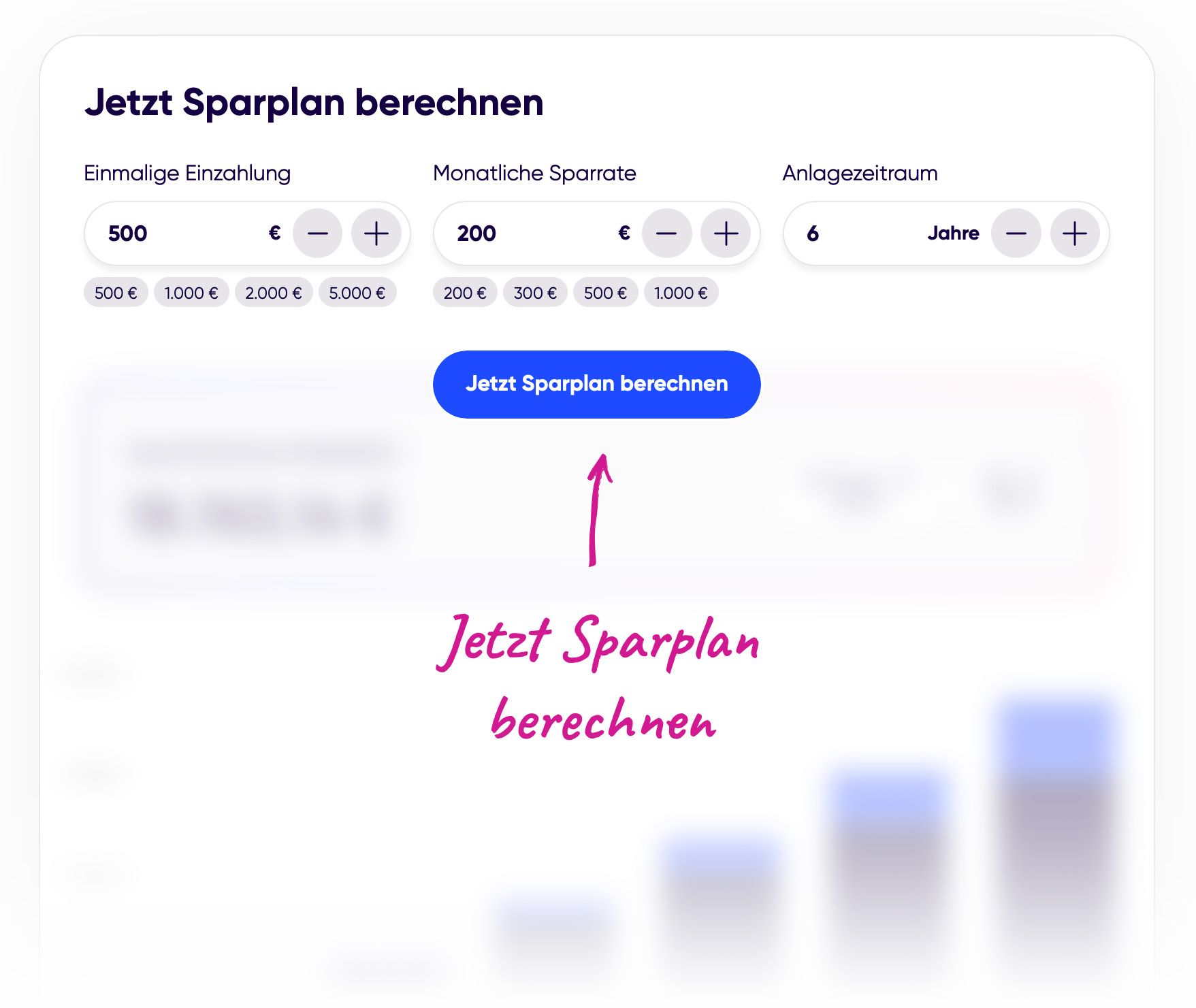
Tip: With quirion's ETF savings plan calculator, you can easily simulate how your savings plan would develop over various investment periods, depending on the size of your contribution.
Further tips for determining your savings amount
For effective wealth building, you ideally invest 10–20 % of your net income into your ETF portfolio. The exact savings rate ultimately depends, of course, on your individual circumstances. It is important that you can really do without the invested money and will not need it in the near future.
You should ideally pay off any outstanding loans before your investment. It is also advisable to have an “emergency fund” of at least 3 net salaries available to you for unexpectedly necessary expenses. This way you ensure that you do not have to tap into your portfolio at short notice and that you can save over the long term without financial disadvantages.
As a general rule: Anything is better than not investing. Even with smaller amounts, you can build up considerable assets over a long investment horizon. At quirion, you can therefore save from as little as 25 € per month.
Which ETFs are suitable for retirement provision?
Equity ETFs can form the foundation for retirement provision, as they represent a part of the capital market and this is where the highest return opportunities exist. To limit the risk as effectively as possible, it is important to invest with broad diversification. It would be ideal to represent the entire global capital market, but that is impossible because of the sheer number of shares. The goal should therefore be to find an index with the broadest possible diversification. The MSCI All Country World Index, for example, contains shares of over 2,600 companies from 23 industrialised countries and 24 emerging markets. Even better, however, is to invest in an ETF portfolio made up of various ETFs, as is possible at quirion. quirion's global ETF portfolio takes scientific findings into account. As a result – compared with ETFs that only track a single index – further unnecessary risks can be avoided (e.g. too strong a weighting towards the USA).
Another important factor for retirement provision is bond ETFs. These are less prone to fluctuation than shares and therefore bring calm to the portfolio. This becomes more relevant the closer the start of retirement approaches. Bond ETFs then temper the ups and downs of the more volatile equity ETFs.

Retirement provision with ETFs: tips for every age group
Fundamentally, it is never too late to invest in ETFs, even when it comes to retirement provision. Depending on which stage of life you are currently in, however, you can approach the topic of ETFs for retirement provision in different ways. You can adjust both your equity-to-bond ratio and your savings amount at any time.
For investors just after starting their career
The earlier, the better – especially young people who are at the beginning of their working life can make full use of the long term of an ETF savings plan up to retirement. And right at the start, even small contributions are enough, since the compound interest effect¹ can work over a very long period. For young, risk-affine investors, a very high equity share can be suitable. There are then high return opportunities in the portfolio.
For investors aged 40 and over
Anyone who is already in the middle of life and is engaging with the topic of private retirement provision for the first time is by no means too late. Many people at this stage of life already have more financial means than in earlier years. Possibly there is an inheritance that can be invested as a lump-sum investment. Anyone who starts an ETF savings plan at 40 or over ideally chooses a higher savings amount than someone just starting their career.
Alongside the investment amount, the investment period is also important. Just 5 years more or less can have a significant impact due to the exponential compound interest effect. In this stage of life, too, a high equity share is certainly still a good option for wealth building, whereby bonds can also be added entirely according to your own sense of risk and risk-bearing capacity.
For pensioners
Are ETFs still relevant for people who are already in retirement? Absolutely – after all, the average life expectancy after retirement in Germany is 20.5 years. This is more than enough time for a positive increase in value in the portfolio.
The closer you get to the withdrawal phase, the more sensible bonds or bond ETFs become. With bonds, you prevent negative price developments at the moment of need from significantly diminishing your assets. In smaller doses, however, shares can still be a valuable portfolio component even in the withdrawal phase².
For the next generation
Independently of your own retirement provision, you can also use an ETF savings plan to do something financially good for your children or grandchildren. Even small contributions, for example 50 € a month, can work true wonders here over the long term. If you want to give away or bequeath an ETF savings plan, a high equity share can be sensible even at an advanced age, in order to build up assets for the next generation.
Investing for children: Anyone who wants to save for their own descendants has various options to choose from. An ETF savings plan can lay a valuable foundation for the financial future of the next generation.
Find out more about this in our article on investing for children >>
Good to know: Thanks to the statutory deposit guarantee, amounts of up to 100,000 € in your current or instant-access savings account are protected against a possible insolvency of the bank. For amounts above this value, the statutory deposit guarantee no longer applies. Bear this in mind should you ever want to take larger amounts out of your securities account.
Conclusion: closing the pension gap with ETFs
ETFs offer you a simple and flexible way to provide privately for your pension. With a broadly diversified ETF portfolio, you can build up assets to close your pension gap, especially with a longer investment horizon. With quirion, you can invest in ETFs in a relaxed and low-cost way, without having to become a financial professional yourself.
In vier Schritten zu deinem persönlichen ETF-Sparplan:
Get an investment proposal
Open an account
Set up a savings plan and deposit money
Auf Rendite freuen!
¹ Example: return of the MSCI World (in euros, including dividends) over the past 30 years (as at 31.12.2024) = 8.73 % p.a. Retirement provision. Once set up, you invest your money automatically and at regular intervals, so that it can work for you in the background and generate a return over the long term.
2 Generated income is reinvested and, over the long term, likewise generates income. If you want to give away or bequeath an ETF savings plan, a high equity share is in principle also advisable even at an advanced age, in order to effectively build up assets for the next generation.