






Investing 10,000 euros in ETFs: the basics
If you want to invest 10,000 euros in ETFs, there are a whole range of options, which we discuss below.
To begin with, however, investors should think about the following 3 basic rules of investing:
- Define your investment goals: What do you want to achieve with your investment? Do you want to protect your capital (e.g. against inflation)? Provide for your retirement? Build up assets for a particular purchase?
- Determine your investment horizon: How long do you want to invest your money? The longer the investment is held, the smaller the fluctuations (and thus the risks) in your portfolio become.
- Risk appetite: How much risk are you prepared to take? It is important to bear in mind that attractive returns always come with a certain amount of risk.
Good to know: Investments in ETFs fluctuate continuously and are always associated with certain risks. Broad diversification does, however, help to reduce these risks. At quirion, for example, diversification takes place not only through the use of ETFs but also at the portfolio level: worldwide diversification cushions the risks of individual markets.
1. Implementation options: lump sum or savings plan?
If you have 10,000 euros available in liquid form, the answer to this question is actually fairly clear-cut, because it has been examined by financial scientists: a lump-sum investment is often better than paying the amount in over longer periods (= savings plan). This has mainly to do with the so-called opportunity costs that arise if you do not invest.
Good to know: Opportunity costs generally represent the lost benefit of an alternative that was not chosen. The specific opportunity costs of a lump-sum investment not made are missed returns and, in this connection, possibly also a loss of purchasing power due to inflation or interest rates that are too low (e.g. if the uninvested money is sitting in an instant-access savings account).
However: If investors feel more comfortable with an investment spread over time – for example three lots of 10,000 euros instead of 30,000 euros all at once – then that is acceptable too. Anything is better than not investing.
2. Investing in asset classes: equities or bonds?
Whether you invest 10,000 euros solely in equity ETFs or in a mix of equity and bond ETFs has a lot to do with your personal risk profile. While there are many gradations, a rough distinction can be drawn between these two types of investor:
- Defensive investors (prefer a portfolio with fewer fluctuations – and accept lower returns in exchange.)
- Aggressive investors (can better tolerate highly fluctuating investments – and in exchange have the chance of higher returns.)
As a rule of thumb, the following can be noted in this respect:
- Defensive investors invest in equity ETFs but cushion their stronger fluctuations with a higher bond-ETF ratio (e.g. with a share of 70%).
- Aggressive investors do well with a high equity allocation of up to 100%.
Save with the test winner
3. Basic rules of investing [table]
Below you can see the most important basic rules of investing that investors should be sure to observe before making an investment in equity or bond ETFs.
Investing 10,000 euros in equity ETFs
For an optimised portfolio, investors should select only ETFs that, taken together, invest as broadly as possible across the whole world, across as many sectors as possible and in companies of varying sizes. Unfortunately, a single ETF is not enough for this, because important segments of the global equity market are then given too little weight or not covered at all – such as smaller secondary stocks (small caps), emerging-market equities, value stocks and much more.
Equity funds deliver attractive returns over the long term, at higher risk
With equity ETFs, investors are deliberately backing the value creation of the economy. When the global economy grows (e.g. through trade, investment, innovation and so on), this is reflected in rising revenues and profits. However, this principle does not apply to every single company, which is why it is important to invest in the broad market.
As a general rule: equity ETFs are the return driver in every portfolio. Since companies can go bankrupt at any time (example: Wirecard) and market situations can change abruptly (see coronavirus), equities always carry the risk of losses. The shorter the investment period and the narrower the diversification within the portfolio, the higher these risks are.
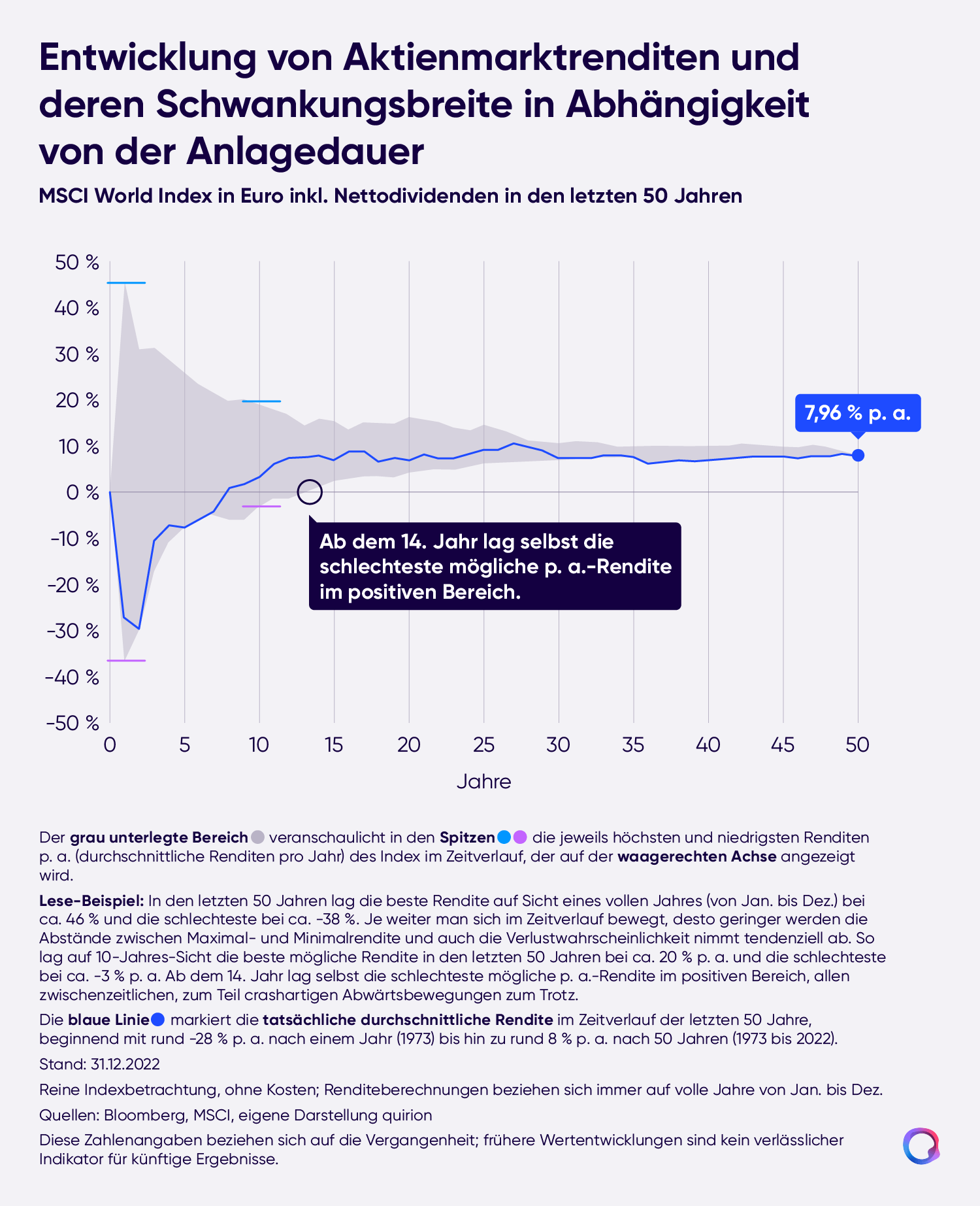
Long investment periods protect against losses
Earning a return with equities works over the long term. In addition to spreading investments as broadly as possible, investing over the longest possible periods also brings about a noticeable reduction in risks, that is, in price fluctuations.
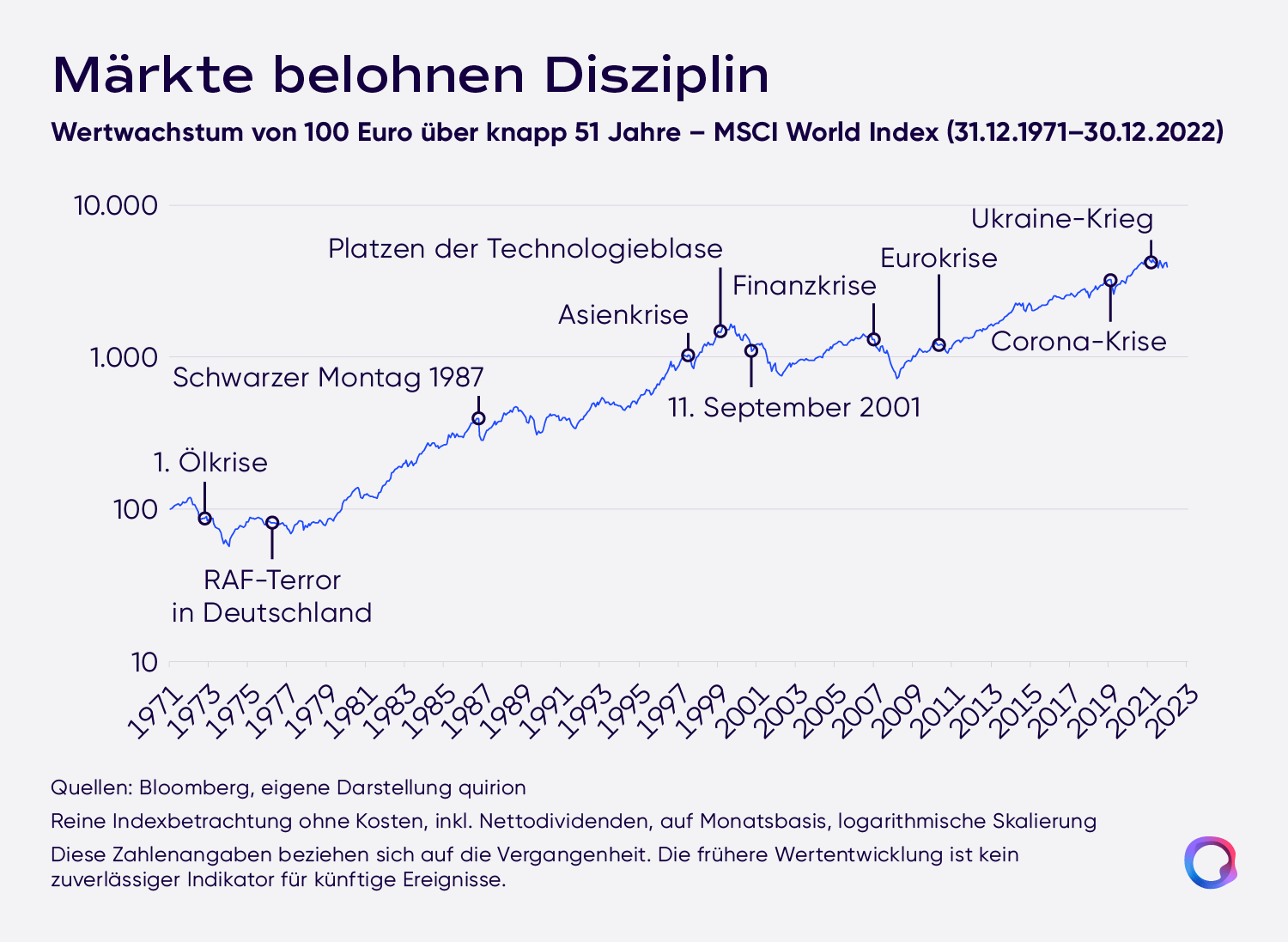
The decisive factor for a successful investment is therefore always the investment period as well, because the markets reward the discipline of sticking with the strategy originally chosen even through lean periods (buy-and-hold):
Diversification increases the chances of a return
From the perspective of all investable markets, you should in particular take these three levels into account:
- Countries: Invest as broadly as possible across developed and emerging markets
(Asia, Europe, emerging markets, North America and so on) - Sectors: Invest in as many industries as possible
(technology, finance, healthcare, consumer goods, real estate, etc.) - Company size: Investments in companies of varying sizes
(small caps, mid caps, large caps / blue chips)
Good to know: At quirion, investors invest in around 8,000 companies worldwide – across all regions, industries and company sizes.
>>> Find out more in the guide on diversification
100% equity allocation – which investors is it suitable for?
Aggressive investors who can tolerate strong fluctuations in the markets and who trust that a long investment horizon will pay off in the end – the key word being buy-and-hold – can consider a portfolio with an equity allocation of up to 100%.
Equities – broadly diversified – are, after all, the ultimate return driver over the long term.
Expert tip: We generally advise against investing solely in thematic ETFs, commodity ETFs or real-estate ETFs. Unlike a worldwide equity investment, the scope for broad diversification is limited and the risk of loss is high.
Investing 10,000 euros in bond ETFs
In the case of bonds, the central banks' key interest rate hikes between 2022 and 2023 raised the yield level considerably, which brings increased earnings opportunities. This means that bond ETFs can once again better fulfil their traditional role – as an anchor of stability – within a diversified portfolio.
Bonds deliver smaller returns at lower risk
It is important to emphasise here that bond ETFs serve primarily as a risk buffer within an investment made up of equity funds. They do not represent an alternative to equities – as the return driver in the portfolio!
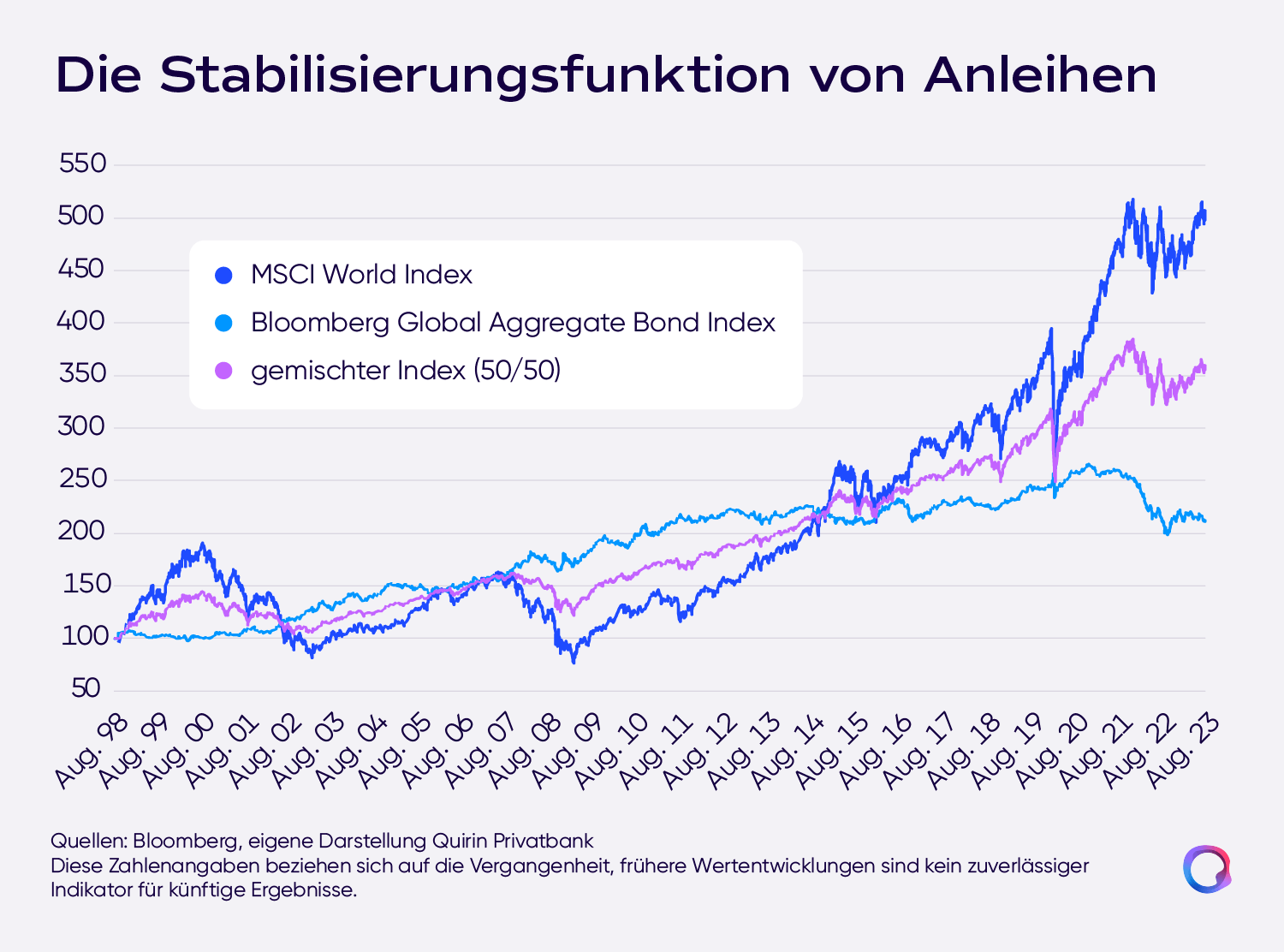
Good to know: Bonds are generally not significant return drivers, but they bring stability (or calm) to the portfolio, which is an advantage for less risk-tolerant investors. Bonds can also deliver certain returns that may offset inflation, but far more decisive is their function as a "stabiliser" or "cushion" for the more volatile equity component.
Which bond allocation suits which type of investor?
Defensive investors who do NOT cope well with (larger) losses and who are made nervous by big swings between gains and losses should not, when building their portfolio, rely 100% on volatile equities; instead they should add a noticeable proportion of bond ETFs, because this asset class brings more calm to the portfolio.
Bonds are now (more) attractive again
Since the end of 2021, inflation in Europe increased sharply, meaning that the prices of products and services rose strongly. In October 2022, the annual inflation rate in the euro area reached a peak of over 10%. Although inflation has been falling since 2023, it is still at an above-average level.
The European Central Bank made several interest rate hikes to counteract the erosion of the currency's value.
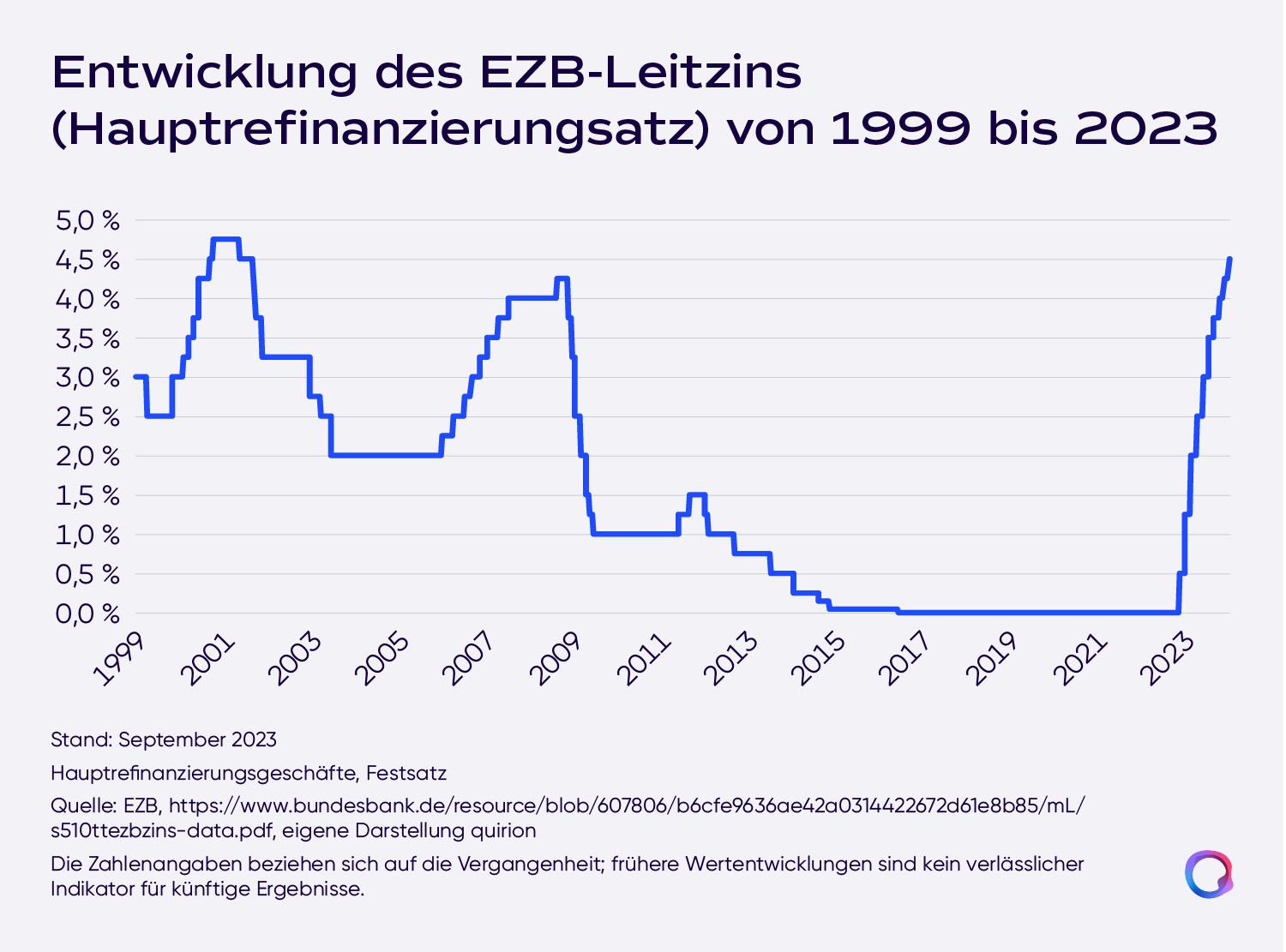
The sharp rise in interest rates in 2022 caused comparatively high price losses in the bond segment and meant that the risk-buffer function could exceptionally not be fulfilled in 2022. But before the interest rate turnaround, that is, before 2022, bond ETFs were as a rule at least a good stabiliser at relatively low performance.
Now that the central banks have raised key interest rates, achievable bond yields have risen sharply again, making these securities considerably more attractive.
Are there sensible alternatives to equities and bonds in 2024?
Despite the interest rate turnaround, even in 2024 there are no genuine alternatives to an investment in broadly diversified equity and bond ETFs.
Invest in fixed-term or instant-access deposits?
Instant-access or fixed-term deposit accounts are a popular form of investment, because they carry no price risks and the return is virtually "guaranteed", i.e. known in advance. In addition, the money – thanks to what is known as deposit protection – is legally protected at German banks. This means that, in the event of a bank's insolvency, investors are protected up to a certain amount.
Compared with equities or bonds, instant-access deposit accounts are of course less risky. They offer a guaranteed rate of interest and daily availability, which for many investors may initially be an important criterion.
However, it must be emphasised that, despite the 2022/2023 interest rate turnaround, the interest on instant-access and fixed-term deposit accounts is usually still so low that investors cannot generate sufficiently high returns with this form of investment to offset inflation. Even if inflation falls back into the central banks' target range of 2%, a genuinely useful overcompensation of inflation by means of instant-access deposits will as a rule scarcely be possible.
With a worldwide equity portfolio, for which you can assume a long-term average of around 7% p.a.1, preserving purchasing power succeeds considerably better.
Invest in gold?
If you take a closer look at the development of the gold price, the following factors, among others, play a major role:
- The supply situation in the producing countries
- Demand for physical gold
- The exchange-rate development of the dollar against the euro
For many investors, gold is rather unattractive, since it yields neither dividends nor interest. In the past, gold also proved to be a speculative investment, fluctuated strongly and certainly went through longer and painful loss phases too. To a certain extent, however, gold investments can contribute to spreading risk.
Good to know: Unlike equities and bonds, gold does not participate in the value creation of the global economy, so it is not a "productive" asset. That is why quirion does not invest in gold either. At quirion, stabilisation within the portfolio is achieved through bonds.
Invest in cryptocurrencies?
Whether Bitcoin, Dogecoin or Ethereum: cryptocurrencies are subject to extremely strong fluctuations, and a total loss can never be ruled out.
There is also the risk of suffering a total loss through hacking attacks or technical errors. So far, there is also barely any government regulation and no deposit protection for cryptocurrencies.
Before investing in cryptocurrencies, you should inform yourself thoroughly about the high risks and consider whether you are prepared to bear them. It is important that you familiarise yourself with the technical and economic fundamentals of the respective cryptocurrency and trade exclusively on reputable cryptocurrency exchanges.
As a substitute for broadly diversified equity or bond investments, the highly speculative cryptocurrencies are not suitable.
Which strategy does the robo-advisor quirion use?
Because we act as a digital asset manager, we can trade on the stock market differently from private investors and thus offer our clients attractive terms.
In the Digital package, the fee is 0.48 per cent of the investment volume per year.
This fee covers the costs of …
- managing the portfolio
- the permanent monitoring of the investments and
- the rebalancing
- the account and custody-account management
In addition, there are product costs for holding ETFs – in quirion's case an average of 0.17% p.a. These costs are not billed separately but are already factored into the prices of the ETFs by the ETF issuer. Incidentally, investors always have to bear these ongoing costs, even in self-managed custody accounts.
Equity and bond ETFs broadly diversified across the whole world
At quirion, we want to cover the global equity market as representatively as possible, because only in this way is an optimal risk-return ratio achieved.
That is why, at quirion, we make the most of the positive effects of broad diversification for our investors – by investing in around 8,000 companies worldwide. And that is across all regions, industries and company sizes. In our selection, we also take account of what are known as the "equity factors" and represent them in the optimal proportion.
Our analyses have shown that, for the broadest possible equity-market coverage – in addition to a block of standard stocks (blue chips) – the following four equity segments, also known as factors, prove to be relevant:
- Value (= stocks with a high intrinsic value)
- Low volatility (= stocks with low fluctuations in the past)
- Small caps (= stocks of smaller companies)
- Momentum (= stocks with recently strong (positive) price dynamics)
Good to know: The relationships between these individual factors are certainly complex, but not impenetrable. Based on historical performance data going back more than 20 years, our analysts develop a cost-efficient ETF portfolio for our clients. This is because, owing to the complex relationships between the factors, a single equity index – such as the MSCI World – proves to be too weak a representative of the global overall market.
>>> Find out more in the guide on diversification
With bonds too, broad risk diversification is essential. Since bond ETFs have a stabilising function within the portfolio, at quirion two-thirds of them are low-risk in nature. The average residual maturity of the bonds included is under 4 years, and they are bond issuers with good credit quality (rating AAA to BBB-).
To optimise returns, our bond portfolio additionally contains bond ETFs with long-dated government bonds of good credit quality as well as ETFs with high-yield corporate bonds of weaker credit quality.
Equity allocation matched to the investor's risk profile
quirion invests your money in a professional ETF portfolio – consisting of equity and bond ETFs – that matches your individual risk profile precisely.
Good to know: To determine the risk profile, our clients simply have to fill out an online questionnaire and then, at the touch of a button, receive an investment proposal for a suitable ETF portfolio.
The more risk-tolerant the personal profile, the higher the equity allocation tends to be. In principle, we consider equity allocations of at least 30% to be sensible, so that investors can generate any noteworthy returns at all.
Conclusion: investing 10,000 euros in equity ETFs and bond ETFs
A sensible ETF investment of 10,000 euros requires not only broad diversification across equity and bond ETFs worldwide, but also patience and good planning. Pay particular attention to the following points and you will most likely be successful on the stock market:
- Invest in a forecast-free way, in which you merely replicate the market rather than trying to beat it. So-called active management is demonstrably not sustainably successful.
- A long investment period of at least 10 years is ideal – along with disciplined perseverance in your investment strategy.
- Pay attention to the costs of your investment and invest only in products that you genuinely understand.
- The more broadly you spread your investment, the more reliably the money works for you, especially in times of crisis.
- Last but not least: before every investment, make sure that you pay off debts and build up a rainy-day fund, so that you do not have to draw on your investment in an emergency.
Good to know: At quirion, investors can invest their money indirectly, via ETFs, in around 8,000 stocks and just under 3,000 bond issuers. Given the numerous ETFs in the custody account, our asset-management fee of 0.48% p.a. is comparatively low.

____________________
1 Derived from the analysis of price time series of broadly diversified equity indices, e.g. the MSCI All Country World Index (a standard-stock index with developed and emerging-market equities), over the last 50 years across a wide variety of long-term (including rolling) periods.