







What is rebalancing? How does it work in practice? [Example]
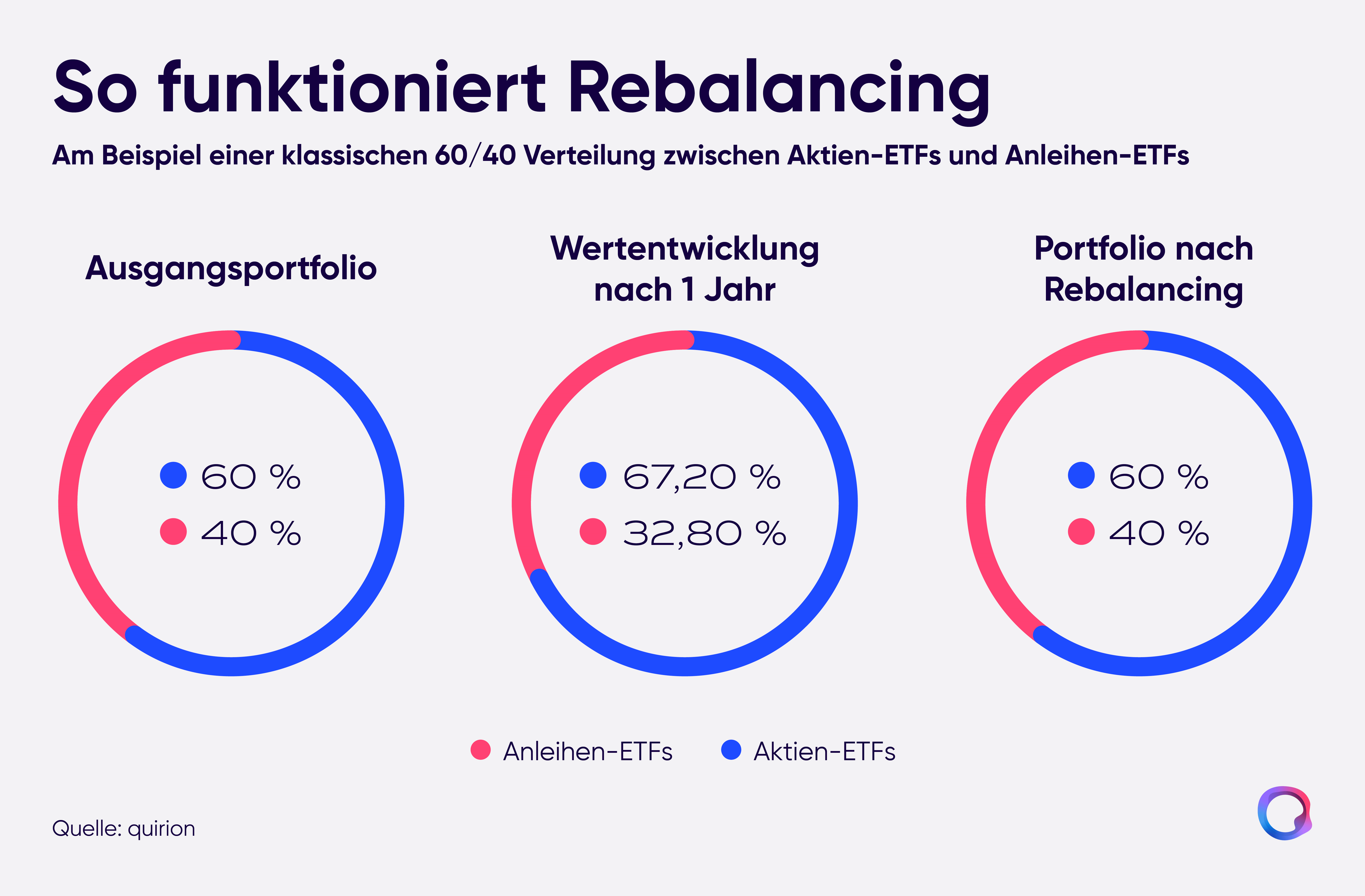
Let us assume that the risk profile determined for an investor leads to this portfolio:
- 60% equities
- 40% bonds
In the following year the equity markets perform particularly well, while bonds do rather less well. This leads to a disproportionate increase in the equity share of the portfolio. After one year, the weighting therefore looks as follows:
- 67.20% equities
- 32.80% bonds
But if investors have decided – for personal reasons – on a ratio of 60/40, the risk profile no longer fits.
The consequence? The percentage distribution within the portfolio must be corrected:
- Equity holdings are sold.
- Bond holdings are bought.
Result: the original 60/40 ratio is restored. That is exactly what rebalancing means.
Putting the terms in context: what is portfolio rebalancing? What is ETF rebalancing?
Both questions are somewhat misleading in themselves: rebalancing always takes place within a portfolio. The term portfolio rebalancing therefore always refers to conventional rebalancing as such. The terms are thus synonyms.
As more and more investors know how to take advantage of ETFs, more and more portfolios consist entirely or partly of ETFs.
The term ETF rebalancing therefore refers to portfolios containing ETFs that are regularly adjusted back to their original weighting. This does not, however, change anything about the meaning and purpose of a rules-based adjustment, that is, rebalancing.
Good to know: A portfolio that becomes riskier through a rising equity share can fluctuate more than planned. Rebalancing restores the investment ratios to their original proportions. Rebalancing is therefore important in order to achieve your personal investment goals while taking your individual risk profile into account.
Rebalancing and the return-risk profile
Price fluctuations on the securities markets mean that portfolios gradually drift further and further away from the weighting originally planned. If the equity markets rise more strongly than the bond markets, the equity ratio increases. These deviations cause shifts, including in the risk distribution.
For investors, a risk distribution could look as follows, for example:
- Portfolio #1: equity ratio 80%, bond ratio 20%
- Portfolio #2: equity ratio 70%, bond ratio 30%
- Portfolio #3: equity ratio 60%, bond ratio 40%
Each of these ETF portfolios reflects the personal return-risk profile of an investor. This opportunity-risk profile reflects the relationship between the expected return and the expected risk of the investment.
The higher the equity share, the more risk investors accept. However, higher risk also means the chance of higher gains.
Good to know: For investors, this return-risk ratio is essential, because it essentially expresses how much money you are willing to potentially lose in a worst-case scenario. As is well known, the buy-and-hold strategy only works if you can also sit out poor market phases – and that is precisely why determining your personal risk profile is important.
Save with the test winner
Why adjust the ETF weighting regularly? Good reasons for rebalancing your portfolio
As already mentioned, rebalancing serves to ensure the risk level chosen by investors themselves over the long term. In addition, rebalancing is not uncommonly accompanied by certain return or risk advantages.
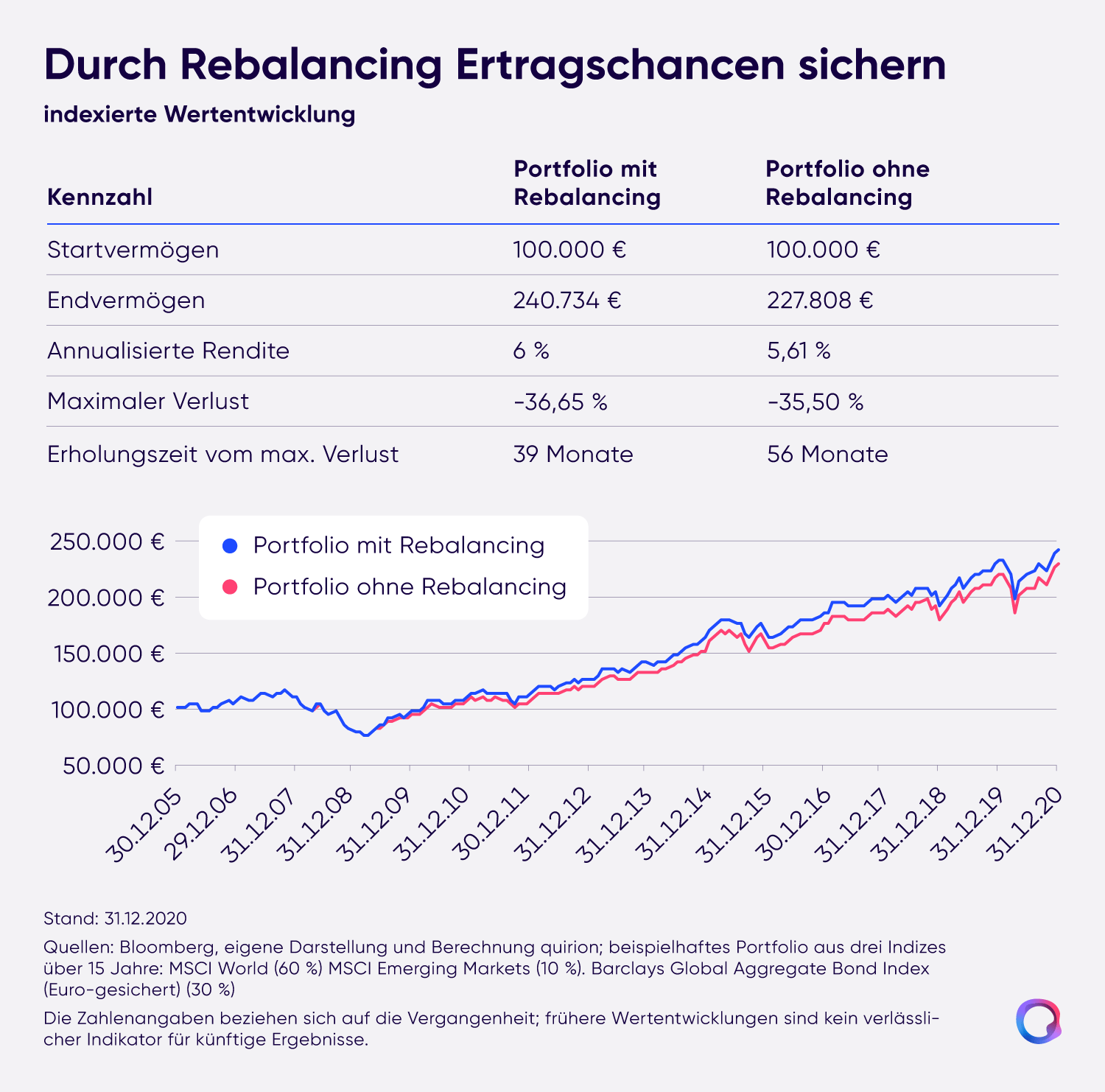
For rebalancing leads to a disciplined sale of securities after price rises and to additional purchases after losses. So you act counter-cyclically and “buy cheap” or “sell dear”. Over the long term, this can lead to return advantages – as the following chart clearly shows:
In summary, (ETF) rebalancing offers the following advantages:
- The original portfolio weighting, and thus your personal risk profile, is preserved.
- Counter-cyclical reallocation can generate more return in the long run.
- Psychologically driven poor decisions can be avoided as a result.
- Personal preferences can often only be maintained through rebalancing.
- Last but not least: consistently following a strategy over the long term is made considerably easier by rebalancing, which can ultimately also have a positive effect on returns.
Rebalancing in practice? Investors either take care of rebalancing their portfolio themselves by regularly reallocating their ETFs so that the original weighting is restored. Or investors invest through a robo-advisor that carries out rebalancing automatically – according to predefined rules – on their behalf.
What types of rebalancing are there?
For many private investors, as well as for many robo-advisors, rebalancing takes place at least once a year. In addition, in many cases rebalancing also takes place whenever the originally defined percentage shares of equities and bonds in the overall portfolio are exceeded or undershot by 10 percent. Both of these also apply to quirion.
Good to know: Only when the share of equities or bonds in the portfolio is very small do limits of 15 or even 20 percent apply at quirion.
In general, a distinction is made between two types of rebalancing:
- Time-based rebalancing
- Value-based rebalancing
#1 Time-based rebalancing
The time-based or scheduled rebalancing usually takes place once a year on a fixed date, in order to restore the original weighting within the portfolio.
This means: for all securities with above-average price gains, sales are triggered in order to eliminate the imbalances that have arisen. The sale proceeds are invested in the securities with below-average performance.
The downside of time-based rebalancing? “Chopping and changing empties your pockets”, as a stock-market adage goes. The biggest disadvantage of scheduled rebalancing is that each reallocation in the account incurs additional costs. In practice, this means weighing the costs against the benefits: time-based rebalancing is not advisable in particular when the shifts amount to only a few percent and the costs for doing so are relatively high. This can be the case above all when investors carry out the rebalancing on their own.
#2 Value-based rebalancing
The conflict just mentioned can be easily avoided with value-based rebalancing. Here you set certain rules, for example for an equity ratio of 10%:
- Upper limit: 13 percent
- Lower limit: 7 percent
If the equity ETF ratio exceeds or falls below one of the two limits mentioned, reallocation takes place (returning it to 10% in each case). It is therefore not the time period that dictates when rebalancing occurs, but selected percentage values that define the limits of the respective investments.
From what deviation from the original weighting does rebalancing make sense?
Here too, it is above all a question of costs, which differ from one account provider to another. But it is also about setting a sensible limit above which a deviation from the original investment strategy affects the desired return-risk ratio too strongly. As a rule of thumb proven in practice, the following can be stated: if the equity or bond ratio of the portfolio is more than 10% above or below the originally agreed ratio, you should act.

The financial experts Davis and Norman concluded in 1990, in a much-cited academic paper, that value-based rebalancing is more efficient than time-based rebalancing.
In summary, their recommendation for investors is:
- Depending on personal investment goals, the risk profile and the costs of the custodian bank, investors should use a range of between 5 and 10 percent as a guide value for rebalancing.
- Below a 5% deviation from the original weighting, you can quite reasonably refrain from rebalancing – especially with an eye on the costs.
- From a 10% deviation onwards, investors should consider rebalancing.
Defining the risk level of a portfolio using fixed equity and bond ratios is, not without reason, the predominant approach among digital portfolio managers.
How rebalancing works at quirion
In further academic studies, a combination of scheduled and unscheduled rebalancing has proven advantageous.
This is also how quirion proceeds. In addition, quirion carries out a rebalancing whenever investors invest or withdraw additional money – so, in effect, an event-driven rebalancing.
The advantages of this approach:
- Reallocation only takes place when it really makes sense.
- The additional event-driven rebalancing ensures that the desired risk level, in line with your personal risk profile, is largely maintained.
- The return targets and the loss risks do not shift in an undesired direction.
- Optimal cost-benefit ratio.
Good to know: At quirion, the asset management fee in the Digital package is just 0.48% p.a. on the invested capital – rebalancing is already included.
What does rebalancing cost? Is it worth it?
As a general rule: the higher the cost of rebalancing, the less often it should be carried out.
The cost of rebalancing initially depends on the executing bank. So-called “neobrokers” often advertise very low transaction fees, whereas higher fees can apply at other banks.
It is a matter of weighing things up: investors who are unsure whether they should act when the account weightings shift can do the following:
1. Calculate the costs that would arise from the reallocation.
2. Check whether the percentage shift in the account weightings really makes action necessary. Rule of thumb: from a deviation of about 10% from the original weighting onwards, action should be taken.
What does rebalancing cost at quirion?
Because we act as a digital asset manager, we can trade on the stock exchange differently from private investors and therefore also pay considerably less when we regularly adjust our clients' accounts.
Asset management fee 0.48% p.a.: While private investors have to pay differences between the buying and selling prices of securities on the stock exchange (spreads) as well as transaction fees on every reallocation, investors at quirion in the Digital package pay only a flat asset management fee of 0.48% p.a. on the invested capital – rebalancing included.
Get started today!
Conclusion: what investors should watch out for when rebalancing
Rebalancing is an effective tool with which investors can keep the risk within their chosen investment strategy in the target range and at the same time achieve a higher return. In principle, with any investment it is important to rely on a long-term strategy, remain patient even in turbulent times on the markets and stick to your personal return-risk profile.
Finally, investors should observe the following tips when rebalancing:
- With equity and bond ETFs, investors can track the global market in a relatively broadly diversified and cost-effective way.
- Investors who rebalance regularly ensure that the portfolio stays on track and permanently matches their individual risk profile.
- With every rebalancing, however, it is also important to keep an eye on the costs.
- To achieve the best cost-benefit ratio, it is advisable to leave rebalancing to a professional, cost-effective provider.
Good to know: Whether you want to carry out the rebalancing yourself or have it automated by a robo-advisor: if you follow the points mentioned, you can reduce the risk in your portfolio and, ideally, optimise the return.