








What advantages do shares offer investors?
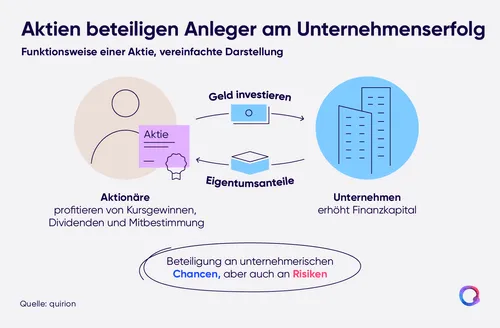
Buying shares is an excellent way to build wealth over the long term. Shares score with the following strengths:
- Return expectations are comparatively high. The risk, which undoubtedly exists, can be limited through broad diversification and a longer investment horizon.
- Dividends: shareholders benefit not only from a positive price performance, but also from regular profit distributions (dividends), through which they share in a company’s economic success.
- Flexibility: thanks to stock exchange trading, investors can buy and sell shares at any time.
- Wide choice: worldwide there is a huge choice of listed companies in which investors can take a stake.
- Versatility: there is a wide range of characteristics in which public limited companies differ from one another. Examples include home country, sector, company size, dividend level or currency.
- Inflation protection: as a tangible asset, shares offer at least a certain degree of inflation protection.
What risks can share investments carry?
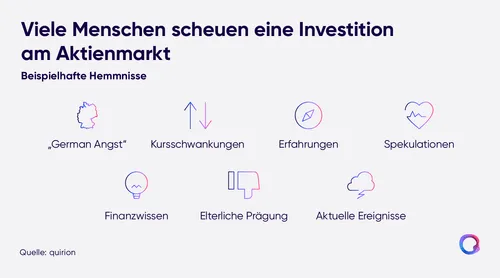
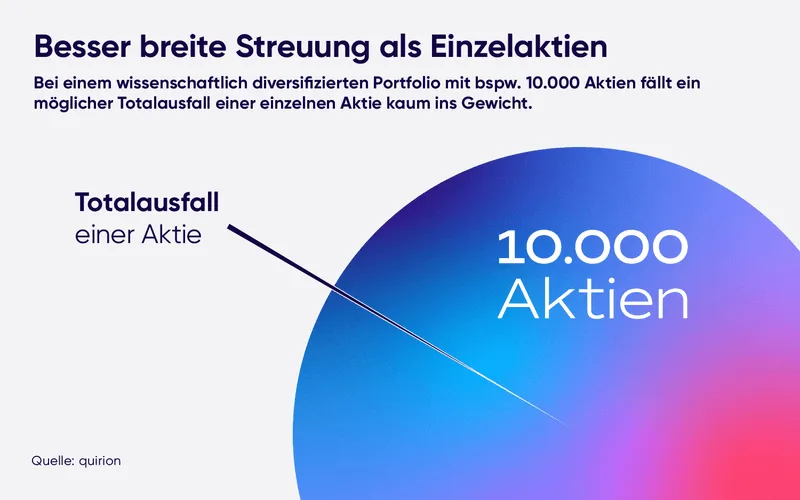
Many private investors shy away from buying shares because in their eyes it is too risky. In the event of a company insolvency, investors must reckon with a total loss of the money they have invested – which, however, happens rather rarely in practice and which can largely be prevented through broad diversification of share investments. What also deters many investors are the at times sharp fluctuations in share prices.
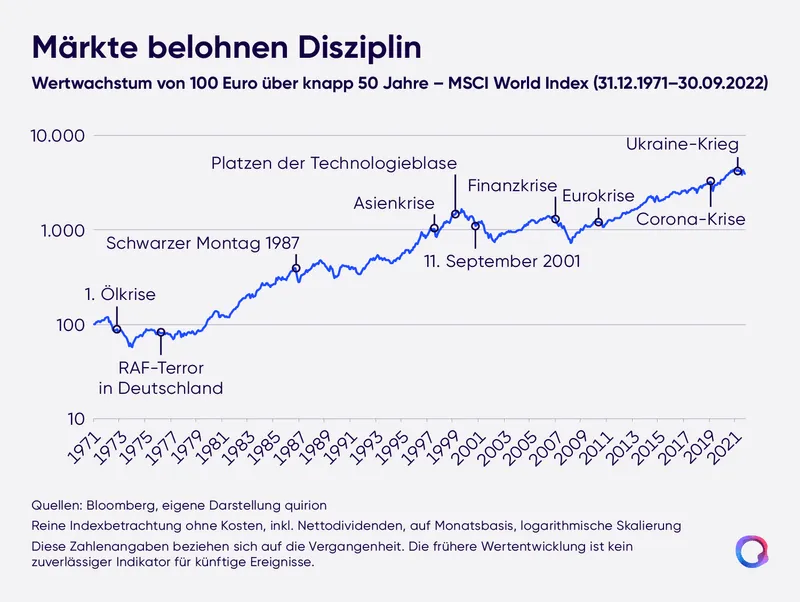
Such fluctuations reflect either the company-specific risk or the general market risk . Company-specific risk refers to the risk that the share price changes due to factors connected with the individual company (profit/revenue performance, change of management). Factors that affect the performance of all shares equally are referred to as general market risk (coronavirus pandemic, war in Ukraine, rising interest rates).
Important to knowis that the risk of price losses can be reduced through a long holding period and the broadest possible diversification. Broad diversification can be achieved without much effort via low-cost equity ETFs. Even though purchases and sales are possible at any time, this is rather to be advised against.
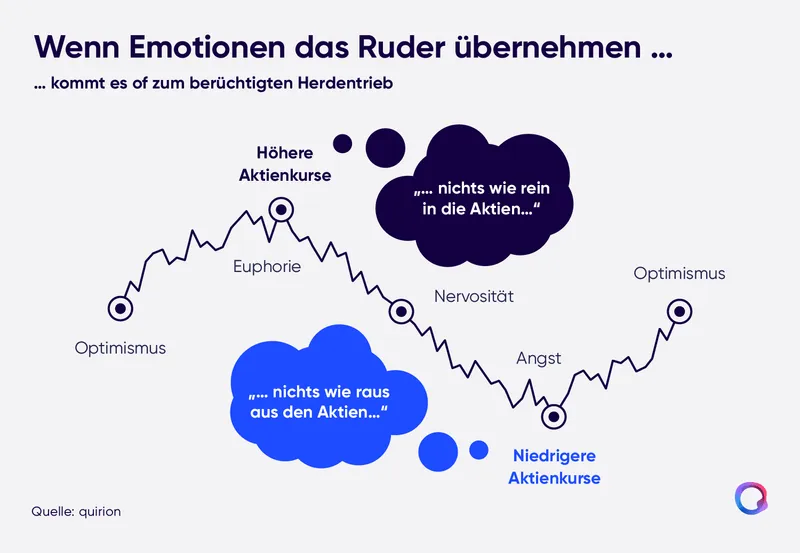
In addition, factors can influence the price performancethat do not have purely rational reasons. It is not only the official announcement about the course of business on the part of a company that can lead to negative reactions on the stock market, but also current sentiment, opinions or the spreading of rumours (psychological market risk).
How is the share price formed?
The share price is formed by supply and demand. The stronger the demand for a share, the higher the price. A wide variety of factors influence demand and supply:
- Business performance, profit forecasts and other company news
To a certain extent, the company itself has it in its own hands how sought-after its shares are. Important events such as the presentation of annual reports, general meetings and business outlooks sometimes have a very marked effect on share prices – both positively and negatively. This applies above all when expectations are exceeded or missed.
- Economic situation in the countries in which the company operates
The economic situation often affects consumer behaviour, which many companies (and their shares) subsequently feel. Government measures, planned legislative changes
Governments can significantly influence the corporate environment. Through legislative changes, government regulation and subsidies, they can alter companies’ profit expectations.
- Interest rate level
Fixed-income investments are considered less risky and gain in attractiveness relative to the stock market when interest rates rise. Investors may then withdraw their money from the stock market and shift into bonds. In addition, higher interest rates also mean higher costs when companies take out loans.
- Psychology
Current sentiment, opinions and the spreading of rumours can affect share prices more or less markedly.
- Takeovers and buy-backs
In a takeover bid, one company wishes to acquire shares of another company for a certain price and, to that end, makes the shareholders concerned a public offer to buy their shares. In a share buy-back, a company acquires its own shares from the shareholders. The public limited company thus buys back the securities it issued itself. Both measures generally have a price-driving effect on the relevant share prices. Dependence on commodity and energy prices
Prices are also influenced by whether a company can purchase the commodities/energy it needs at a favourable price.
- Sector situation / trends
If an entire sector is struggling with difficulties, the share prices of all companies in the affected sector are often, without exception, adversely affected. Conversely, there are trending topics (clean energy, digitalisation, artificial intelligence) that can drive up the share prices of all companies associated with them.
- Exchange rates
Many companies operate internationally. Changes in exchange rates can make goods more expensive or cheaper abroad, which can be disadvantageous or advantageous for a company.
Who determines the price of a share when it is issued?
Before a share can be traded on the stock exchange , it must be issued and placed . The issue (= the issuance of shares) can take place using various procedures. The most common is what is known as the “book-building process”, in which investors can submit purchase offers within a defined price range and a previously specified time frame. After the bids have been examined and taking the current market situation into account, a uniform issue price and the allocation of the shares are then set.
{{cta-2-component}}
Rights and obligations of shareholders
Shareholders may attend the general meeting and have a voting rightthat reflects the number of securities held. In addition, they have a right to information. Representatives of the public limited company must therefore disclose to them once a yearwhat the economic situation of the company is. Shareholders are not entitled to have profits distributed in the form of dividends. If, however, profit distributionsare made, they share in them. This is also ensured by the principle of equal treatment , under which all shareholders have the same rights and obligations . If the company issues new shares, the shareholder generally has a subscription right to these new shares.
Shareholders also have some obligations. Under the duty of loyalty they must have regard to the interests of the company and of other shareholders. For example, at general meetings they must vote in the interests of the common purpose and, with regard to the AG, must not make discrediting statements to third parties. The shareholder’s only main financial obligation is to pay for the subscribed shares accordingly, that is, to make a corresponding contribution.
Where can I buy shares?
Shares are traded on a stock exchange. Private investors, however, cannot trade on the stock exchange themselves. Instead, they must generally place their order to buy/sell shares in person via an adviser at their bank, or by telephone, email or fax. With online brokers or direct banks, you can carry out the task of placing a securities order yourself, quite simply online. Before you can start share trading , you will also still need a securities account.
What advantages do companies gain from going public?
One of the most important motives for a stock market flotation is to provide the company with new financial resources through the issuance of shares. By bundling many small contributions from a mostly anonymous group of shareholders, a large amount of capital is raised, with which the company can finance its growth.
How are gains from share trading taxed?
Share gains and dividends have been taxed since 2009 by means of withholding tax on investment income (plus solidarity surcharge and, where applicable, church tax). This withholding tax on investment income is a so-called “withholding tax”. For share investors, this means that you do not have to deal with the taxation yourself. The credit institution as the source of your capital gains/dividends handles this automatically for you. Your credit institution also directly offsets gains and losses, so that you only have to pay tax on the difference. The withholding tax on investment income currently stands at 25 %. On top of this comes the solidarity surcharge of 5.5 % and, if you are liable for church tax , a further amount depending on the federal state of 8 - 9 % on top. The complete withholding tax on investment income thus stands, depending on your individual situation, at between 26.375 - 27.995 %. The good news for small investors is that share gains and dividends have remained tax-free since 1 January 2023 up to 1,000 euros for single people and 2,000 euros for married couples.
What types of shares are there?
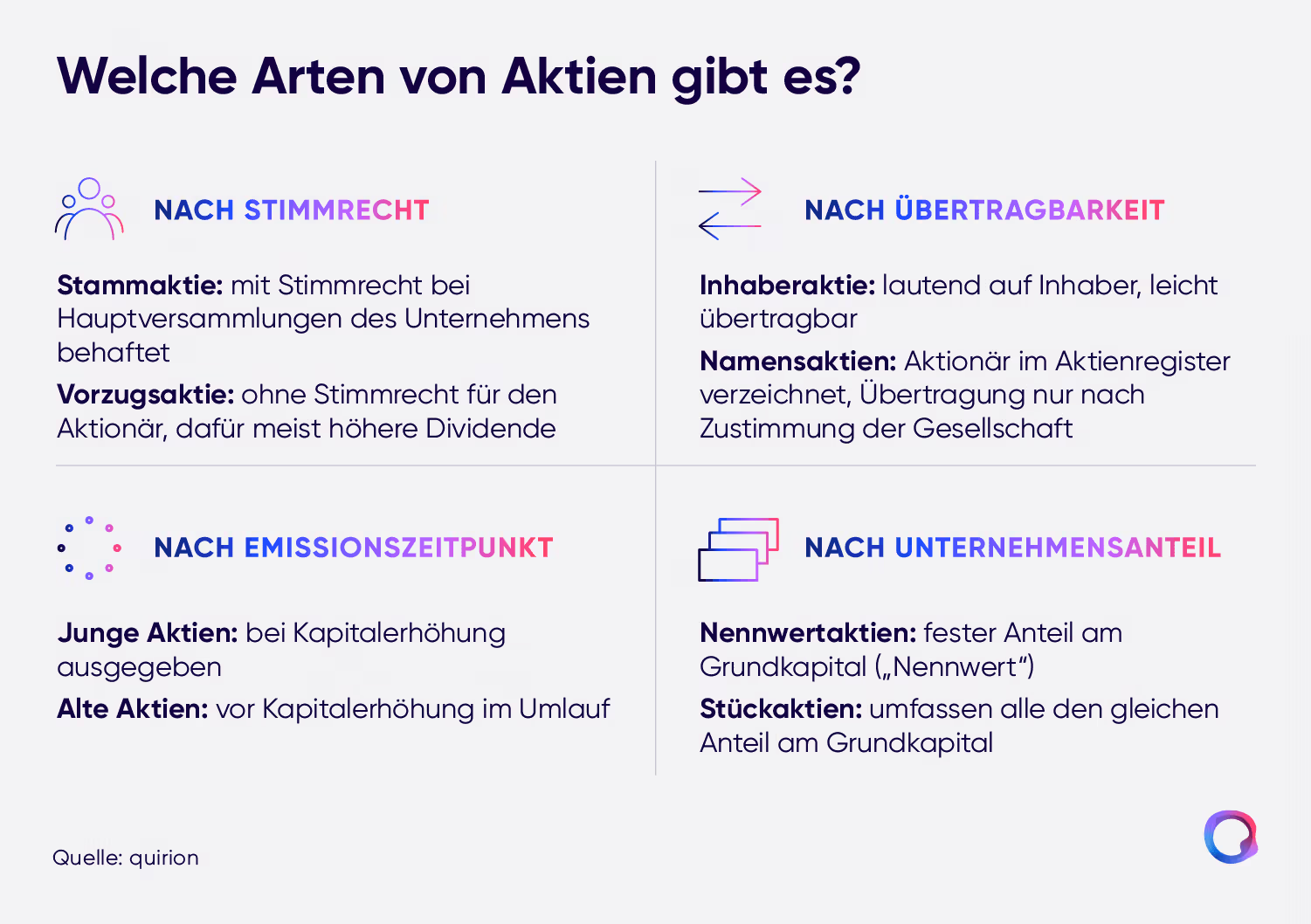
- Ordinary shares / preference shares: Ordinary shares are the standard type of share. They grant the shareholder all the rights due under the Stock Corporation Act and the company-specific articles of association. Preference shares, by contrast, carry certain preferential rights relating, for example, to a higher dividend entitlement compared with ordinary shares or to treatment in the event of insolvency. In return, they are usually issued without voting rights.
- Bearer shares / registered shares: Bearer shares are not made out in a specific name, but to the respective bearer. This makes them transferable at any time. Registered shares, by contrast, are generally entered in the respective company’s share register with the name of the holder.
- New shares / old shares: New shares are also called fresh shares. These are types of shares that an AG issues on the basis of a capital increase. New shares are issued by AGs in order to raise fresh capital for investments. Public limited companies prefer this method to the conventional bank loan. Old shares are shares of the same company that were issued some time ago.
- Par-value shares / no-par shares: Par-value shares are made out for a fixed sum of money that represents the size of the stake in a public limited company’s share capital. The situation is different with no-par shares: they represent a certain proportion of the share capital laid down in the articles of association. This proportion is expressed not as a sum of money, but as a unit stake. For the private investor, the distinction between par-value and no-par shares is not significant.