







Definition: what are ETFs and how do they work?
ETF is the abbreviation for Exchange Traded Funds, i.e. exchange-traded funds. Investors can therefore trade ETFs on the stock exchange and do not have to buy them from the fund company.
Unlike many other investment funds, ETFs do not represent an active investment. In other words, they do not try to outperform the relevant market, but instead aim to track the changes in value of an index as closely as possible. This type of investment is also referred to as passive investing . Above all, the ETF issuer makes sure that the fund's weighting matches the index's performance as precisely as possible and adjusts the ETF's composition in line with changes to the index.
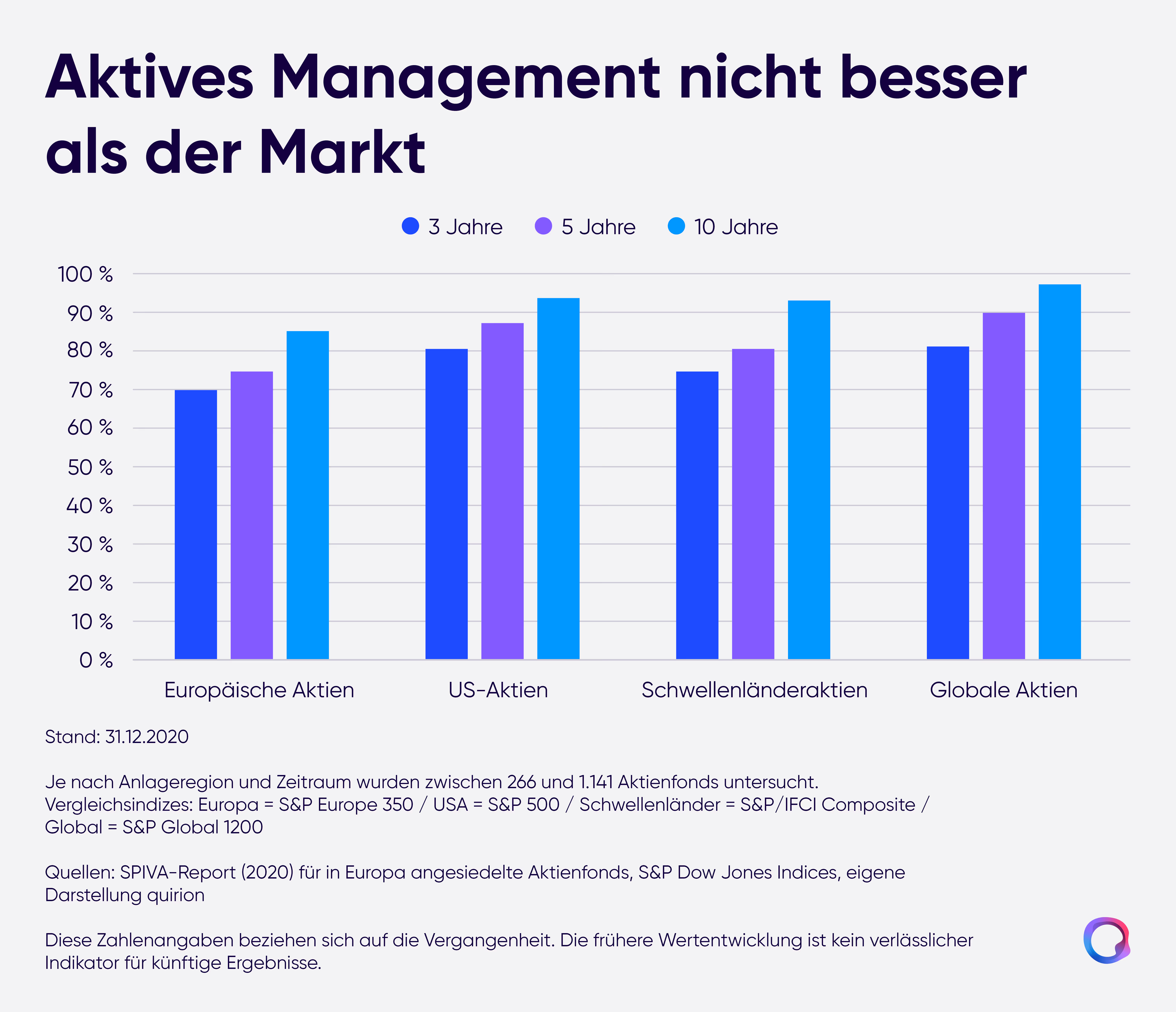
This investment strategy has the advantage of requiring fewer staff, because the decision on investments strictly follows the weighting of the index. This makes an ETF significantly cheaper than actively managed fundswhich, over the long term, fail to achieve their goal of outperforming a comparable index.
Background: Through „stock picking“, i.e. targeted investment in individual securities that supposedly deliver above-average investment results, no systematic success can be achieved. The same applies to trying to time the best possible entry and exit points (market timing). No one manages to make reliably accurate forecasts over the long term.
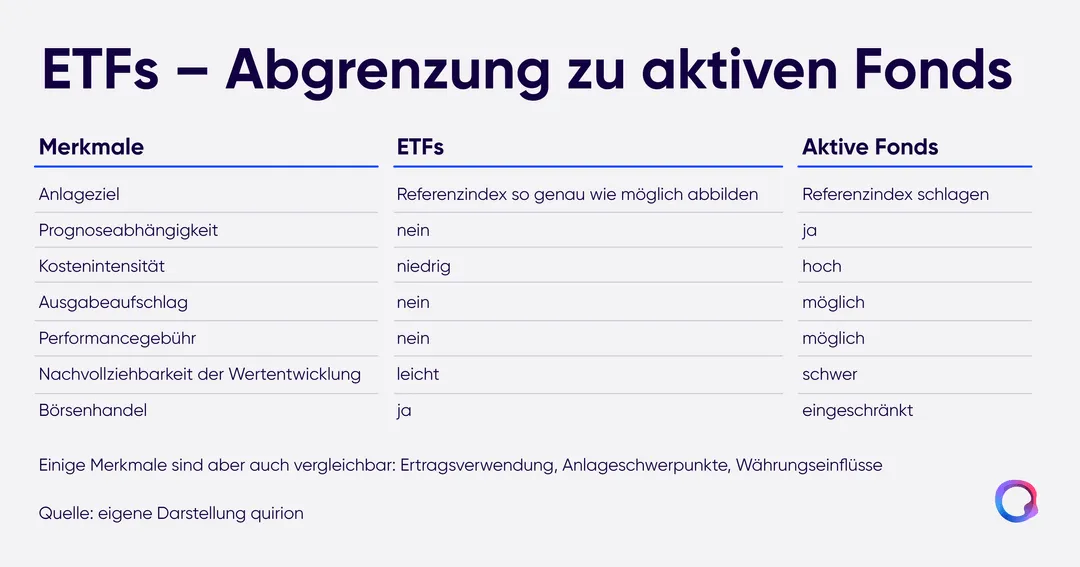
ETFs – distinction from active funds
Active management no better than the market
{{cta-component}}
ETFs: simply explained using the MSCI World as an example
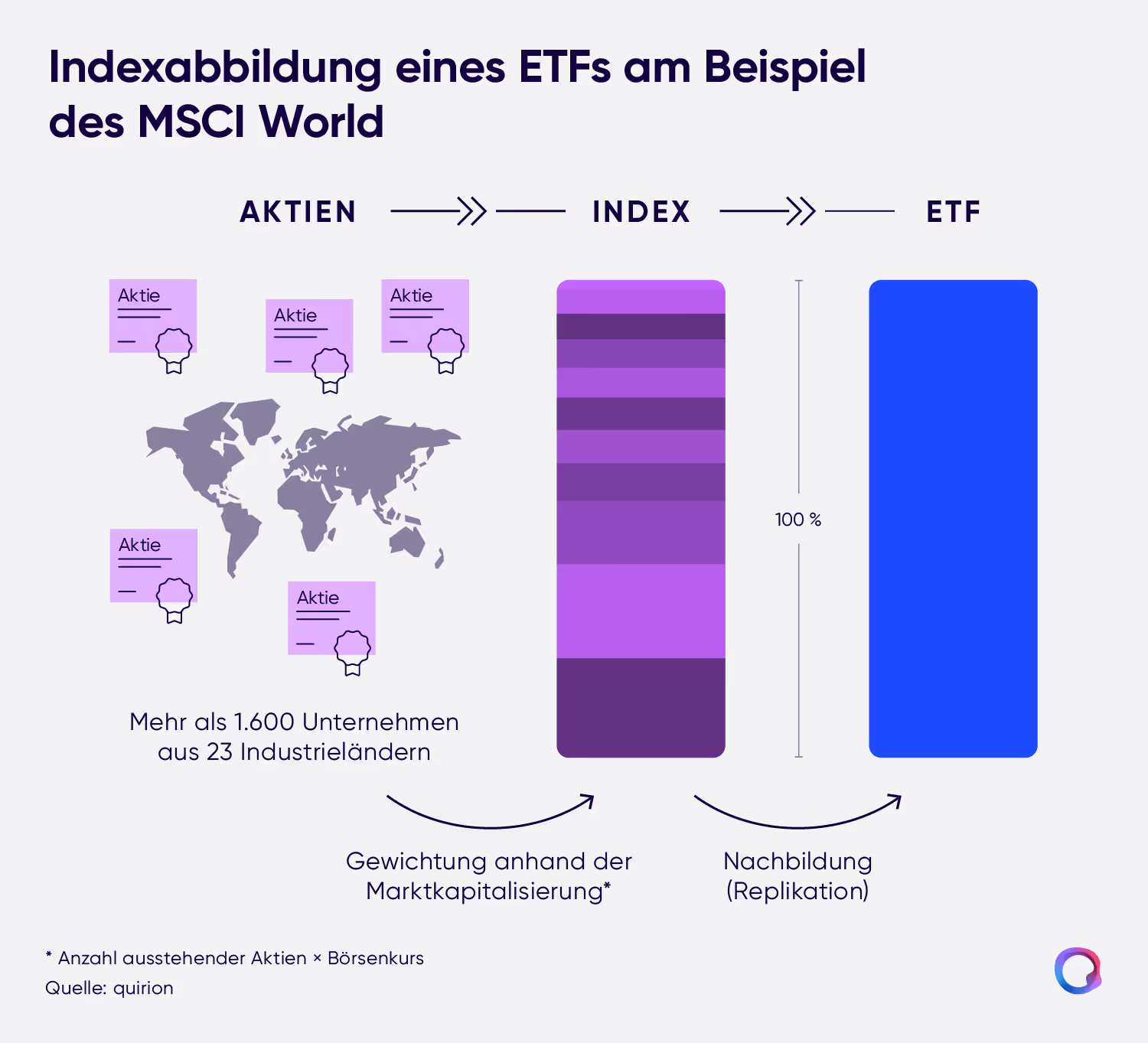
The MSCI World is an international equity indexthat currently consists of around 1,500 individual securities . Anyone wanting to buy just a single share of every company included in the MSCI World in order to track it would have to invest a high six-figure euro amount.
Another problem: This way, no sensible weighting is achieved that reflects the financial clout of the companies. Around €1,500 would be invested in the company Chipotle Mexican Grill this way – that is what one share costs (as at the end of March 2023) – and thus roughly six times as much money as in Microsoft's share, which costs around €250 (also as at March 2023). Chipotle, however, is not worth six times as much as Microsoft on the stock exchange, but only a fraction. Looking at the share price alone is misleading here. The true market value is measured using what is known as market capitalisation . It is determined by multiplying the share price by the number of shares in circulation . In Chipotle's case, the market capitalisation is around €42 billion. Microsoft's, by contrast, is €1.9 trillion. The corresponding weightings in the MSCI World Index are around 0.1% and around 3.8% respectively (all as at the end of March 2023).
Building a portfolio matching the index yourself is virtually impossible. The financial outlay alone exceeds the means of most investors – and on top of that there would be disproportionately high order fees. The administration costs would rise even more sharply because the portfolio has to be adjusted regularly, since the weighting keeps changing as a result of market movements.
Anyone who instead buys an MSCI World ETF – whether as a single purchase or as part of a regular savings plan, both of which are already possible with small amounts – invests conveniently and with little effort in the index and thus in the individual shares it contains, where they are weighted by market capitalisation . From an investor's perspective, the shares are therefore acquired not directly but indirectly via the ETF. The weighting of the individual securities within the ETF changes automatically depending on the individual price movements. Other changes to the index (e.g. the replacement of individual shares) are tracked by the fund management.
Investing in the broad market cost-effectively and efficiently – using the MSCI World as an example
Replication method: physical & synthetic ETFs (swap ETFs)
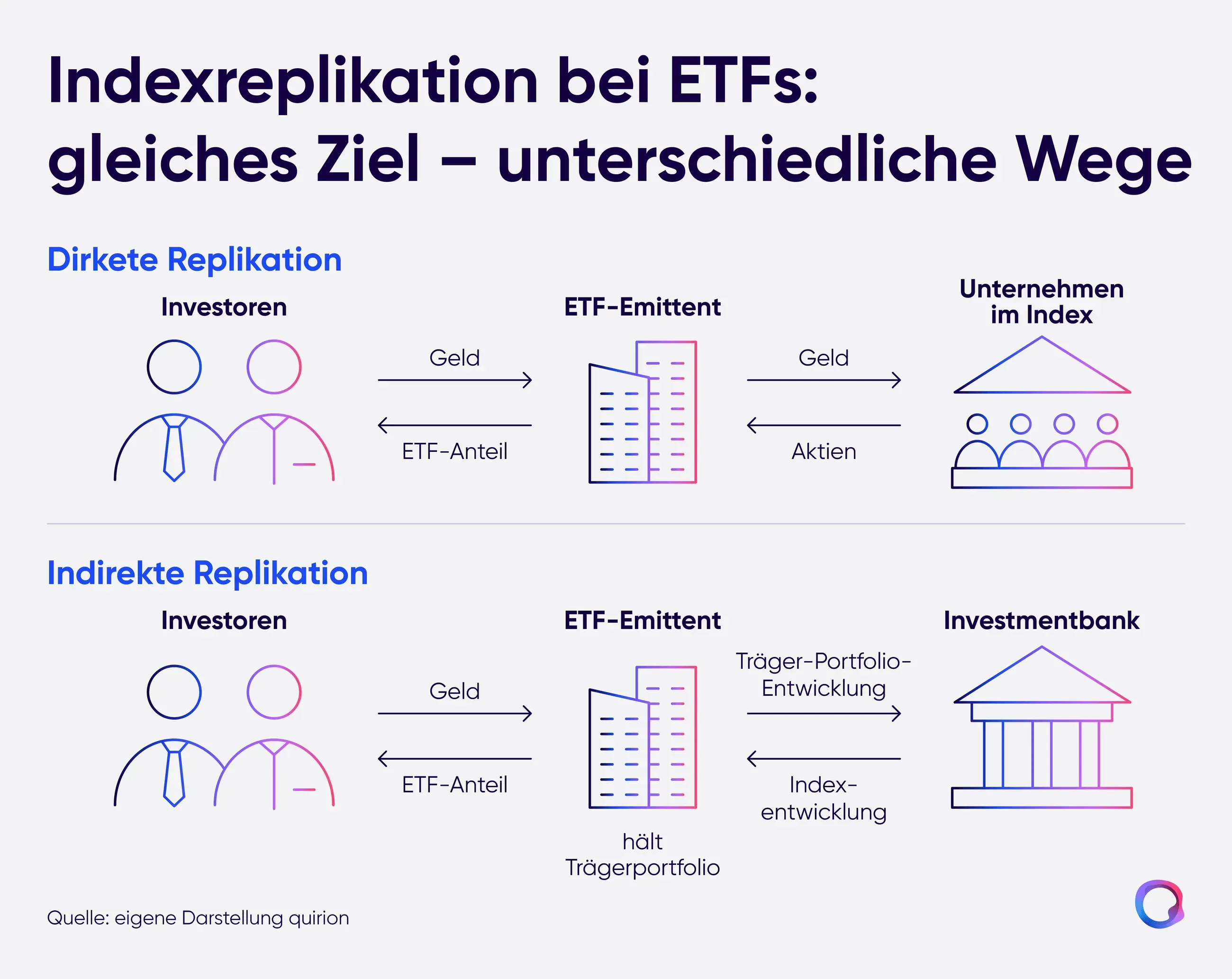
Physical Exchange Traded Funds invest directly in securities. They therefore take investors' money and use it to buy securities in a weighting that matches the index weighting as closely as possible. Synthetic ETFs often also acquire securities that are not included in the index („carrier portfolio“). Instead, they use swap transactions (swaps) with investment banks to track the index indirectly. This replication method is significantly cheaper, especially for indices with a very large number of individual securities, meaning that many synthetic ETFs are better able to track the performance of the index. In addition, this allows access to markets that are out of reach for a physical ETF, such as the money market. On the other hand, this type of replication carries a counterparty risk relating to the swap. Payments from the swap partner could fail to materialise. In practice, however, the safeguards within the ETFs are so strict that such defaults are extremely unlikely .
Index replication with ETFs: the same goal – different routes
How safe are ETFs?
In principle, ETFs are considered a safe investment, especially as they legally constitute segregated assets . Within the ETF there is also no speculative risk or above-average losses caused by poor timing or the wrong selection of individual securities. Instead, investors invest in asset classes, markets, regions or sectors and, through diversification, achieve a lower risk through diversification than when investing in individual securities.
{{cta-2-component}}
How are the costs of ETFs made up? How high are they?
The costs of passive funds are usually stated in the Total Expense Ratio (TER) . This is a readily comparable and transparent metricthat relates the expenses to the ETF's volume. Depending on the product, the TER of ETFs is usually between 0.05 and 0.8%. As a general rule, the TER is higher for physically replicating ETFs .
The TER includes the following cost items:
- Administration costs: fees for managing the ETF
- Custodian bank fees
- Licence fees for the tracked index
- other distribution and operating costs
Unfortunately, the TER therefore does not include all expenses or indeed all income. Swap fees, transaction costs and income from securities lending are not included. Even more meaningful, accordingly, is looking at the return difference between the index performance and the ETF, because this reflects all cost components.
Accumulating and distributing ETFs simply explained
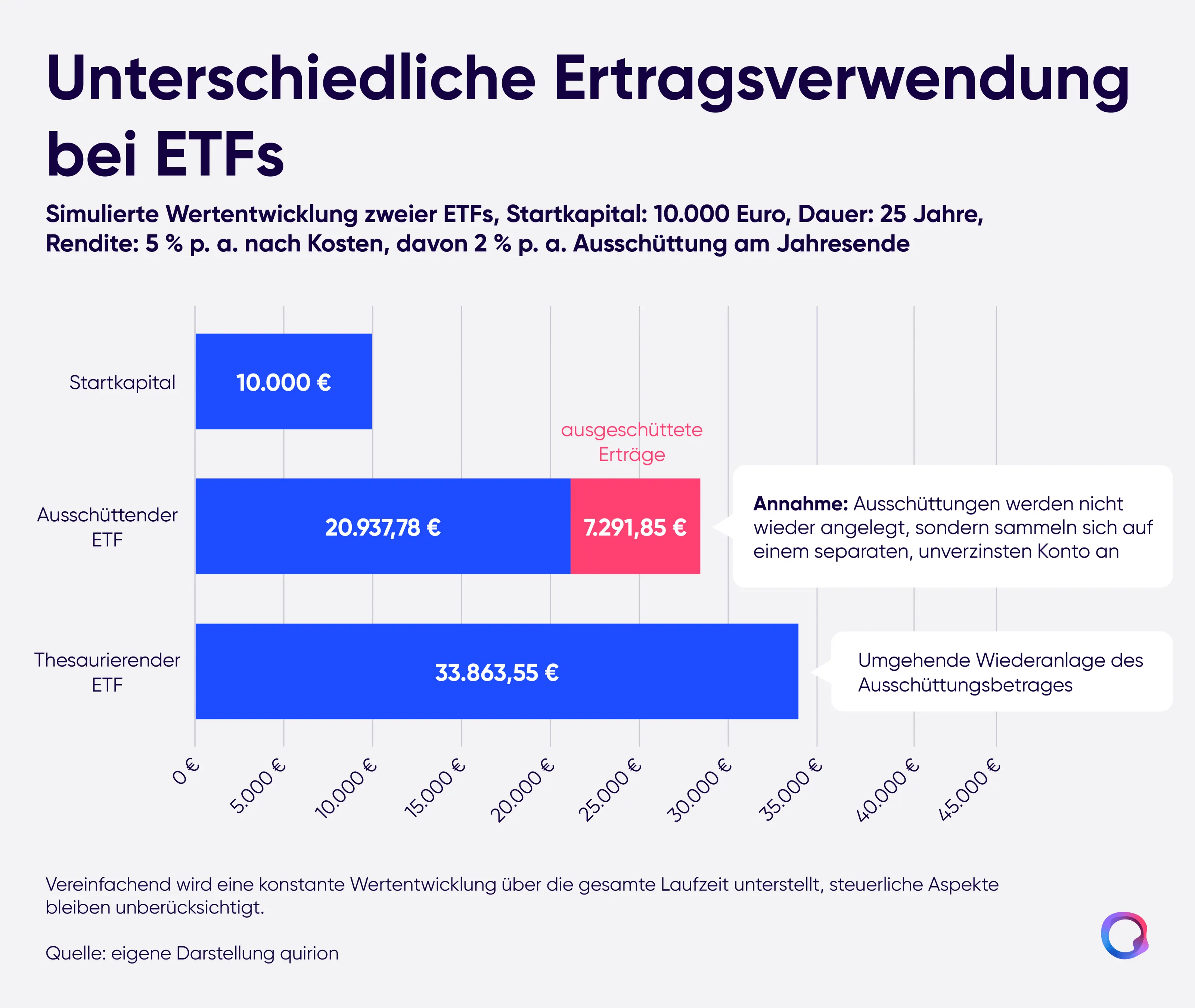
Accumulating funds reinvest ongoing income as a matter of principle. So if, for example, Volkswagen AG pays out a dividend, an accumulating DAX ETF takes this dividend and reinvests it proportionately across all DAX securities. A distributing fund , by contrast, pays out this dividend proportionately to investors.
For long-term performance it makes very good senseto reinvest income directly into securities. In principle, this is also possible with distributing funds. However, investors have to deliberately take care of reinvesting in securities if they invest on their own. Alternatively, robo-advisors, such as quirion, handle the reinvestment.
Different uses of income with ETFs
What are the quality features of a good ETF?
A recommended ETF usually stands out through the following characteristics:
- At least two years old: only this way can important metrics be reliably compared.
- The lowest possible tracking error and a low return difference relative to the index: the ETF should reflect the performance as accurately and consistently as possible.
- Fund volume of over €50 million or strong volume growth: the higher the fund volume, the lower the proportionate costs.
Which ETF providers are there?
Specialised investment firms offer ETFs. Many larger banks have their own ETF product line. The best-known brands and providers in Europe are:
- iShares (BlackRock)
- Xtrackers (DWS)
- UBS
- Amundi
- Vanguard
- SPDR (State Street)
- Invesco
In addition, there are other, smaller providers that usually occupy niches.
Where can I invest in ETFs?
Investors can acquire ETFs anywhere there is access to the stock exchange. Typically, such investment funds are therefore acquired via online brokers or asset managers. Digital asset managers (robo-advisors) are becoming increasingly important in this regard. At quirion, investors invest on the basis of scientific findings in a globally diversified ETF portfolio.
How much should you invest in ETFs?
In principle, investors can make one-off investments or use ETF savings plans . The amounts invested generally depend on personal financial circumstances and needs . There are no upper limits . ETF savings plans are now possible even from small minimum amounts, for example from €25 per month. However, investors should always pay attention to a sensible asset allocation.
Investing in ETFs with the robo-advisor
Passive index funds and robo-advisors make a very sensible combination, because both pursue a low-cost investment approach . Robo-advisors that use ETFs on a forecast-free basiscan put into practice the findings of financial market research, according to which achieving an excess return relative to the broad market is impossible over the long term. In doing so, they track market developments as closely as possible and let investors through low costs participate in this as well as possible.
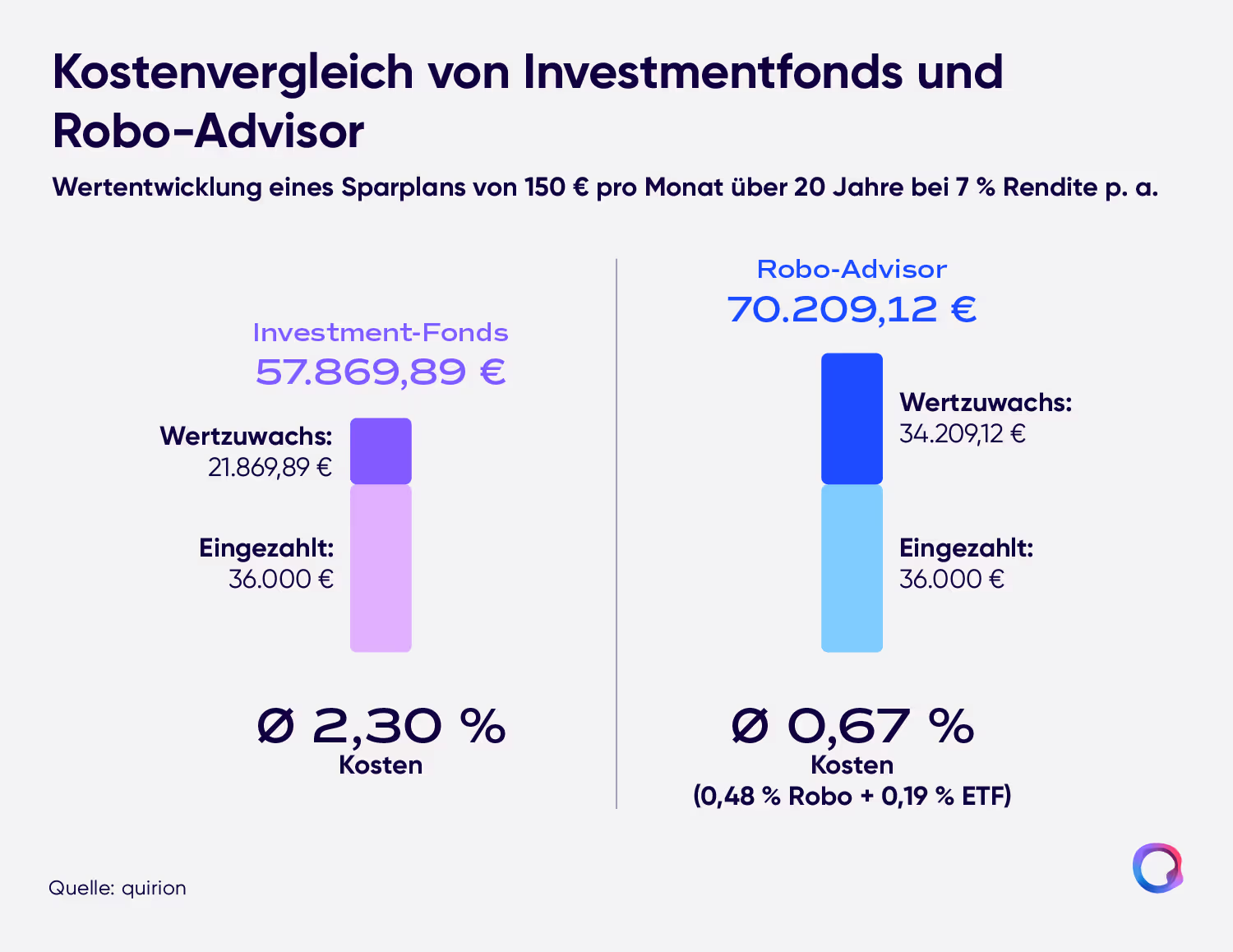
Such robo-advisors put together ETF portfolios suited to investors' risk type.
{{konzept-component}}
ETFs or shares?
Financial market research answers this question unequivocally with: „ETFs“. What is important here, however, is the broadest possible diversification without too strong a focus on individual regions, sectors or individual securities. It is scientifically proven that the optimal ratio of expected return to expected risk in the equity segment arises when all the shares in the global market are bought, weighted according to their market capitalisation (global market portfolio). In practice, this is possible neither with individual securities nor with a combination of ETFs. With an intelligent combination of ETFs , however, a close approximation to the global market portfolio can be achieved.
Investments in individual shares carry what are known as unsystematic risks. These are risks that are specifically linked to the individual company, e.g. poor business performance or fraudulent conduct by the management. Such risks can lead to considerable price losses, right up to a total loss. There is no economic logic according to which the prices of individual shares must at some point recover after severe losses. It is in the nature of market economy systems that individual companies – indeed even whole sectors – can go under. For that reason, no reward in the form of a readily calculable return for the (unsystematic) risk taken on can be expected for individual share investments – and, incidentally, for overly one-sided ETF investments either.
With a portfolio diversified as broadly as possible across the globe, things are different. Here, unsystematic risks are, so to speak, „diversified away“. All that remains is the so-called systematic risk. It relates to price fluctuations resulting from general developments that affect the entire market and that have to be accepted even with a very broadly diversified investment. Examples of systematic risks are global economic crises or wide-ranging trade wars. Price losses in the context of systematic risks can certainly be substantial. However, this happens relatively rarely, and prices ultimately always recover – provided that the market economy system does not collapse.
Unsystematic risks are therefore, in principle, avoidable risksthat strike more frequently and more intensely than systematic risks. From a financial science perspective, a return above the risk-free rate (risk premium) can be expected for taking on systematic risks.
Eliminating unsystematic risks = maximum diversification
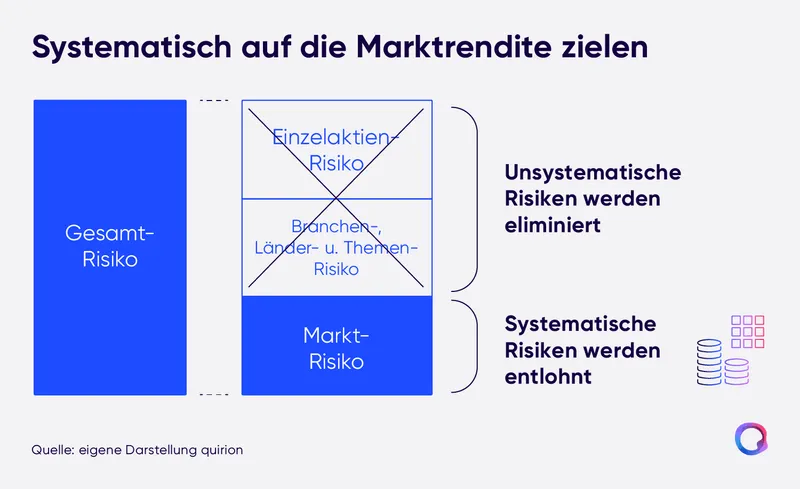
Anyone wishing to invest money on the capital market or save regularly should therefore turn to ETFs or ETF savings plans and not to individual shares. Robo-advisors can provide strong support here if, as at quirion, the scientific findings of capital market research are followed. Because then investment is made in an ETF portfolio that is diversified as broadly as possible and tailored to the personal risk profile, which then contains only the systematic risk.
The most important advantages of ETFs at a glance
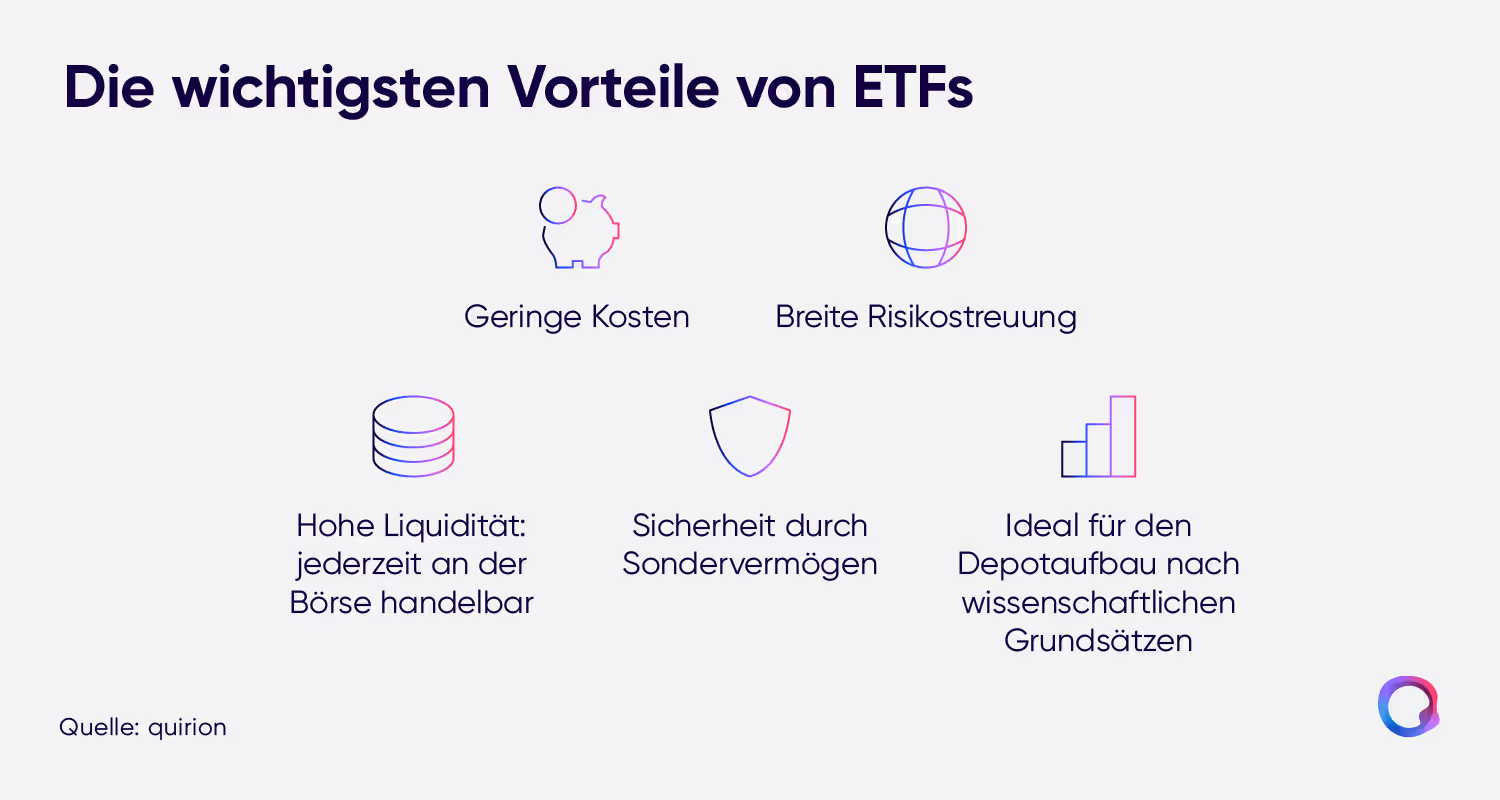
meaningful opportunities to outperform the indices they track.