





7 options for private pension provision at a glance
First, we give you a comprehensive overview of the 7 most important options for private pension provision. In the following table you will find the common variants and their specific characteristics clearly summarised.
What about occupational pension provision?
Occupational pension provision can and should be used as well to provide for retirement. The employer grants contributions. Bear in mind that the state and occupational pension provision are usually still not enough to maintain your accustomed standard of living in old age. The state, occupational and private pension provision combined form the 3 pillars of pension provision.
1. Private pension insurance
In Germany, private pension insurance policies are among the most popular options for private pension provision. A private pension insurance policy is a contract between you and an insurance company under which you pay in regular contributions. In return, you receive a monthly pension or a one-off lump-sum payment once you reach retirement age.
● Traditional pension insurance: Your contributions are invested with a focus on security, mainly in fixed-income securities. The insurer guarantees a certain minimum interest rate and a lifelong pension.
● Unit-linked pension insurance: Your contributions are invested in investment funds. The size of the later pension depends on the performance of these funds.
● New Classic (hybrid): This variant combines elements of traditional and unit-linked pension insurance. “New Classic” products reduce the guarantee (e.g. only an 80 % contribution guarantee) and can therefore invest more heavily in higher-return assets.
● Index-linked pension insurance: The return on this insurance variant is based on the performance of a particular stock market index (e.g. the DAX). You participate in the index's gains – in a more limited form if more extensive guarantees are built in, or in a stronger form with fewer guarantees (and a higher risk of loss).
Immediate annuity: With an immediate annuity, you pay in a larger amount as a one-off payment and in return immediately receive a lifelong, monthly pension. Acquisition and distribution costs are often 4 – 6 % of the single premium and are deducted at the start of the contract. Administration costs and risk costs are incurred on an ongoing basis, so that the return is frequently lower than with alternative payout plans or ETF withdrawal strategies.
The best-known variants of private pension insurance include the state-subsidised Riester pension and the Rürup pension (basic pension).
Who is private pension insurance suitable for?
Private pension insurance is particularly suitable for people with a lower risk appetite who prefer a traditional insurance solution. However, because of high costs and low guaranteed interest rates, traditional pension insurance policies are often less profitable than other forms of investment. Unit-linked variants do offer higher return opportunities, but they also carry a greater risk.
2. Riester pension
The Riester pension was introduced in 2002 to offset the pension level, which was already declining at the time. It goes back to former Federal Minister Walter Riester and is aimed mainly at employees subject to social insurance contributions and civil servants. It is subsidised through direct state allowances and, where applicable, additional tax advantages. The Riester pension can be taken out in various forms:
● Traditional pension insurance
● Unit-linked pension insurance
● Bank savings plans
● Wohn-Riester (residential Riester)
The advantage of the Riester pension is based mainly on the state allowances, which can be attractive primarily for families with several children. Because of the high costs and low returns, taking out a new Riester contract is generally no longer advisable for most people today.
Who is the Riester pension suitable for?
The Riester pension is aimed above all at employees subject to social insurance contributions as well as civil servants who wish to benefit from state allowances and tax advantages. The model can be particularly worthwhile for families with children thanks to child allowances. However, the products are often associated with high costs and complicated contract terms.
3. Rürup pension (basic pension)
The Rürup pension was introduced in 2005 and is aimed primarily at the self-employed, freelancers and well-earning employees who cannot make use of Riester subsidies. It is characterised by tax advantages, as the contributions can be deducted as special expenses up to certain maximum limits. The self-employed can use the Rürup pension as a substitute for the state pension. The Rürup pension can be taken out as either traditional or unit-linked pension insurance.
Unlike the Riester pension, with the Rürup pension a one-off lump-sum payment is not possible; benefits are provided exclusively as a lifelong pension. The entitlements from the Rürup pension are also generally not inheritable, not transferable and cannot be used as collateral, which makes it particularly inflexible. However, survivors' protection can be agreed optionally.
Who is the Rürup pension suitable for?
The Rürup pension is intended above all for the self-employed and well-earning employees without access to Riester subsidies. It offers high tax advantages during the accumulation phase, but is extremely inflexible, as the capital cannot be paid out early and is available exclusively in the form of a lifelong pension.
4. Life insurance
Life insurance policies serve primarily to make payments to survivors or to pay out a certain sum to the insured person at a set point in time. That is why some people consider them a suitable option for private pension provision. Caution is advised here, however: high costs and often low return opportunities make life insurance fundamentally unsuitable as a form of pension provision.
Who is life insurance suitable for as pension provision?
Traditional endowment life insurance policies are intended for people who want to provide for old age and at the same time create protection for survivors. Because of low guaranteed interest rates and high fees, however, they are usually not very attractive as pure pension provision. Anyone who wants protection for dependants should combine term life insurance with a separate investment.
5. Property
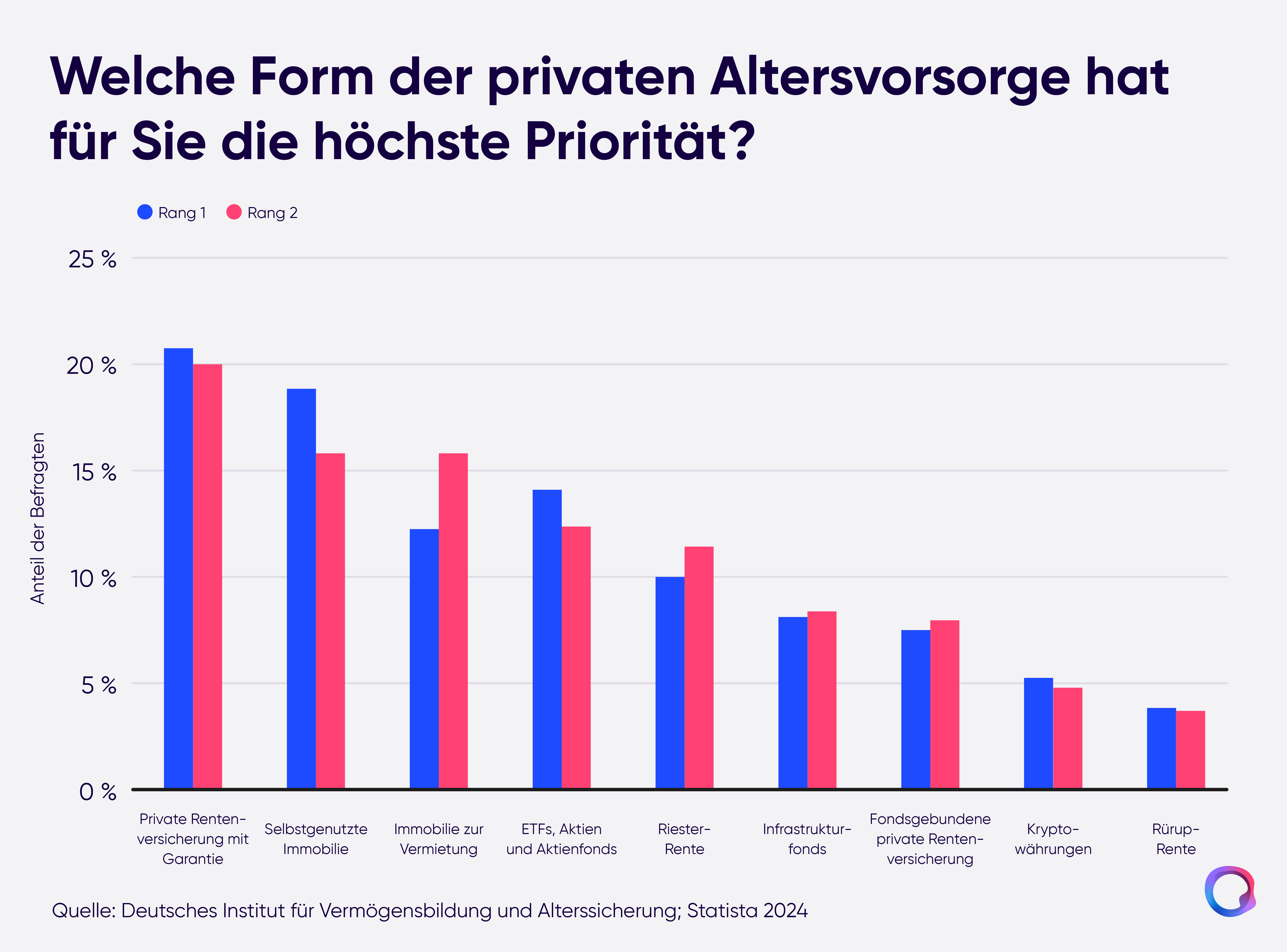
For many people in Germany, property has not lost any of its relevance as a means of securing their retirement. This is also clear from a survey conducted in 2023: when asked about their personal priority regarding private pension provision, a considerable 18.8 % of respondents named owner-occupied property. Property is therefore seen, after private pension insurance, as the second most important form of private pension provision.
Property can contribute to your pension provision in various ways:
● Owner-occupied property: You acquire a property that you live in yourself. By paying off the property loan before you retire, you live rent-free in old age, which reduces your monthly outgoings.
● Let property (capital investment): You acquire a property that you let in order to generate regular rental income. This income, less maintenance costs, can be used to pay off any remaining mortgage loan and later serve as an additional source of income in old age.
● Sale of property: Through the sale of a property, ideally at a profit, you receive a sum of money in one go, which you can invest, for example, in an immediate annuity or an ETF portfolio. A private sale of property in Germany is generally tax-free if at least 10 years lie between acquisition (= the notarised purchase contract) and sale. If the property was used continuously by the owner for residential purposes in the year of sale and the two preceding calendar years, no speculation tax whatsoever is payable – even if the 10 years have not yet been reached.
For many people in Germany, acquiring a property is now barely possible any more, or is associated with years of financial losses. Property is only suitable for pension provision if there is already enough capital available for rapid repayment, or if the property is acquired through an inheritance or gift. It should be noted that, unlike other forms of investment, an increase in value cannot automatically be assumed.
Who is property suitable for as pension provision?
Property as pension provision is suitable for people who have sufficient capital to acquire and maintain a property and who want a long-term investment. Owner-occupied properties can save on rental costs in old age, while let properties can provide a regular source of income. However, property investments are associated with high incidental costs, administrative effort and possible fluctuations in value.
6. Shares and actively managed funds
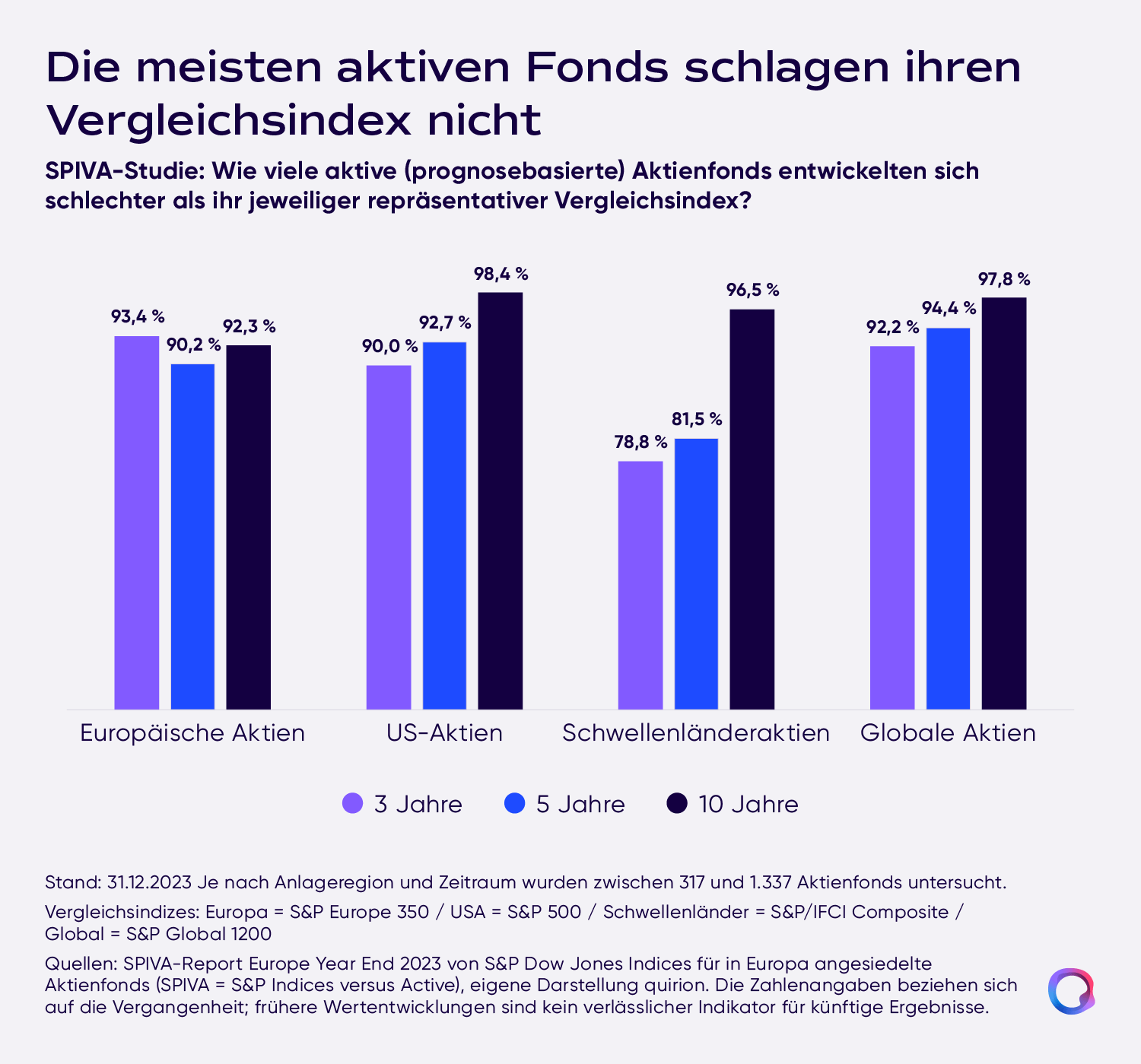
With individual shares or active funds, you invest in the capital market. To do so, you need a securities account, which you can open either with a bank or with an (online) broker. The return opportunities of shares and corresponding funds are generally high – but caution is advised, as active fund management usually incurs high costs, which reduce the return accordingly. Attempting to actively beat the market (by timing supposedly good entry and exit points and by overweighting supposedly promising shares) has also, in the past, paid off far too rarely compared with passive ETF investment strategies.
Who are shares and active funds suitable for as pension provision?
Direct share investments or actively managed funds are, in principle, not suitable for investors. A lack of diversification, wrong investment decisions and high fees reduce the return potential. This is scientifically proven. A broadly diversified and passively managed ETF portfolio, by contrast, offers a significantly better risk-return ratio.
7. ETFs for private pension provision
With ETFs (exchange-traded funds) you likewise invest in the capital market; however, these do not try to beat the market but instead passively track the performance of a financial index (in the equity area, e.g. the DAX or the MSCI World). This means: however the index performs, so does the value of your securities account. The risk of loss, especially with a globally diversified ETF portfolio, is far lower than with individual shares, since an ETF portfolio contains up to thousands of shares from different countries and sectors.
The quirion app
Who are ETFs suitable for as pension provision?
ETFs are suitable for anyone who wants to build up assets for retirement over the long term – regardless of age or income. They are particularly attractive for people who are looking for a low-cost, flexible and high-return alternative to traditional pension products. Young investors benefit from the long investment horizon and the compound interest effect, but working people in the middle of life can also use an ETF savings plan to close their pension gap in a targeted way.
Even for people shortly before or in retirement, ETFs are a sensible addition for preserving assets and protecting them against inflation. Since ETFs can be traded at any time, they are particularly suitable for those who want to arrange their pension provision individually and access their capital at any time.
Pension provision with ETFs: Find out everything about how you can use ETFs quite easily for your pension provision in our comprehensive guide: This is how pension provision with ETFs
Investing made simple



Private pension provision: this is what quirion offers you
With quirion, you have the opportunity to invest cheaply and securely in a broadly diversified ETF portfolio. Benefit from the return opportunities of the world's capital markets without having to become a financial professional yourself, and open your ETF securities account for your private pension provision today.
Opening an account with quirion is this easy:
Registrieren
Open an account
Deposit money
Claim your welcome bonus
Auf Rendite freuen!