





What are the 3 pillars of retirement provision?
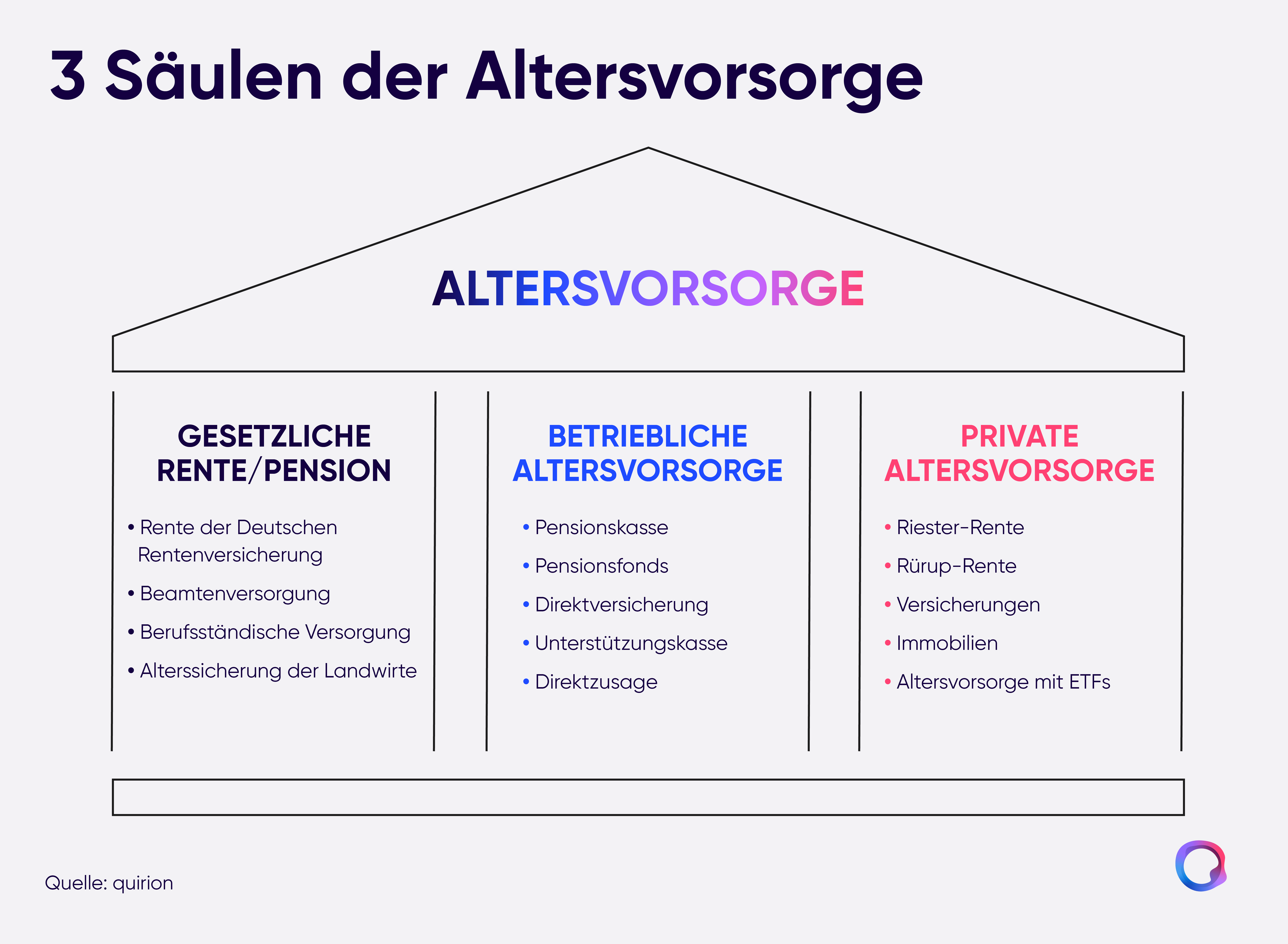
In Germany, the options for retirement provision are divided into three categories. These are also referred to as the 3 pillars of retirement provision:
• the statutory pension,
• the occupational pension and
• the private pension.
Every person is free to structure their retirement provision using one, two or all three pillars. A large part of the population is, through employment, already automatically insured under the statutory pension scheme. The other two pillars have to be activated by yourself.
1. The statutory pension
The statutory pension is generally administered through the German Statutory Pension Insurance (Deutsche Rentenversicherung). It manages the contributions and makes the pension payments. In addition to the old-age pension, the statutory pension insurance covers further benefits such as reduced earning capacity and survivors' pensions (widow's/widower's and orphan's pensions) as well as the costs of rehabilitation measures. The funds come from the monthly contribution payments of employees subject to pension insurance and of employers.
How the statutory pension works
If you are in employment, you and your employer pay a portion of your gross wage into the statutory pension system. As a result, you yourself acquire an entitlement to a later pension payment in the form of what are known as pension points. With your current pension contributions, however, you are not financing your own future pension, but that of today's pensioners. This is how the so-called pay-as-you-go system, or generational contract, is currently structured in Germany. This system works well as long as the number of people in employment is significantly larger, in relative terms, than the number of people in retirement. When this pay-as-you-go system was introduced in 1957, this was indeed the case: 6 contributors covered the pension of one person. Because the birth rate has fallen steadily over recent decades and the large baby-boomer generation is now retiring, the statutory pension is now being shouldered by just 1.8 people in employment.
How high the statutory pension turns out to be
The amount of your pension entitlement is calculated from the pension points you have accumulated. If you have an average income and work full-time, you accumulate one pension point per year of employment. After 45 years of employment, that is, with 45 accumulated pension points, you are entitled to the average pension, which currently stands at a pension level1 of 48 %. This means that in retirement you will receive less than half of your last earned income.
If your salary is below the average gross income in Germany, or you are short of years of employment, you accordingly also accumulate fewer pension points. Your pension will then turn out to be even lower .
Why the statutory pension alone is no longer enough
Anyone who has built up a certain standard of living by the time they retire can only in the rarest of cases maintain it permanently on 48 %, or even less, of their usual income. For this reason, the other two pillars, namely the occupational and the private pension, have gained more and more importance in recent years and are today virtually essential in order to remain financially well provided for in old age.
2. The occupational pension
The occupational pension (bAV) forms the second pillar and is an important complement to the statutory pension. In principle it is offered voluntarily by companies; however, employees have the right to request an occupational pension in the form of salary conversion. The company pension is organised and administered by the company and can be financed by the employer, the employees, or by both jointly.
How the occupational pension can be implemented
With the occupational pension, part of the gross salary is paid into one of the following occupational provision arrangements. The occupational pension generally also offers tax advantages.
- Direct commitment (pension commitment): With the pension commitment, the employer undertakes directly to pay employees a certain benefit when the pension falls due. To this end, provisions are set aside in the balance sheet, with the full financing risk resting on the employer's side. To reduce this risk, many companies take out reinsurance cover.
- Relief fund (Unterstützungskasse): A relief fund is a legally independent provision institution established by one or more companies. It finances the benefits through allocations from the sponsoring companies and from capital income. Employees generally have no direct legal claim against the relief fund; rather, the benefits are promised by the employer's side.
- Direct insurance: Here the employer takes out a life or pension insurance policy with an insurance company in favour of the employees. The contributions are either borne entirely by the employer's side or financed through salary conversion from the employees' gross salary. On retirement, the employees receive the agreed benefits directly from the insurer.
- Pension fund (Pensionskasse): A Pensionskasse is a legally independent provision institution sponsored by the employer or by several companies. It collects contributions and, when the pension falls due, pays out old-age, disability or survivors' pensions to the beneficiaries via an insurance policy.
- Pension investment fund (Pensionsfonds): A Pensionsfonds is a standalone institution that invests contributions from both employers and employees. The sponsors of pension investment funds can select investments more freely than Pensionskassen, e.g. on the capital market. Thanks to the possibility of higher equity ratios, potentially higher returns can be achieved. It is important here that the return generated should be higher than the costs and the rate of inflation.
Reforms of the occupational pension since 2025
The contribution assessment ceiling (BBG) in pension and unemployment insurance was standardised nationwide in 2025, which means that the previous differences between the old and new federal states are removed. As a result of the increase in the BBG, the tax-free subsidy framework for contributions to the occupational pension also rises. Employer contributions and salary conversions into a direct insurance policy, a Pensionskasse or a Pensionsfonds are tax-free up to 7,728 euros per year.
Are the statutory and occupational pensions together enough?
It is in any case advisable, in addition to the statutory pension, to find out about occupational provision options and to make use of them too. This does not, however, render the private pension obsolete: without additional private retirement provision many people will not be able to maintain their accustomed standard of living, despite a combined statutory and occupational pension.
3. The private pension
The third pillar, the private pension, encompasses all those additional forms of provision that you can use independently of the statutory compulsory contributions. These include:
• Private pension insurance (including state-subsidised forms such as Riester or Rürup)
• Life insurance
• Real estate
• Capital market investments, e.g. with actively managed investment funds, but best of all with low-cost ETFs
Investing made simple



For your private retirement provision you can use one or more of these options. Bear in mind that, above all, classic provision products such as private pension insurance can entail high costs relative to the return you can expect. So compare the various options and check them carefully for:
• the expected return in relation to the risk,
• the ongoing costs of the provision product,
• the protection of your capital and
• the flexibility and availability of your assets.
Your options for private retirement provision
You will get a comprehensive insight into which options for private retirement provision are available to you in our article: Options for private retirement provision.
How to use the 3 pillars for your personal retirement provision
In the following, we show you how best to proceed so that your retirement provision is securely built on a solid foundation.
First of all, you should get an overview of the amount of the statutory pension that you will later be entitled to.
- Check your pension statement: From the age of 27, contributors receive a pension statement from the German Statutory Pension Insurance once a year. This contains the pension entitlements acquired so far and a projection for the future pension.
- Use a pension calculator: With an online pension calculator you can estimate your likely pension amount in advance.
- Personal advice: You can also make use of free advice from the pension insurance to find out about your pension entitlements in old age.
Step 1: Determine the statutory pension
First of all, you should get an overview of the amount of the statutory pension that you will later be entitled to.
- Check your pension statement: From the age of 27, contributors receive a pension statement from the German Statutory Pension Insurance once a year. This contains the pension entitlements acquired so far and a projection for the future pension.
- Use a pension calculator: With an online pension calculator you can estimate your likely pension amount in advance.
- Personal advice: You can also make use of free advice from the pension insurance to find out about your pension entitlements in old age.
Step 2: Calculate the pension gap
Next, you should find out how large the difference is between the statutory pension and the income you need in order to continue maintaining your standard of living in old age.
- Estimate your cost of living: First find out how much money you will need for housing, food and leisure. Also bear in mind that, over time, expenditures will arise, such as renovating your flat or house, or replacement purchases such as new kitchen appliances, a new heating system, buying a new car, or other everyday items subject to wear and tear. A common rule of thumb assumes that around 80 % of your last net income is needed to maintain your standard of living in retirement.
- Calculate the pension gap: Strictly speaking, the pension gap can express two things: on the one hand, it refers to the difference between your statutory pension and your last net income. On the other hand, it can also mean the difference between your pension payment and the costs you have to cover in retirement. To estimate your pension gap, you can also use handy online pension-gap calculators.
- Take inflation into account: Keep in mind that in future, too, the cost of living will rise due to inflation, and this may not be fully covered by pension adjustments.
Step 3: Make use of the occupational pension
Once you know how large your pension gap will be, you can first sound out your options for an occupational pension in order to close the difference at least in part.
- Check what your company offers: Many employers now offer models such as direct insurance, pension investment funds or relief funds for the occupational pension. Since 2025, companies have also been obliged to offer an occupational pension in the form of salary conversion.
- Make use of state subsidies: Payments into Pensionskassen, pension investment funds or direct insurance policies are exempt from tax and social security contributions up to a certain limit. For direct commitments and relief funds, these benefits are even unlimited.
- Check for employer top-ups: Employers must also provide a top-up of 15 % of the converted salary if, through salary conversion, you save on social security contributions.
Step 4: Choose a private pension
In addition to the statutory and occupational pension, a private pension is an important complement in order to close the pension gap.
- Compare your options: whether life insurance, state-subsidised pension insurance or retirement provision with ETFs: first find out about the options for private retirement provision.
- The right choice: Ideally, the following factors feed into your decision: costs, expected return, protection of your capital, as well as access to and availability of your assets.
- High returns at tolerable risks: In order to cushion the future loss of purchasing power caused by inflation, your private retirement provision should generate a sufficient return while at the same time not carrying any unnecessary risks. With ETFs, these two factors can be combined very well if you invest over the long term in a broadly diversified equity and bond portfolio.
Step 5: Close the pension gap with all 3 pillars
The combination of two or even all three pillars of retirement provision ideally brings about effective wealth accumulation and thus secures you financially for your retirement.
- No occupational pension? If you are self-employed or your company does not offer any attractive provision options, the private pension is all the more important for you.
- Provide for the future and build wealth: With investments in a broadly diversified ETF portfolio you take part in global economic growth and can comfortably build up a financial cushion over the years.
With the targeted combination of all 3 pillars of retirement provision you can provide for your retirement with peace of mind and enjoy your well-earned retirement to the full.
How retirement provision with ETFs works
An outstanding way to build wealth over the long term is with ETFs that invest in the equity market with the broadest possible spread. Find out how this works, how much you should invest for your retirement and which strategy is particularly suitable for whom.
To the article: Retirement provision with ETFs
How quirion supports you with retirement provision
With quirion you do not have to become a financial expert yourself. Open your retirement provision portfolio today and invest with peace of mind and cost-effectively in your financial independence.
Opening an account with quirion is this easy:
Registrieren
Open an account
Deposit money
Claim your welcome bonus
Auf Rendite freuen!
¹ In detail, the pension level is calculated as follows: the amount of the statutory pension (based on 45 years of contribution payments and an average income) in relation to the average earned income from employment in Germany. In the calculation, both figures are reduced by the applicable social security contributions (health and long-term care insurance, and for income additionally unemployment and pension insurance). The pension level is stated as a percentage.