





Why retirement provision is especially important for women
In Germany, women receive on average 36.9 per cent* less pension than men (*not including survivors' pensions/benefits).
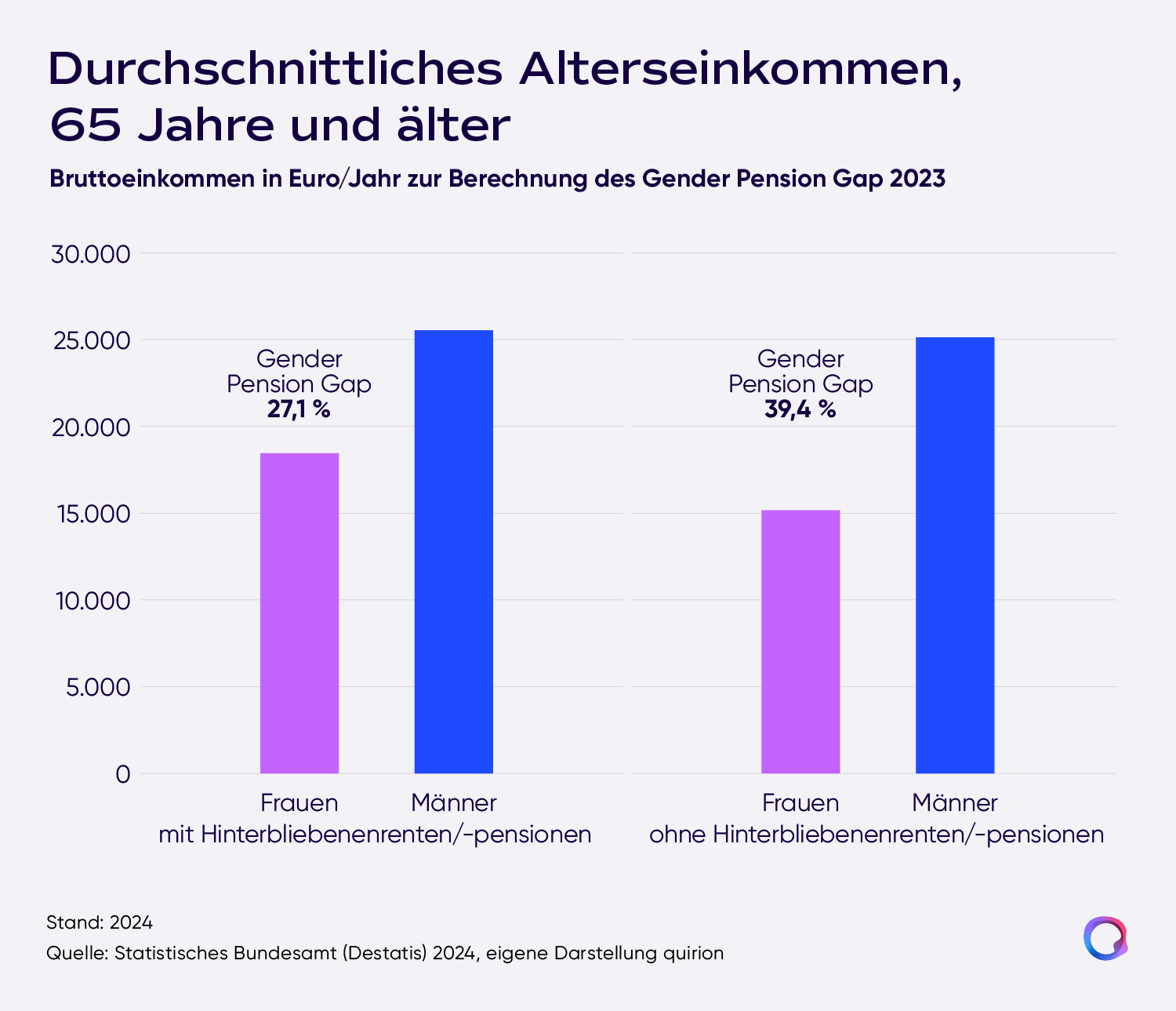
The Gender Pension Gap refers to the gender-specific pension gap, i.e. the relative difference in retirement income between women and men, usually from the age of 65. It indicates by what percentage women's average old-age security benefits are lower than those of men. The reasons for this Gender Pension Gap are many and varied – they include, for example:
- women more often working part-time
- interruptions to employment due to parental leave or caring for relatives
- an often lower income than men despite full-time employment
The resulting contribution gaps and lower payments into the pension fund have a direct impact on state pension entitlements. Yet the often modest pension entitlements are only one side of the coin: because of their higher average life expectancy, women at the same time also have to make their money last longer in old age.
How to calculate your pension gap
The pension gap expresses how much money you may be short of in retirement in order to be able to maintain your accustomed standard of living. You can find out how large your personal pension gap might be and how you can close it effectively in our article: Closing the pension gap: understand, calculate, provide for it.
What women can do for their retirement provision
Depending on your circumstances, you as a woman have various options for additional retirement provision. As a general rule: the earlier you start thinking about your own retirement provision, the better.
Make use of the 3 pillars of retirement provision
In Germany, retirement provision rests on 3 pillars: the state, occupational and private retirement provision. Make the most of each of these pillars as far as you possibly can.
- State pension insurance: the higher your earnings and the fewer gaps in your contribution payments, the higher your state pension entitlements will be. Important: be sure to report periods spent raising children or providing care to the pension insurance provider, as you can have these credited towards your insurance periods.
- Occupational retirement provision: Ask your employer what occupational pension options they offer. Make use of these offers even if you work part-time.
- Private retirement provision: Since the state and occupational pensions together will all too often not be enough to maintain your accustomed standard of living in old age, private retirement provision is essential. Equity ETF savings plans in particular are a cost-effective and straightforward way to build up considerable wealth over time, even with small monthly savings amounts.
Private retirement provision for women with ETFs
For women in particular, ETF savings plans are a sensible way to provide for retirement. Through regular payments into a broadly diversified ETF portfolio (made up of equity ETFs), your wealth grows over the medium to long term. At quirion, this is possible from savings amounts of as little as 25 euros a month. If you have a larger sum of money available, for example from an inheritance, you can also invest this amount immediately as a lump sum.
How much should you pay into an ETF savings plan?
A rule of thumb is that, ideally, you should save or invest around 10 per cent of your gross income. The exact amount is of course very individual and depends entirely on your circumstances. Reduce or pause your savings rate if, for example, you currently have no regular income, and increase it when you have more money available again.
With quirion's free ETF savings plan calculator you can find out in just a few clicks how the level of your savings rate affects the growth of your wealth.
5 tips especially for women: retirement provision made easy
The following 5 tips are intended to help you shape your financial future in a self-determined and active way:
1. Take your finances into your own hands
Make yourself financially independent and do not rely solely on your partner or the state pension for your retirement provision. Don't worry, you don't have to become a financial expert yourself. Even basic knowledge and regular saving can help you look more calmly towards your financial future.
2. First build up a financial cushion
Before you invest for the long term, you should set aside an emergency fund of three to six net monthly salaries , e.g. in an instant-access savings account. This gives you financial security in the event of unexpected expenses.
3. Make use of the potential of shares
Perhaps you too are one of those people who have so far shied away from investing in shares. This concern is, however, unfounded: historically, broadly diversified equity investments over long periods have achieved the best returns. With equity ETFs you can invest simply and cost-effectively in thousands of different companies at the same time.
4. Save regularly (even small amounts)
Sticking with it is especially important when building wealth. Don't let it put you off if you don't (currently) have large savings amounts available. Simply save the amount that is currently possible for you, without restricting your quality of life too much.
5. Start as early as possible
The best time to start your retirement provision is now. Because the earlier you begin, the longer and more powerfully the growth in value takes effect. As an example: with a monthly savings rate of 25 euros and an assumed average annual return of around 8 per cent, your wealth with an equity ETF savings plan grows over a period of 30 years to a handsome 32,239 euros (total savings contributions: 9,000 euros). And every year that you are able to save for longer pays off: after just 5 more years, with the same savings rate and return, you could already count on wealth of 48,146 euros.
What can you do if you only start providing for retirement late?
Thanks to women's longer life expectancy, investing is often still worthwhile even at an older age. At 60, statistically speaking, you still have about 24 years ahead of you – that is definitely enough time to benefit from long-term investments. To make up for the return you would have earned by starting to invest earlier, you can do the following:
- Higher savings rates: if you have fewer years available for your investment, you can offset the shorter investment horizon with higher savings rates, provided you have money to spare for this.
- Use lump-sum payments: if you have larger sums of money available, for example from inheritances or life insurance policies, you can invest these purposefully and immediately as a lump sum and thus, via equity ETFs, benefit from the growth of the global economy.
- Invest purposefully: choose the form of your private retirement provision carefully. Private pension insurance policies, for example, are often associated with high costs and low returns. Investments in a broadly diversified ETF portfolio with an ideal ratio of equities to bonds – tailored to your individual risk profile – can instead deliver the perfect combination of return and security.
What to do with old insurance contracts?
Riester, Rürup and other private pension insurance products in most cases do not meet the expectations originally placed on them: high costs meet an often very low expected pension payout. If you have such a contract, it is best to seek advice from an independent body (e.g. the consumer advice centre or an independent bank such as Quirin Privatbank) on the best course of action in such a case.
In the specific case, it should be examined whether it is worth stopping payments into insurance contracts and instead investing your money in a higher-return investment, such as an ETF savings plan.
ETF retirement provision with quirion … not just for women
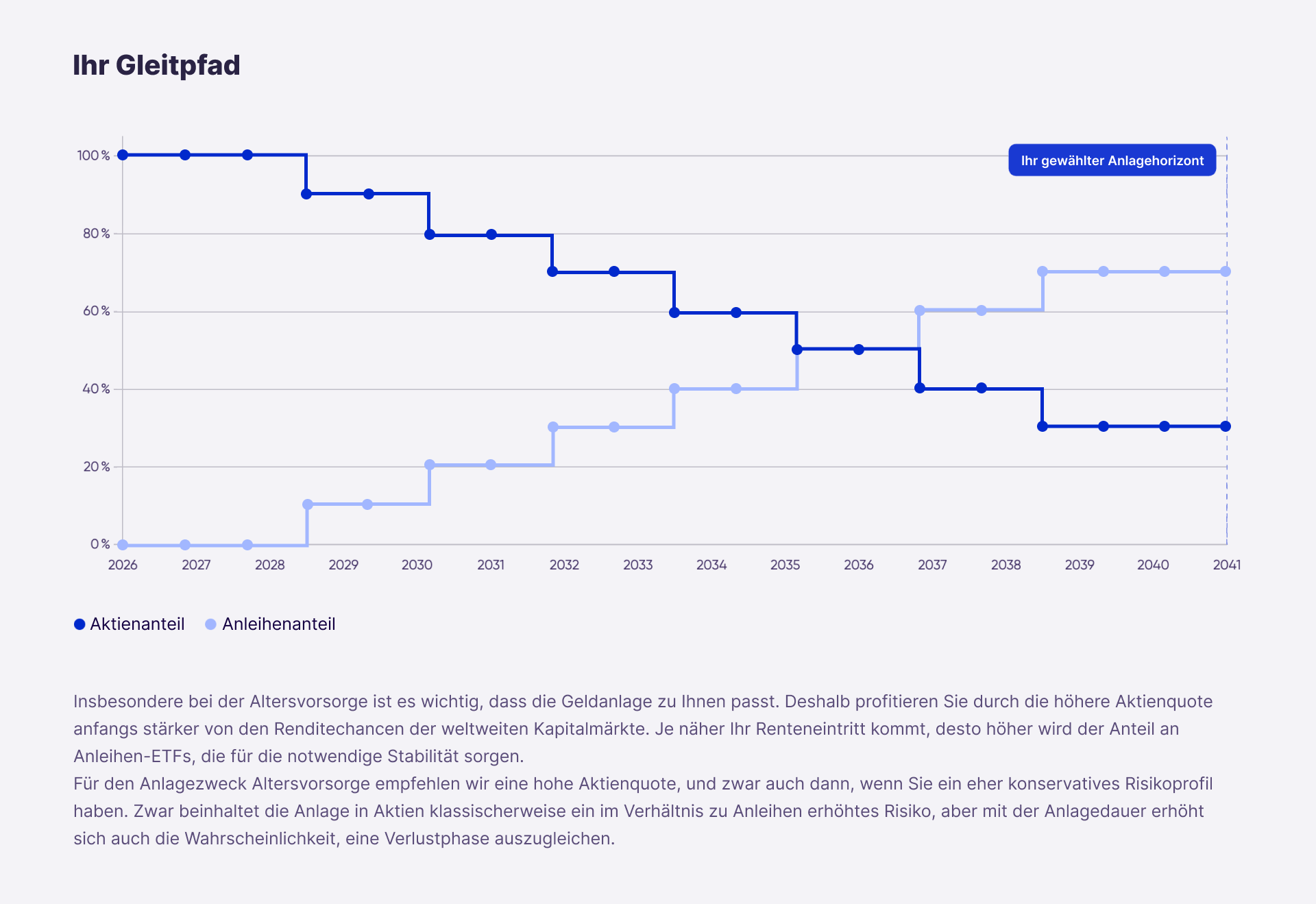
With quirion's innovative retirement provision portfolio, you not only invest in a broadly diversified, globally spread ETF portfolio, but also benefit from the automatic adjustment of your investment during the accumulation phase. This works as follows:
- For much of the accumulation phase, a high equity share in the portfolio provides higher return opportunities, while accepting greater fluctuations.
- Towards the end of the accumulation phase and during the payout phase, the share of lower-volatility bonds is automatically increased step by step in order to reduce the risk of losses.
In short: the closer you get to your payout phase, the less your portfolio is exposed to possible (severe) fluctuations on the capital market. At the same time, the adjusted equity share still provides the important return boost in your portfolio.