





How to plan your long-term investment
Investing money long-term means making financial decisions today that will benefit you or your loved ones in the future. To do so, you first consider:
- What do I want to invest money for? Whether retirement provision, general wealth building, providing for children or caring for your parents: your goal influences your investment horizon and your risk capacity.
- How long can I invest my money for? Hardly anything matters more in long-term investing than the time factor. The earlier you can begin investing, the longer your wealth can build up continuously.
- What (loss) risk can I bear? The higher the expected return, the higher any interim losses can be. The safer and less volatile the investment you choose, the less return it generally yields.
Once you have answered these three questions for yourself, it is a matter of choosing the right type of investment.
What should you best invest in?
To keep calm even during interim fluctuations, you should choose a type of investment whose risk-return profile you are also comfortable with. The expected return should be high enough to achieve real gains over the long term, that is: a positive return after deducting inflation (and any fees on your investment). If that is not the case, you experience a loss of purchasing power with your investment.
Investing made simple



Popular ways of investing money long-term compared
In the following table we compare the expected returns and volatilities (ranges of value fluctuation) and the availability of four forms of long-term investment that are popular in Germany. The illustrative average values relate to the 30 years from 1995 to 2024. The returns stated are nominal, that is not yet adjusted for inflation. Costs were not taken into account.
Basis for the return examples:
Passbook savings account: average interest rate on deposits of private households with an agreed notice period of up to 3 months according to Bundesbank statistics (1995 to 2024)
Gold: gold price performance in euros from 31.12.1994 to 31.12.2024
Equity ETFs: MSCI World Index in euros including reinvested dividends from 31.12.1994 to 31.12.2024
These figures relate to the past; past returns are not a reliable indicator of future results.
The specific return figures reflect snapshots in time. In other long-term periods, sometimes markedly different returns came about. In this respect, returns in the savings and equity spheres are far more calculable than for gold investments.
- Passbook savings accounts offer a very low nominal return of about 1 % per year. Although they offer high security and immediate availability, in the past the capital was usually devalued in real terms by inflation. This form of investment is therefore not suitable for long-term wealth building.'
- Private pension insurance policies achieve – depending on the type of contract – very different nominal returns. However, the availability of the accumulated capital is heavily restricted, as it is generally only paid out in retirement age. In addition, high acquisition and administration costs noticeably reduce the net return.
- Gold investments did admittedly achieve a considerable nominal return of just over 7 % per year on average over the past 30 years. However, the volatility of gold is high and the gold price therefore fluctuates strongly. Moreover, the returns are practically incalculable, because the development of the gold price depends heavily on investor confidence and gold in itself is not productive. It only becomes so when it is processed in production processes. Ultimately, however, this happens in companies, and so you are then in the world of equities. Availability depends on whether gold is held physically (e.g. in the form of coins or bars) or via the stock exchange (in the form of ETCs – Exchange Traded Commodities). While exchange-traded gold products are very liquid, physical gold requires more effort and incurs higher costs.
- Equity ETFs (e.g. on the MSCI World Index) enable broad diversification across global equities and achieved on average just over 8 % nominal return per year over the last 30 years. This order of magnitude represents a readily calculable return expectation for a broadly diversified long-term investment in equities. Equity ETFs can be traded on every stock exchange trading day and are therefore very flexibly available. Marked price fluctuations are possible (especially in the short to medium term), including interim losses in the higher double-digit percentage range. The longer the investment period, however, the more the fluctuations smooth out and the more calculable the investment outcome becomes. Note: due to various imbalances in the index (e.g. a high US and technology weighting), an investment strategy should not be based on the MSCI World alone.
Safety-oriented investments do not protect against (real) loss of value
Many safety-oriented investments, such as passbook savings accounts, building society savings contracts or traditional pension insurance policies, are rather less suitable for a long-term investment. Because of the currently low interest rates on these products, your money would in the end be worth less after deducting inflation than at the start of your investment. High administration fees, as is often the case in particular with unit-linked pension insurance policies, additionally reduce your net return.
Opt for high-return investments
Now the great advantage of a long investment horizon comes into play. Since with a long-term investment you ideally stay invested over many years or even decades, you can rely on the long-term return generator par excellence: equities. To spread the risk as broadly as possible, however, you should not rely on individual shares, but on a large number of different shares from different sectors, countries and sizes. Equity ETFs enable you to do this particularly cost-effectively.
Why not individual shares?
Individual shares, that is stakes in a single company, carry too high a default and price risk. Managing a portfolio consisting of various individual shares also involves an enormous amount of effort. A long-term investment ideally works without you having to attend to it regularly and carry out reallocations. Such reallocations also incur additional fees every time, which come at the expense of your net return.
Why are ETFs particularly well suited?
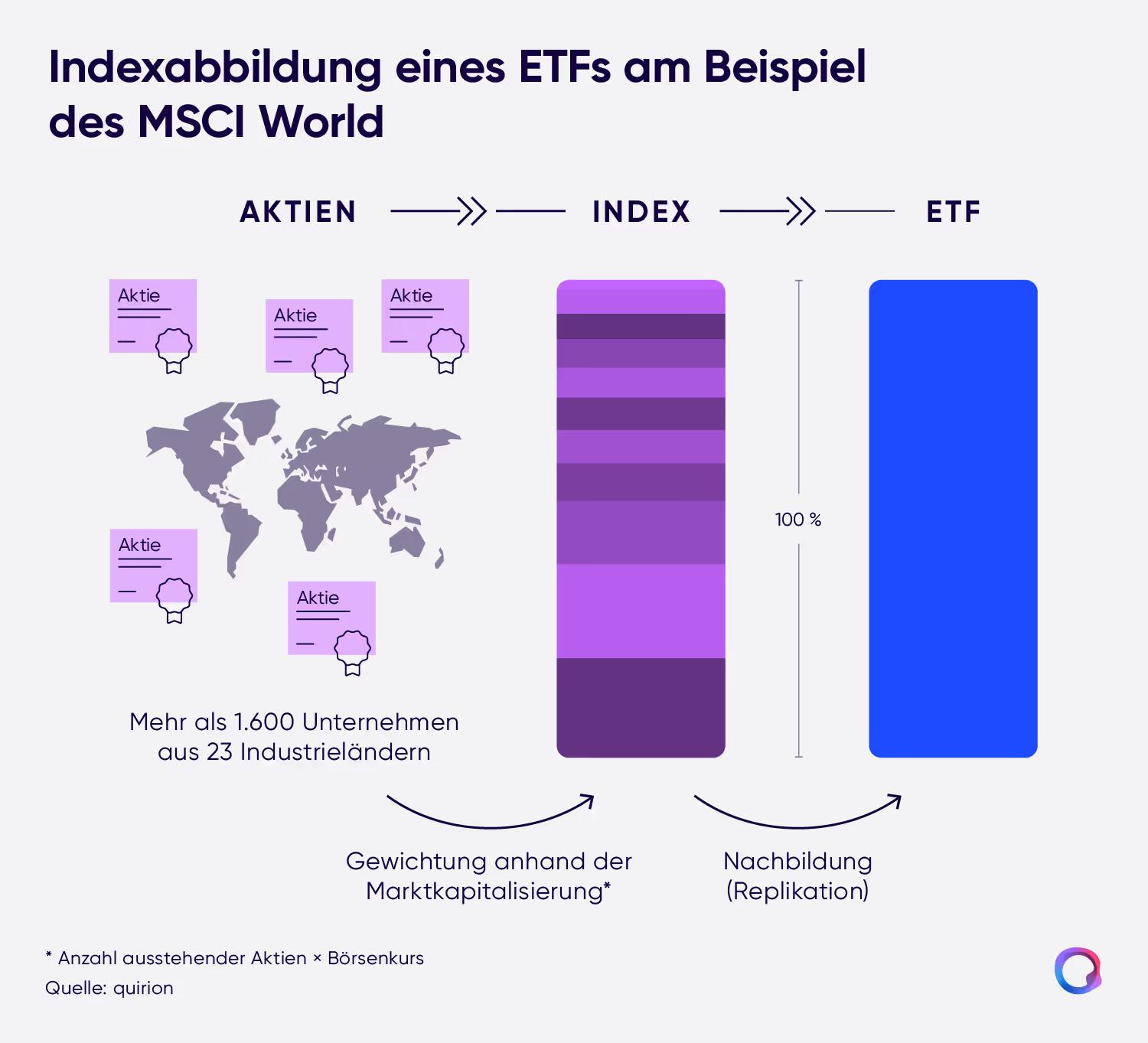
Equity ETFs (Exchange Traded Funds) are exchange-traded funds that mostly track an index passively, e.g. the DAX or MSCI World. Through this, with ETFs you invest in those shares that are listed in the corresponding index. An optimally diversified ETF portfolio maps the world economy as well as possible via a range of ETFs. As a result, with your ETF portfolio you benefit from global economic growth and consequently from rising corporate profits (which should boost share prices).
How to invest long-term with ETFs
To invest in ETFs, you first open a securities account with a bank or a broker. In doing so, pay attention to possible costs for maintaining the securities account or for individual services: these have a negative effect on your return, above all over the long term. Opening the securities account itself often takes only a few minutes and can also be done online by means of video identification. Once you have opened a securities account, you can invest in ETFs either by means of one-off payment(s) or a savings plan.
If you already have a larger sum of money available that you want to invest, choose the one-off payment. If you want to build up wealth over the long term, the ETF savings plan is perfectly suited to it. At quirion you can invest as little as from 25 € a month in an ETF savings plan that contains a whole range of ETFs at once (ETF portfolio).
Opening an account with quirion is this easy:
Registrieren
Open an account
Deposit money
Claim your welcome bonus
Auf Rendite freuen!
Buy and hold: invest your money and sit back
After you have decided on a type of investment and, for example, invest in an ETF portfolio, the best thing you then do is: nothing. In doing so, you should let neither short-lived price slumps nor crises unsettle you. Historically speaking, the world economy has always recovered again even after such phases. Anyone who, for instance, stayed invested during the 2008 financial crisis was often able to enjoy high returns later on.
With an ETF savings plan at quirion, you automatically invest the amount you have chosen regularly into your ETF portfolio. To see how your ETF savings plan can develop over the long term, simply use our free ETF savings plan calculator.
4 tips for investing money long-term
The following tips help you to create the ideal conditions for your long-term investment.
- First pay off any existing debts, especially consumer loans, before you start investing. On the one hand, loan interest can literally eat up the return on your investment. On the other hand, this way you avoid having to draw on your long-term investment to pay off debt.
- Additionally build up an emergency fund. A financial reserve, the so-called “emergency fund”, serves to be able to flexibly pay for unforeseen expenses, for example for a broken fridge or a larger car repair.
- Avoid panic selling. When the market slumps, many people tend to sell their investments hastily. Anyone who invests long-term can in most cases calmly sit out such market lows, may buy in more cheaply during these phases with a savings plan (cost-average effect) and thus benefits from the price recovery to be expected after the slump. However, you should bring some patience to this.
- Regular rebalancing ensures that your portfolio always matches your target risk-return profile. In most cases, such rebalancing at least once a year makes sense. At quirion, our experts do this automatically for you.
At quirion, you do not have to first spend time reading up on the world of ETFs. On the basis of scientific findings, the perfect portfolio is created for you, based on your goals and wishes: whether for your own retirement provision, saving for children/grandchildren or long-term wealth building!
How to invest safely and profitably with a long investment horizon
While passbook savings accounts and traditional pension insurance policies often lead to a real loss of purchasing power, high-return investments such as broadly diversified equity ETFs offer the best chances of solid and long-term wealth building. Anyone who also keeps a cool head in turbulent times will be rewarded with solid returns and will enjoy steadily growing wealth over many years.
Whether you are still at the beginning of investing or already familiar with financial jargon: in the podcast “klug anlegen”, Karl Matthäus Schmidt, Chief Executive Officer of Quirin Privatbank AG and founder of the digital investment platform quirion, regularly talks about current topics around investing money. Discover the podcasts on Spotify, Apple Podcast or on Youtube.