






“Investing money”: what exactly does that mean?
Investing money means that you invest your money, usually over the longer term, in order to protect it from a loss of value (e.g. through inflation) and, ideally, to achieve an increase in value. Various forms of investment are available to you for this purpose, including financial products such as shares and bonds, or tangible assets such as real estate. What essentially unites all forms of investment is the goal of growing the money you have invested.
Saving vs. investing money – the crucial difference
Saving means not spending money and setting it aside so that it is available later, often for a specific purpose (a new washing machine, a new car). By the way, if you transfer your money to a savings account or an instant-access savings account for this purpose, you are already investing it; because the (albeit usually low) interest income ensures that the amount of money in your account increases over time. The traditional savings account, as well as instant-access savings, are currently among the forms of investment with the lowest returns.
Why is investing money so important?
Every year, inflation ensures that your money continuously loses real value. If you simply “only” save your money, that is, keep it in cash or unremunerated in a current account, it accordingly loses more value every year. To illustrate: assuming an inflation rate of 2 % p.a., only €9,057.31 of the original purchasing power remains of €10,000 after five years. This means that, although you would still have €10,000 in your current account, in five years’ time you could only buy as much with it as €9,057.31 buys today.
Investing made simple



Where should I invest my money?
If you want to invest your money in such a way that at least the annual loss of purchasing power is offset, you need to choose a correspondingly high-return investment. The traditional savings account, or instant-access/fixed-term deposits, often do not meet this requirement; in return, your money is invested with fundamentally low risk. So if you want to “park” your money in the short term and at least receive a small amount of interest, instant-access or fixed-term deposits are certainly interesting options.
But you can also invest your money in such a way that you not only offset inflation, but it can also grow over the long term. These long-term high-return investments include above all shares and, related to this, funds and ETFs (Exchange Traded Funds). Whereas when buying a single share you bear the risk of a total loss should the respective company fail (insolvency), with an ETF you invest cost-effectively in a large number of different companies, which considerably reduces the risk of loss.
To invest in shares, funds or ETFs, you first need a securities account with a bank or broker of your choice. Through the settlement account linked to your securities account, you can then buy the securities you want.
Before you invest money: this is what you should bear in mind
Before you start investing money, in the best case you should bear a few more points in mind. The following 3 tips should enable you to approach your investment as relaxed as possible.
1. Pay off debts
Ideally, at the start of your investment journey you should have no outstanding loans or consumer debts to settle. On the one hand, because the interest rates for outstanding loans are usually higher than the expected return on an investment. On the other hand, this is intended to ensure that you do not unexpectedly (have to) fall back on your investment in order to repay your debts on time. So the rule is: repaying debt takes priority over investing.
2. Set aside an emergency fund
The so-called emergency fund refers to the financial buffer that you have ideally built up before your first investment. This money serves to enable you to cope with unforeseen expenses, e.g. for car repairs or replacing a broken washing machine, without having to dip into the money you have invested. Ideally, this emergency fund amounts to between three and six net monthly salaries.
We recommend keeping the emergency fund in an instant-access savings account or using money market investments kept separate from your other invested assets. This way you separate the emergency fund from your money for everyday expenses and from your long-term investments. Unlike a current account, an instant-access savings account and money market investments earn you interest income. Money market investments are interest-bearing securities with a very short term. The expected returns are based on the ECB’s key interest rates and are therefore usually higher than standard instant-access savings rates. With Cash-Invest, quirion offers a whole portfolio of various money market ETFs in the form of a discretionary asset management service.
3. Define your investment goals
What may sound trivial at first has a decisive effect on your investment: think in advance about what goal you actually want to achieve with your investment. For example, do you want to close your looming pension gap or invest money for a larger purchase in the future? Your personal investment goals define how much money you should invest over what period in which investment product. Possible investment goals include, for example:
● your own retirement provision,
● creating financial provision for children,
● medium-term investment goals (e.g. buying your own home) or simply
● protecting your money from a loss of value (i.e. inflation).
Investing money: how best to go about it
Before you start investing, you need to know what you want to invest in and how much you want and are able to invest. To find this out, you have 3 options:
- You make use of investment advice and rely on its recommendations.
- You acquire sufficient financial knowledge yourself and invest on your own.
- You use a hybrid solution combining a robo-advisor and human expertise.
The expensive way: investment advice
Investment advice is the most costly option and requires corresponding trust in the respective advice. Depending on where you obtain it, the recommendation of certain forms of investment may also be driven by the adviser’s own interests, for example when a bank recommends a fund it has set up itself, on which it can earn correspondingly high commissions.
On your own: investing money without advice
Of course, you can also acquire the necessary knowledge yourself and make your investment decisions independently. This requires that you engage thoroughly with the wide variety of different investment options and their advantages and disadvantages. If, for example, you want to put together your own ETF portfolio, you first need to work out the optimal allocation and composition of the ETFs it contains. Our recommendation in any case is: invest as broadly spread and diversified as possible and keep an eye on the costs.
Above all when it comes to investments on the stock market, you should bear one thing in mind: the development of individual stock markets, or even of individual shares, cannot be predicted by anyone. The performance of individual shares cannot be reliably forecast, and the attempt to invest money on the basis of forecasts and promising-sounding investment stories is risky. Neither the current news situation nor the forecasts of supposed experts from the stock market news should influence your investment decisions.
The hybrid and clever solution: a robo-advisor
Another, modern option for your investment is a hybrid variant with a technical and a human component. As a digital asset management service, quirion therefore offers you a combination of robo-advisor and human expertise. Thanks to the technical support of the robo, this variant is particularly cost-efficient, without losing sight of the all-important human factor.
What is a robo-advisor?
With a robo-advisor, certain processes in asset management are digitalised, which allows them to be handled far more cost-efficiently, effectively and quickly. At quirion, the robo-advisor determines a concrete investment proposal for you based on a questionnaire you fill in and your risk appetite. The final selection of the suitable ETFs for your portfolio is ultimately made by human experts.
Find out more about this in our guide: What is a robo-advisor? >>
Investing money in ETFs
Broadly diversified equity ETFs offer an excellent way to participate over the long term in global economic growth and rising corporate profits (in the form of rising share prices), without taking on the risks of a single investment. This is because ETFs fundamentally track an index passively, for example the DAX or the MSCI World. An ETF on the MSCI World Index accordingly contains the shares of those companies that are included in this index. So if you buy or regularly invest in an ETF on the MSCI World, you invest in the roughly 1,400 companies from 23 industrialised countries it contains.
Ultimately, ideal is a whole portfolio with various broadly diversified and low-cost ETFs, tailored to your personal risk profile and your investment goals; it offers precisely the risk-return ratio that suits you. While an investment in individual shares can indeed generate high returns in the short term, it is always associated with the risk of a total loss (if the company becomes insolvent). If instead you invest in thousands of different companies worldwide, losses of individual companies can often be more than offset again by the good performance of the others.
In vier Schritten zu deinem persönlichen ETF-Sparplan:
Get an investment proposal
Open an account
Set up a savings plan and deposit money
Auf Rendite freuen!
Ideal for getting started: an ETF savings plan
An ETF savings plan is excellently suited to those who are just starting to invest, do not have a larger sum of money available and want the most balanced ratio of return and risk possible. But even for experienced investors, ETF savings plans offer an attractive way to invest in the global equity and bond markets. With an ETF savings plan, you pay in a certain amount of money regularly, similar to a savings account, which is then continuously invested in the ETF you have selected.
You can set up an ETF savings plan quickly and easily with many providers and get started with even small savings amounts. At quirion, this is already possible from a monthly savings amount of just €25 and, at quirion, the money is not just invested in a single ETF, but sensibly in a whole portfolio of different ETFs (in the form of a discretionary asset management service).
An example calculation: If you invest €25 per month in an ETF savings plan over an investment horizon of 15 years, this will ultimately grow to around €8,600 assuming a return of 8 % p.a. – on total contributions of €4,500. And now it becomes clear why the investment period is even more significant than the amount invested: investing just five years longer at the same savings amount results in a final sum of around €14,700, on total contributions of €6,000.
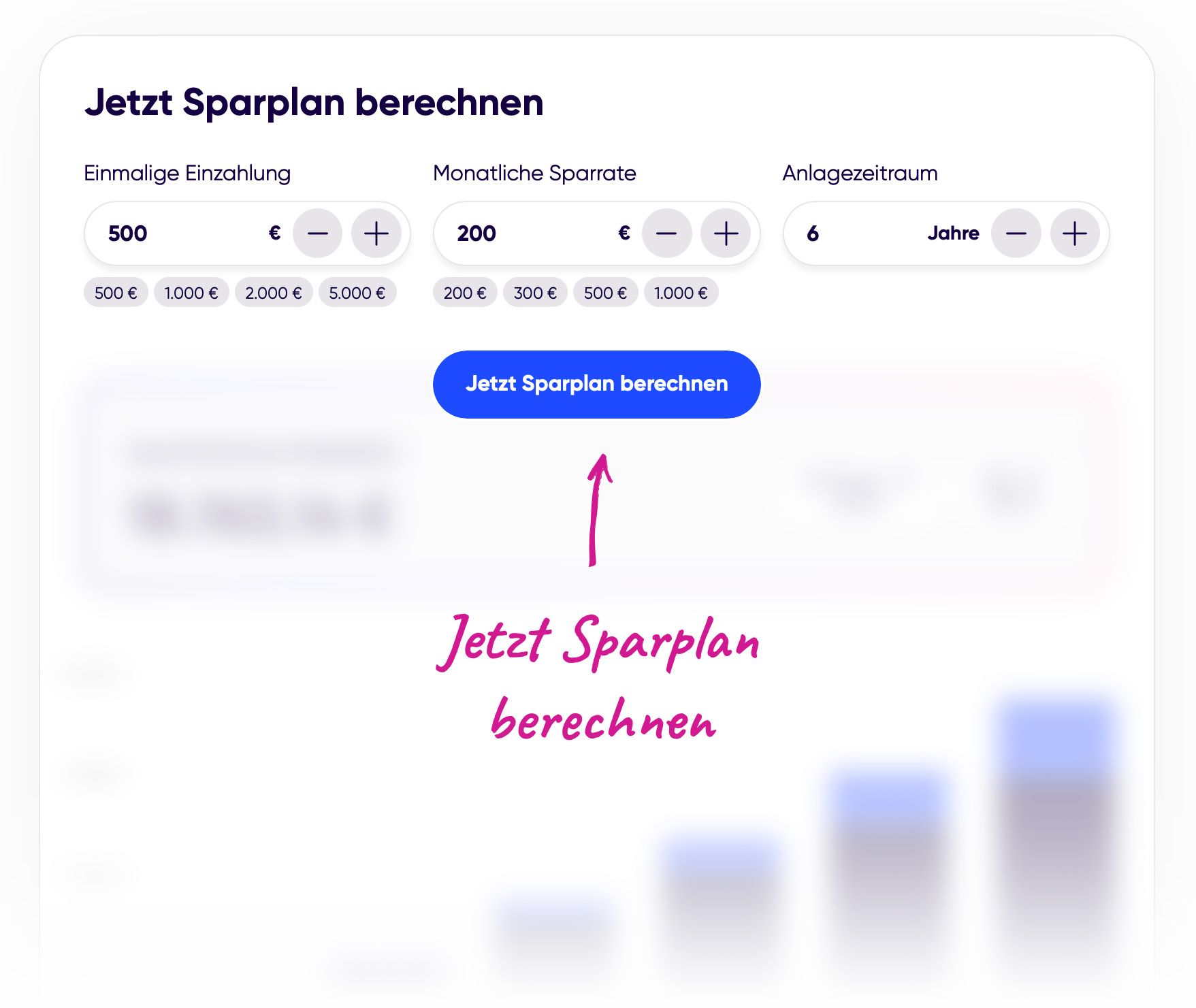
If you want to find out in just a few clicks how your assets can grow with an ETF savings plan, simply try it out with our free ETF savings plan calculator!
How much should I invest in ETFs?
For long-term wealth building, we recommend that you invest around 10 - 20 % of your net income (where feasible) regularly in your investment. As a general rule: the longer your investment horizon, i.e. the time in which you can let the money work for you and do not need to access it, the smaller the initial capital or the monthly savings instalments can be. The longer you are invested, the more strongly the compound interest effect takes effect.
3 tips for successful investing
Finally, we give you 3 more tips that can be applied to every form of investment.
The right time to invest is always now
The key to successful long-term wealth building is to stay invested with discipline (buy-and-hold strategy). There is a guiding principle for this: “Time in the market beats timing the market”, which essentially means: it is more important to stay consistently invested over the long term than to try to catch the right moment for the investment. This ideal moment (both for entry and for exit) simply cannot be predicted by anyone, and the longer you are invested, the more strongly the compound interest effect can influence your assets and the better intermittent stock market setbacks can be made up again. And for those who currently do not have a larger investment amount available, a regularly funded ETF savings plan is a highly recommendable alternative.
Keep an eye on low costs
The aim of an investment is to make more of the money invested. High annual management fees have a noticeably negative effect on the return, particularly with actively managed funds . This makes it all the more important always to keep an eye on the ongoing costs when investing and to choose low-cost investment options. Here, too, ETFs offer an excellent way to invest cost-effectively. Due to the passive tracking of an index (and no active fund management), the product costs (TER) in a sensibly diversified equity ETF portfolio average around 0.20 % p.a. For comparison: with actively managed equity funds, an average management fee of around 1.5 % applies … per year!
Invest in a diversified way
Investing in a diversified way means spreading your investment across as many different countries, sectors and company sizes as possible. If you bet on a single horse (e.g. individual shares), you may have to accept severe losses. An index such as the MSCI World, by contrast, contains shares of around 1,400 large and mid-sized companies from 23 industrialised countries. At quirion, you sensibly invest not just in a single ETF, but in a cleverly composed ETF portfolio that maps the global financial market as optimally as possible.
Opening an account with quirion is this easy:
Registrieren
Open an account
Deposit money
Claim your welcome bonus
Auf Rendite freuen!